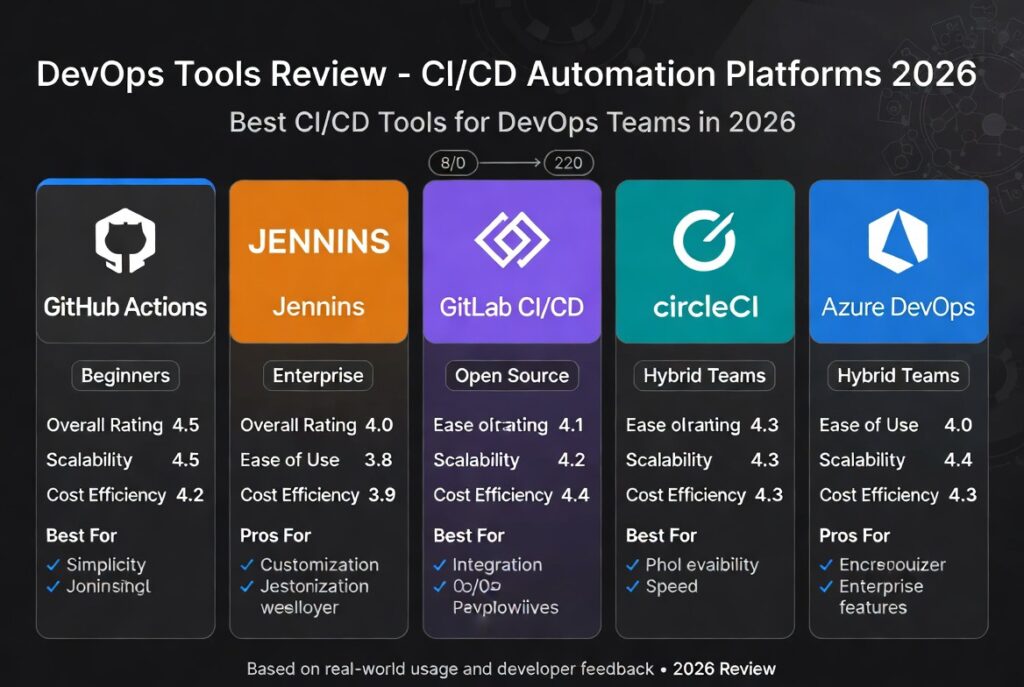
DevOps Tools Review: Best Platforms for Automation in 2026
Devops tools review is essential for developers and teams looking to automate CI/CD pipelines, manage infrastructure, and streamline deployment workflows. With dozens of platforms available, choosing the right tool can significantly impact performance, cost, and productivity.
In this guide, we review the best DevOps tools in 2026, compare their features, and help you choose the right platform for your workflow.

If you’re new to DevOps, start with our
best devops tools for beginners guide.
Top DevOps Tools Reviewed
This devops tools review covers the most popular platforms used by developers and enterprises.
Jenkins
Jenkins is one of the most widely used open-source automation servers. It provides extensive plugin support and flexibility for building complex CI/CD pipelines.
- best for enterprise customization
- open-source and highly flexible
- requires infrastructure management
Official site:
Jenkins
GitHub Actions
GitHub Actions is a cloud-based CI/CD platform integrated with GitHub repositories. It simplifies automation with minimal configuration.
- easy setup
- native GitHub integration
- scales automatically
Official docs:
GitHub Actions
GitLab CI/CD
GitLab provides an all-in-one DevOps platform with built-in CI/CD pipelines, version control, and monitoring tools.
- complete DevOps solution
- strong security features
- integrated workflows
Learn more:
GitLab
Docker
Docker enables containerization, allowing developers to package applications and dependencies into portable containers.
- lightweight deployment
- consistent environments
- essential for microservices
Official site:
Docker
Kubernetes
Kubernetes is an orchestration platform used to manage containerized applications at scale.
- high scalability
- automated deployment
- enterprise-grade orchestration
Official site:
Kubernetes
Performance Analysis
Performance is a key factor in this devops tools review. Different tools excel in different areas depending on the use case.
Speed
GitHub Actions provides fast execution due to cloud-based runners, while Jenkins performance depends on infrastructure setup.
Scalability
Kubernetes and GitLab CI/CD are highly scalable, making them suitable for enterprise environments.
Reliability
All tools offer high reliability, but managed services like GitHub Actions reduce operational overhead.
Pros and Cons
Jenkins
- ✔ highly customizable
- ✔ large plugin ecosystem
- ✖ complex setup
- ✖ requires maintenance
GitHub Actions
- ✔ easy to use
- ✔ seamless GitHub integration
- ✖ limited customization
- ✖ usage-based pricing
GitLab CI/CD
- ✔ all-in-one platform
- ✔ built-in security
- ✖ can be expensive
Docker
- ✔ portable environments
- ✔ fast deployment
- ✖ learning curve for beginners
Kubernetes
- ✔ powerful orchestration
- ✔ scalable infrastructure
- ✖ complex setup
Best Use Cases
This devops tools review shows that each tool serves different use cases depending on team size and requirements.
Startups
- GitHub Actions
- Docker
Growing Teams
- GitLab CI/CD
- CircleCI
Enterprises
- Jenkins
- Kubernetes
Cost vs Value
When evaluating DevOps tools, cost should be balanced with productivity gains. Free tools like Jenkins may require infrastructure investment, while paid tools offer convenience and scalability.
See full pricing breakdown:
devops automation tools pricing
How to Choose the Right DevOps Tool
- team size
- budget
- workflow complexity
- integration requirements
Compare platforms:
jenkins vs github actions comparison
Download Free DevOps Roadmap
Learn CI/CD, automation, and cloud deployment with this step-by-step roadmap.
Future Trends in DevOps Tools
DevOps tools are evolving with AI-driven automation, self-healing systems, and serverless architectures. Future platforms will reduce manual configuration and improve efficiency.
Teams that adopt modern DevOps tools early will gain a competitive advantage in software delivery.
Conclusion
This devops tools review highlights the strengths and weaknesses of the most popular platforms. Whether you choose Jenkins, GitHub Actions, or Kubernetes, the right tool depends on your workflow and goals.
By selecting the right DevOps tools, teams can automate processes, reduce errors, and deliver software faster.
FAQ
What are the best DevOps tools in 2026?
Popular DevOps tools include Jenkins, GitHub Actions, GitLab CI/CD, Docker, and Kubernetes.
Which DevOps tool is best for beginners?
GitHub Actions is ideal for beginners due to its ease of use and integration with GitHub.
Are DevOps tools expensive?
Some DevOps tools are free, but enterprise features and scaling can increase costs.

Leave a reply