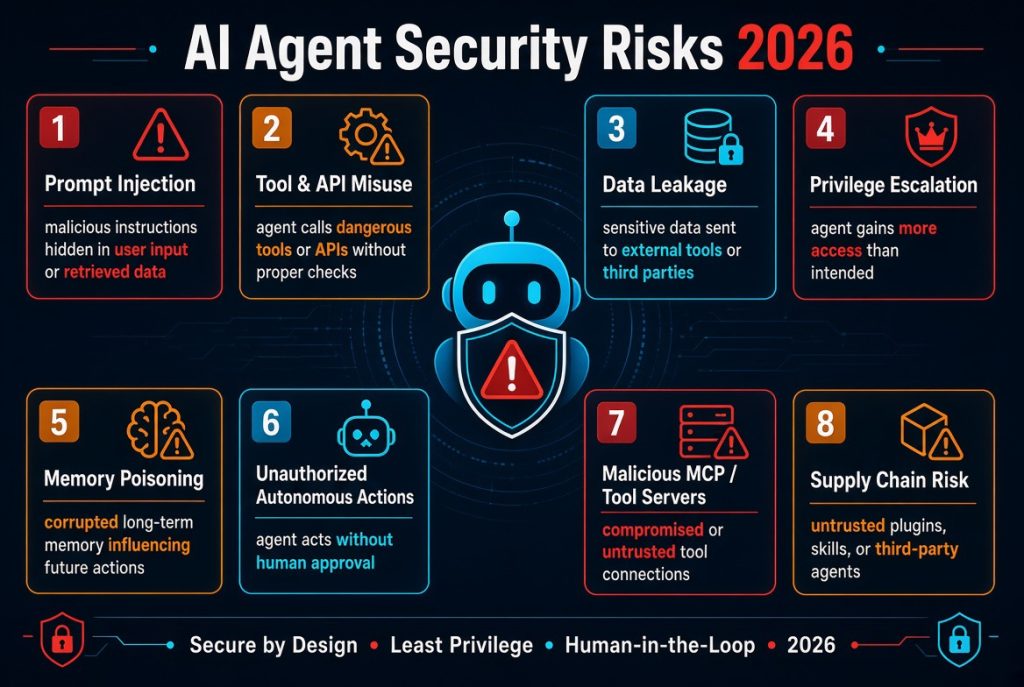
AI Agent Security Risks: 10 Critical Threats Businesses Must Know in 2026
AI agent security risks are becoming harder for businesses to ignore as autonomous AI systems gain access to company data, applications, APIs, files, and tools that can perform real-world actions.
Unlike a traditional chatbot that mainly generates text, an AI agent can be given the ability to retrieve information, call APIs, update records, send messages, execute workflows, interact with software, and make decisions on behalf of users. That additional capability creates a much larger security and governance challenge.
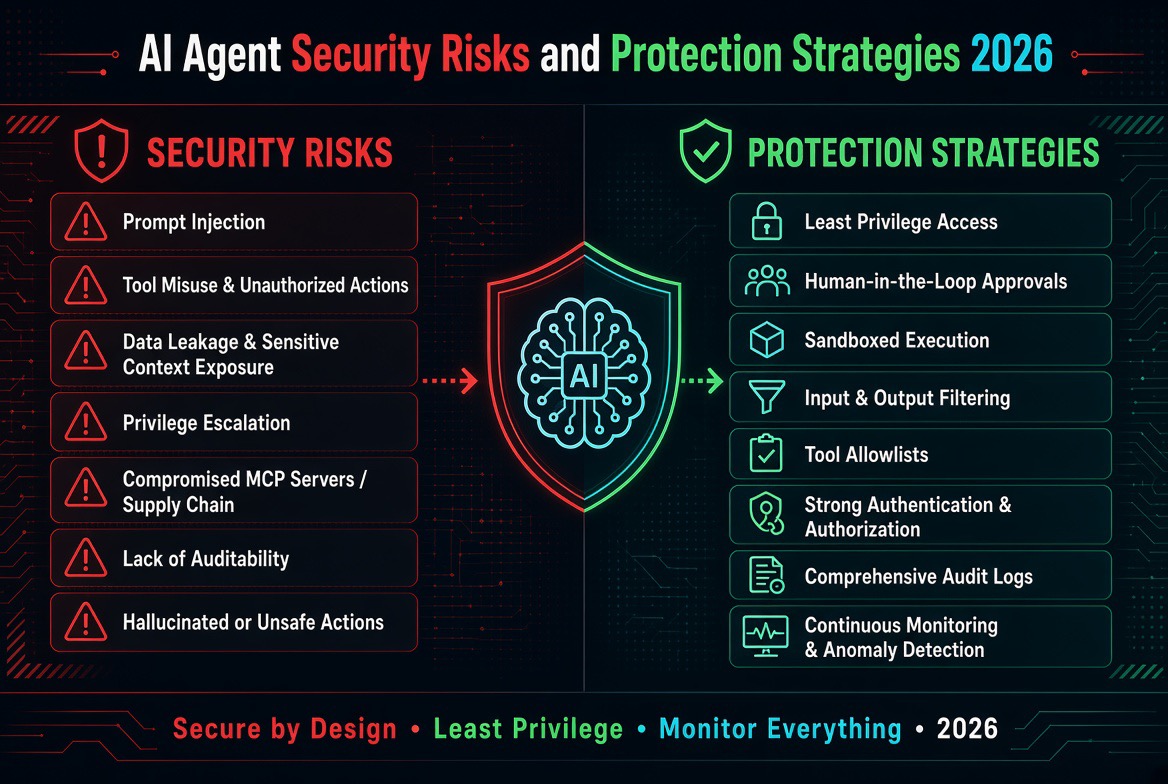
AI agent security is therefore not simply a matter of protecting the underlying AI model. Organizations need to secure the entire agentic workflow: the model, prompts, identity, memory, tools, APIs, data sources, integrations, infrastructure, users, and actions performed by the agent.
This guide explains the most important AI agent security risks businesses should understand in 2026 and provides practical strategies for designing safer AI agents.
Why AI Agent Security Risks Matter in 2026
The security profile of AI applications changes significantly when an AI system moves from generating recommendations to taking actions.
Imagine an internal AI assistant that can search company documents. Its main risk may be exposing confidential information. Now give that same assistant access to email, customer records, a CRM, payment systems, cloud infrastructure, and production applications. The potential impact of an incorrect or manipulated decision becomes much greater.
This is why agent security should be treated as an application-security problem as well as an AI-security problem.
The OWASP GenAI Security Project identifies risks such as prompt injection, sensitive information disclosure, supply-chain vulnerabilities, excessive agency, and other weaknesses affecting generative and agentic AI applications.
- AI agents may access sensitive business information
- Agents can interact with external tools and applications
- Untrusted instructions can influence agent behavior
- Excessive permissions can increase the impact of an attack
- Automated actions can happen faster than humans can intervene
- Multiple agents can create additional communication and trust boundaries
- Third-party models, tools, libraries, and services create supply-chain dependencies
My view is that businesses should stop asking only, “Is this AI model secure?” The better question is, “What could this agent do if its instructions, credentials, data, or tools were compromised?”
What Are AI Agent Security Risks?
AI agent security risks are threats that can affect an AI agent, its underlying model, connected tools, data sources, identities, users, infrastructure, or automated workflows.
The security challenge is therefore broader than protecting a model from malicious prompts. A production agent may sit in the middle of several systems and act as a bridge between them.
For example, an enterprise research agent could have access to:
- Internal documents
- Cloud storage
- Search engines
- Company databases
- CRM systems
- APIs
- Business intelligence platforms
Each connection introduces another trust boundary that needs to be evaluated.
The 10 Biggest AI Agent Security Risks in 2026
Not every organization will face these threats at the same level. The actual risk depends on what an agent can access, what actions it can perform, how it authenticates, and how much human oversight exists.
However, the following ten categories should form part of any serious AI agent security review.
1. Prompt Injection
Prompt injection occurs when an attacker supplies instructions designed to influence an AI system into behaving differently from its intended purpose.
This becomes especially concerning when the AI is connected to tools.
A conventional chatbot might be manipulated into producing an inappropriate response. An agent could potentially be manipulated into calling a tool, retrieving information, sending a message, or performing another action that the attacker was never authorized to request.
Prompt injection can originate from direct user input, but it does not necessarily have to. An agent might retrieve a web page, email, document, support ticket, or database record containing malicious instructions.
OWASP currently identifies prompt injection as LLM01:2025 and notes that manipulated inputs can alter model behavior and potentially influence downstream systems.
How to reduce the risk:
- Treat external content as untrusted data
- Separate instructions from retrieved information
- Validate sensitive tool calls independently of the model
- Limit the agent’s permissions
- Require approval for high-impact actions
- Test agents against direct and indirect prompt-injection scenarios
My take: Prompt injection should be treated less like a simple “bad prompt” problem and more like an input-trust problem. Developers should assume that anything an agent can read may eventually contain content designed to influence it.
2. Sensitive Data Exposure
AI agents often need access to information to complete their tasks. The problem begins when an agent can access more information than it actually needs.
Potentially sensitive information can include:
- Customer records
- Employee information
- Financial data
- Source code
- Business strategy documents
- API credentials
- Internal communications
- Personal information
A poorly configured agent could expose sensitive information through responses, logs, generated reports, tool calls, or connected applications.
Businesses should therefore apply data minimization. If an agent only needs access to order status, there is little reason to give it unrestricted access to an entire customer database.
The principle is simple: an agent cannot leak information it was never allowed to access.
3. Excessive Permissions and Excessive Agency
Excessive permissions are among the most important AI agent security risks because they determine how much damage an attacker or malfunctioning agent could cause.
Consider two agents.
Agent A can read product documentation.
Agent B can read documentation, modify customer accounts, send email, issue refunds, change database records, and deploy software.
If both agents are compromised, the second agent presents a dramatically larger risk.
This is why the principle of least privilege matters.
OWASP’s current AI security guidance explicitly includes excessive agency among the risks associated with AI applications.
Recommended controls:
- Give agents only the permissions required for their role
- Separate read and write permissions
- Use short-lived credentials where possible
- Restrict access to sensitive tools
- Set transaction and usage limits
- Require human approval for irreversible actions
In my opinion, the safest enterprise agent is rarely the most autonomous agent. It is the agent with the right amount of autonomy for the business process.
4. Tool and API Abuse
Tools are what make AI agents useful, but they are also one of their biggest security boundaries.
An agent might have tools for:
- Searching databases
- Sending emails
- Creating tickets
- Updating CRM records
- Running code
- Accessing cloud storage
- Making payments
- Deploying applications
If the model can invoke these tools without adequate controls, an attacker may attempt to manipulate the agent into using them in unintended ways.
Tool arguments should therefore be validated by application code rather than trusted simply because the AI generated them.
For example, an agent might request:
refund_customer(amount=500000)The application should not blindly assume the request is legitimate. It can independently verify the user’s authorization, transaction limits, customer identity, business rules, and approval requirements.
The model should make recommendations. Security-critical application logic should enforce the rules.
5. Insecure Agent-to-Agent Communication
Multi-agent architectures introduce another security boundary: communication between agents.
One agent may send instructions or information to another agent, which may then perform an action based on that message.
If the receiving agent blindly trusts the sender, a compromised component could potentially influence the rest of the workflow.
For example, imagine a system containing:
- A research agent
- An analysis agent
- A financial agent
- An approval agent
If the research agent is compromised and can send arbitrary instructions to the financial agent, the entire architecture becomes vulnerable.
This is why multi-agent systems should use explicit identity, authorization, message validation, and trust boundaries.
Learn more about the architecture in our guide to agent-to-agent communication and our deeper explanation of multi-agent systems.
6. Malicious or Untrusted External Data
Agents increasingly retrieve information from external sources. That creates an important distinction between data and instructions.
A web page may contain useful information and malicious instructions at the same time. A customer email may contain legitimate information but also text designed to manipulate an AI system. A document uploaded to a knowledge base may contain hidden instructions intended to influence an agent.
The agent should not automatically treat every piece of retrieved information as trusted instructions.
Developers should establish clear trust boundaries around retrieval systems, databases, documents, emails, and external websites.
For RAG-based systems, access controls should also apply to the underlying documents. Retrieval should not become a back door around existing authorization rules.
7. Credential and Secret Exposure
AI applications often require credentials to access external systems. These might include API keys, OAuth tokens, database credentials, cloud credentials, or service-account permissions.
One of the worst design decisions is placing secrets directly into prompts or giving an agent unrestricted access to credential files.
Instead, credentials should be managed by dedicated security infrastructure.
- Never hard-code secrets into source code
- Do not place API keys in prompts
- Use dedicated secret-management systems
- Rotate credentials regularly
- Use scoped credentials
- Monitor authentication and API activity
- Revoke unused credentials
Agent credentials should also be treated as machine identities, not as an informal extension of the developer’s personal account.
8. Unintended Autonomous Actions
An agent can misunderstand a request, retrieve incorrect information, select the wrong tool, or make an incorrect decision.
The danger increases when the agent can immediately execute the decision.
There is a significant difference between:
“The agent recommends issuing a refund.”
and:
“The agent automatically issues the refund.”
The second design requires much stronger controls.
For high-impact operations, businesses should consider:
- Human approval
- Transaction limits
- Two-person approval
- Rate limits
- Rollback mechanisms
- Dry-run modes
- Automated policy checks
Autonomy should therefore be earned based on demonstrated reliability rather than enabled simply because the technology makes it possible.
9. Supply Chain Risks
AI agents rarely operate as completely self-contained applications.
A production agent may depend on:
- Foundation models
- Agent frameworks
- Open-source packages
- Plugins
- MCP servers
- External APIs
- Cloud services
- Vector databases
- Observability platforms
- Third-party datasets
Every dependency creates another potential security boundary.
A vulnerability in a library or compromised third-party component can affect an otherwise well-designed agent.
Organizations should maintain software inventories, review dependencies, monitor vulnerabilities, and evaluate third-party AI services before connecting them to sensitive systems.
The MITRE ATLAS knowledge base is also useful for understanding adversary tactics and techniques involving AI-enabled systems, including generative and agentic AI.
10. Lack of Monitoring, Logging, and Auditability
An autonomous agent can perform dozens or even hundreds of actions during a workflow. Without appropriate telemetry, investigating an incident becomes extremely difficult.
Security teams should be able to answer questions such as:
- Who initiated the agent?
- Which model was used?
- What tools did the agent call?
- Which identity authorized those calls?
- What data did the agent retrieve?
- What decisions were made?
- What actions were executed?
- What failed?
- What external systems were contacted?
Logs should also be designed carefully. Logging everything without protecting sensitive information can create another security problem.
The goal is meaningful auditability, not simply generating enormous volumes of telemetry.
AI Agent Security Risks: Priority Comparison
| Risk | Potential Impact | Typical Control | Priority |
|---|---|---|---|
| Prompt injection | Unauthorized behavior or tool use | Input isolation, tool validation, testing | Critical |
| Sensitive data exposure | Privacy and data breach | Access control and data minimization | Critical |
| Excessive permissions | Expanded attack impact | Least privilege | Critical |
| Tool/API abuse | Unauthorized business actions | Validation and authorization | Critical |
| Agent-to-agent attacks | Workflow compromise | Identity and message validation | High |
| Malicious data | Behavior manipulation | Trust boundaries and filtering | High |
| Credential exposure | Account compromise | Secret management | Critical |
| Autonomous mistakes | Operational or financial loss | Approval and transaction limits | High |
| Supply-chain attacks | System compromise | Dependency management | High |
| Poor monitoring | Delayed detection and response | Logging and observability | High |
AI Agent Security Risks vs Traditional AI Risks
| Traditional AI Application | AI Agent System |
|---|---|
| Primarily generates information | Can generate information and take actions |
| Often has limited external access | May connect to many tools and services |
| Users commonly review outputs | Some outputs may trigger automated actions |
| Model security is a major concern | Model, identity, tools, data and workflow security all matter |
| Usually has fewer trust boundaries | Can introduce many interconnected trust boundaries |
| Failures may remain informational | Failures can potentially create real operational consequences |
How to Reduce AI Agent Security Risks
There is no single security control that makes an AI agent safe. A production architecture should use multiple layers of defense.
Use Least-Privilege Access
Every agent should receive the minimum permissions necessary to complete its assigned task.
For example, a reporting agent may need read-only access to analytics data but should not have permission to modify the underlying database.
Separate Read and Write Capabilities
Where practical, reading information and changing information should be treated as different privilege levels.
This makes it harder for a compromised agent to turn a data-access problem into a destructive action.
Validate Every Sensitive Tool Call
Tool calls should pass through deterministic application logic.
Do not assume that an action is safe simply because an AI model requested it.
Use Human Approval for High-Risk Actions
Human approval is particularly valuable for actions involving money, account deletion, production deployment, legal commitments, sensitive information, or irreversible changes.
Protect Secrets
Use dedicated secret-management infrastructure and avoid exposing credentials to prompts, model context, logs, or unnecessary application components.
Implement Strong Identity
Agents should have identifiable machine identities, and systems should be able to determine which user, agent, service, or workflow initiated an action.
Monitor Behavior
Monitor authentication events, tool calls, API usage, unusual request patterns, failed actions, privilege changes, and unexpected destinations.
Test Before Production
Security testing should include adversarial prompts, malicious documents, unauthorized tool calls, privilege escalation attempts, malformed inputs, compromised dependencies, and failure scenarios.
Security Architecture for AI Agents
A secure agent architecture should not place the AI model directly in control of every sensitive system.
A stronger pattern is to place policy enforcement between the model and the tools.
A simplified architecture can look like this:
- User submits a request
- Application authenticates the user
- Agent interprets the request
- Agent proposes a tool call
- Policy layer validates the request
- Authorization system checks permissions
- Tool executes the approved operation
- Result returns to the agent
- Security and audit systems record the important event
This design recognizes an important principle: the AI model should not be the final authority for security-sensitive decisions.
AI Agent Security and Zero Trust
Many of the principles used in zero-trust security can also be applied to AI agents.
An agent should not automatically be trusted simply because it operates inside an organization’s network.
Instead, access should be evaluated according to identity, context, permissions, resource sensitivity, and the requested action.
This approach is particularly important for organizations running multiple agents across cloud environments and internal applications.
Security Considerations for Multi-Agent Systems
Multi-agent systems increase the number of communication paths and trust relationships inside an AI application.
For example, a system might include:
- A planning agent
- A research agent
- A coding agent
- A testing agent
- A reporting agent
- A deployment agent
If every agent can communicate with every other agent and access every tool, the architecture becomes difficult to secure.
A better approach is to define explicit boundaries.
- Which agents can communicate?
- What information can each agent receive?
- Which tools can each agent call?
- Which actions require approval?
- How are agent identities verified?
- How are messages validated?
- What happens when an agent behaves unexpectedly?
Our guide to multi-agent systems explains how these architectures work, while our article on agent-to-agent communication explores the communication layer in greater detail.
MCP and AI Agent Security
Modern AI applications increasingly need standardized ways to connect models and agents with external tools and resources.
Model Context Protocol, or MCP, is designed to standardize how AI applications interact with external capabilities and information.
However, MCP should not be viewed as a security solution by itself.
A protocol can standardize communication, but developers still need to implement authentication, authorization, input validation, permission boundaries, secret protection, and monitoring.
Read our MCP (Model Context Protocol) explained guide to understand the technology and its architecture.
Using OWASP for AI Agent Security
Security teams building AI agents should maintain a threat model rather than relying on generic AI safety advice.
The OWASP Top 10 for LLM Applications provides a useful security reference for risks such as prompt injection, sensitive information disclosure, supply-chain vulnerabilities, excessive agency, and other AI application weaknesses.
OWASP’s current GenAI security work is particularly relevant because it is expanding its focus toward agentic AI rather than treating AI systems as simple text-generation applications.
Organizations should use such frameworks as starting points, then adapt the controls to their specific architecture.
Using NIST AI Risk Management Principles
Security should also be connected to broader AI governance.
The NIST AI Risk Management Framework provides a voluntary framework for managing AI risks and promoting trustworthy development and use of AI systems.
NIST’s AI RMF organizes risk-management activities around four functions: Govern, Map, Measure, and Manage.
That structure can be useful for organizations deploying AI agents because security is not only a technical issue. Businesses also need policies for ownership, accountability, risk acceptance, testing, incident response, and ongoing monitoring.
AI Agent Security Testing
Traditional application security testing is still necessary, but agentic systems require additional testing because behavior depends partly on model interpretation.
A security testing program should consider:
- Prompt injection
- Indirect prompt injection
- Unauthorized tool calls
- Privilege escalation
- Sensitive-data retrieval
- Credential exposure
- Malicious documents
- Compromised tools
- Agent-to-agent trust abuse
- Unexpected model behavior
- Rate-limit bypasses
- Resource exhaustion
Security testing should be repeated after significant changes to the model, prompts, tools, permissions, retrieval sources, or orchestration architecture.
AI Agent Security Monitoring
Monitoring should focus on both traditional security events and agent-specific behavior.
Useful telemetry can include:
- Agent identity
- User identity
- Session identifiers
- Tool calls
- Tool arguments
- Authorization decisions
- Data-access events
- API requests
- Model errors
- Policy violations
- Human approvals
- Workflow outcomes
Security teams should also establish behavioral baselines. An agent that normally accesses five internal documents per request but suddenly attempts to retrieve thousands of records deserves investigation.
AI Agent Security Checklist
Before deploying an AI agent into production, use this practical checklist:
- Define exactly what the agent is allowed to do
- Apply least-privilege permissions
- Authenticate users and agents
- Separate read and write access
- Validate tool arguments
- Protect API keys and credentials
- Separate trusted instructions from untrusted data
- Limit access to sensitive information
- Use approval workflows for high-impact actions
- Monitor agent behavior
- Maintain useful audit logs
- Review third-party dependencies
- Test prompt-injection scenarios
- Test unauthorized tool access
- Define incident-response procedures
- Regularly reassess permissions
AI Agents for Business Security
Businesses should evaluate an AI agent according to its actual capabilities rather than simply labeling it “low risk” or “high risk.”
An agent that summarizes public web pages is very different from an agent that can access customer records, modify financial information, send external email, or deploy production software.
A useful business risk assessment should therefore examine three questions:
- What data can the agent access?
- What tools can the agent use?
- What actions can the agent perform?
The more sensitive the data and the more powerful the actions, the stronger the security controls should be.
Read our broader guide to AI agents for business to understand how organizations can apply agentic AI to business workflows.
Human-in-the-Loop vs Fully Autonomous Agents
| Approach | Security Profile | Best Use Cases |
|---|---|---|
| Human-in-the-loop | Lower operational risk | Financial, legal, security and irreversible actions |
| Human-on-the-loop | Moderate risk with supervision | Routine business workflows |
| Fully autonomous | Higher potential impact | Low-risk, well-bounded repetitive tasks |
My recommendation for most businesses in 2026 is not to pursue maximum autonomy immediately. Start with narrow workflows, measure reliability, establish controls, and gradually expand permissions.
Autonomy should be treated as a security-sensitive capability.
E-E-A-T Perspective: What Businesses Should Actually Do
There is a temptation in AI security discussions to produce a long list of threats and leave the reader with the impression that AI agents are inherently unsafe. That is not particularly useful.
The more practical conclusion is that risk depends heavily on architecture and permissions.
An AI agent with no external tools, no sensitive data, and no ability to take consequential actions has a fundamentally different risk profile from an autonomous agent connected to a company’s financial and production systems.
For businesses adopting agents, I recommend a staged approach:
- Start with read-only workflows. Let agents retrieve and summarize information before allowing them to modify systems.
- Introduce narrow tools. Give the agent only the tools required for its specific workflow.
- Add policy enforcement. Put deterministic security rules between the model and sensitive operations.
- Require approval for high-impact actions. Do not automate irreversible decisions simply because the model is capable of doing so.
- Measure behavior. Monitor errors, tool usage, data access, and unusual patterns.
- Expand autonomy gradually. Increase permissions only when evidence shows the workflow can operate safely.
This approach is more realistic than attempting to eliminate every possible AI failure before deploying anything.
The Future of AI Agent Security
AI agents are likely to become more capable, more connected, and more autonomous. That means security architecture will have to evolve alongside agent capabilities.
Future enterprise AI environments may contain hundreds or thousands of specialized agents communicating with one another and accessing shared services.
That environment will require stronger machine identity, authorization, observability, policy enforcement, and automated security controls.
Security teams will increasingly need to understand not only servers, networks, APIs, and applications, but also agent identities, model behavior, tool permissions, context, memory, and agent-to-agent relationships.
The MITRE ATLAS knowledge base is one useful resource for tracking adversary tactics and techniques involving AI systems, including agentic AI.
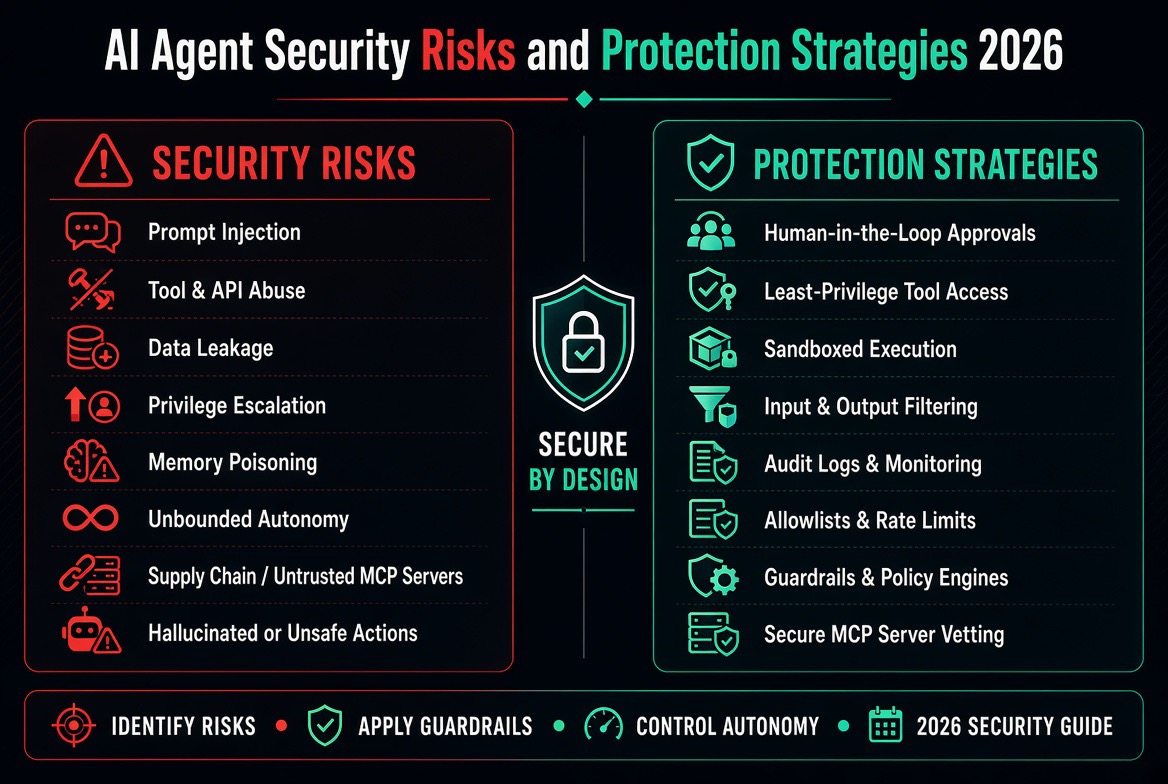
Final Thoughts on AI Agent Security Risks
AI agent security risks are growing because AI systems are moving beyond generating information and increasingly gaining the ability to interact with real systems.
Prompt injection, sensitive-data exposure, excessive permissions, insecure tools, credential theft, malicious data, agent-to-agent attacks, supply-chain weaknesses, autonomous mistakes, and poor monitoring can all create security problems when agentic systems are poorly designed.
But the solution is not to avoid AI agents.
The better approach is to build them with security controls from the beginning.
Use least privilege. Protect identities and secrets. Validate tool calls. Separate trusted instructions from untrusted data. Monitor agent activity. Test aggressively. Require human approval when the consequences justify it.
Most importantly, remember that the AI model should not be the final security authority. Deterministic application controls should enforce what an agent is actually allowed to do.
As businesses move toward increasingly autonomous AI workflows, the organizations that succeed will not necessarily be those that give agents the most freedom. They will be the organizations that find the right balance between autonomy, usefulness, security, and human oversight.
FAQ: AI Agent Security Risks
What are the biggest AI agent security risks?
The biggest AI agent security risks include prompt injection, sensitive information exposure, excessive permissions, insecure tool and API access, malicious external data, credential exposure, agent-to-agent communication risks, unintended autonomous actions, supply-chain vulnerabilities, and inadequate monitoring.
How can businesses secure AI agents?
Businesses can secure AI agents by applying least-privilege access, strong authentication, tool validation, secure secret management, data-access controls, monitoring, audit logging, security testing, and human approval for high-impact actions.
Can AI agents be hacked?
Yes. AI agents can be targeted through prompt injection, compromised tools, malicious external data, credential theft, vulnerable dependencies, excessive permissions, and weaknesses in connected applications.
Should AI agents have access to sensitive business data?
AI agents should access sensitive business information only when it is necessary for their assigned task and when appropriate authentication, authorization, monitoring, and data-protection controls are in place.
What is prompt injection in AI agents?
Prompt injection is an attack technique in which specially crafted input attempts to influence an AI model into ignoring intended instructions or performing unintended actions. In an AI agent, the risk can increase when manipulated instructions cause the agent to access tools or sensitive data.
How does least privilege improve AI agent security?
Least privilege limits an AI agent’s access to only the data, tools, and systems required for its assigned task. This reduces the potential impact if the agent is manipulated, compromised, or makes an incorrect decision.
Are multi-agent systems more difficult to secure?
Multi-agent systems can be more difficult to secure because multiple agents may exchange information, delegate tasks, and access different tools. Strong identity, authorization, message validation, monitoring, and clearly defined trust boundaries are important.

Leave a reply