AWS vs Azure vs GCP Cost Comparison (2026): Which Cloud Platform Saves Businesses the Most Money?
AWS vs Azure vs GCP cost comparison guide for startups, enterprises, AI workloads, Kubernetes infrastructure, and cloud cost optimization in 2026.
AWS vs Azure vs GCP cost comparison is one of the most important decisions businesses face when selecting a cloud platform. Pricing differences between providers can significantly impact infrastructure budgets, scalability, and long-term operational costs.
As cloud adoption accelerates in 2026, companies are searching for the most cost-effective cloud provider without sacrificing performance, security, or flexibility.
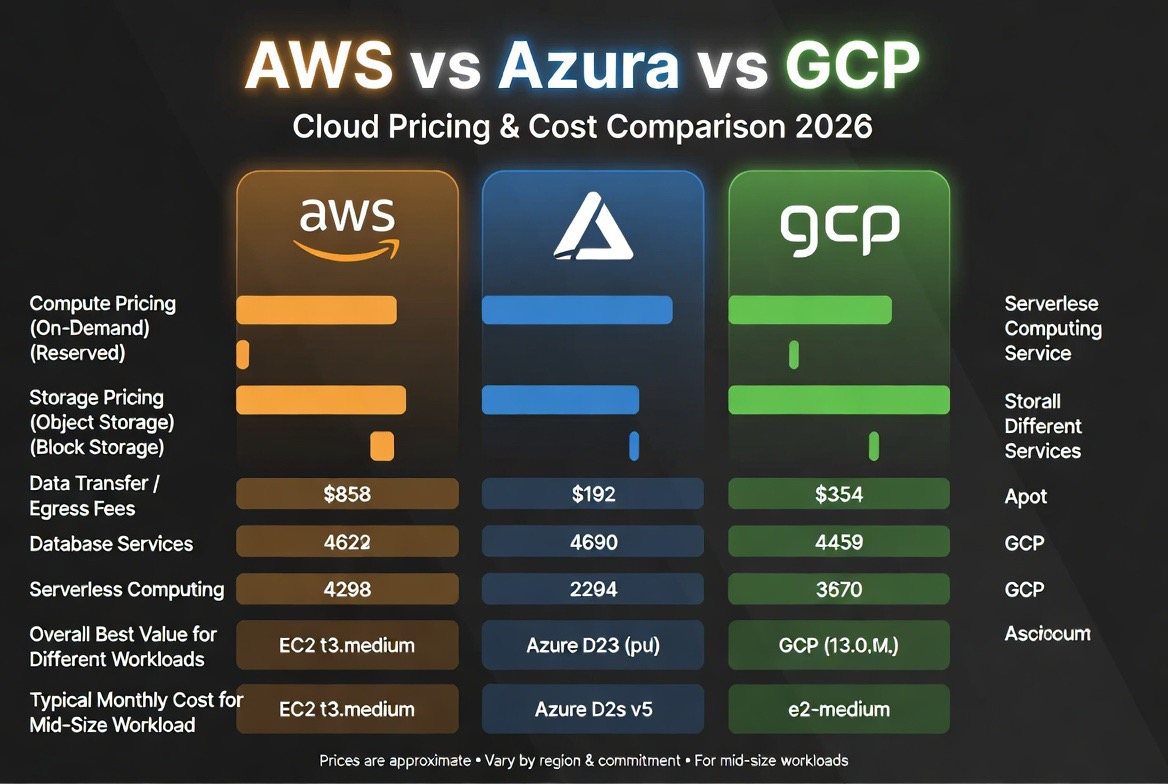
Quick Answer: AWS vs Azure vs GCP Pricing Comparison
Google Cloud Platform (GCP) is often the cheapest cloud provider for analytics, Kubernetes, and sustained workloads because of aggressive sustained-use discounts and efficient infrastructure pricing.
AWS provides the largest cloud ecosystem and strongest infrastructure flexibility, while Microsoft Azure delivers excellent value for enterprise organizations already using Microsoft services.
The cheapest cloud platform depends on workload type, scaling requirements, AI infrastructure usage, networking costs, and long-term optimization strategy.
Before choosing a provider, read our complete
cloud cost optimization guide to understand how businesses reduce cloud expenses across AWS, Azure, and GCP.
Why AWS vs Azure vs GCP Cost Comparison Matters in 2026
Cloud computing costs continue to rise as businesses deploy AI workloads, containerized applications, large-scale storage systems, and global infrastructure.
Without proper analysis, organizations can overspend on cloud resources due to:
- Overprovisioned virtual machines
- Unused storage volumes
- Excessive data transfer fees
- Poor scaling configuration
- Incorrect pricing plans
An effective AWS vs Azure vs GCP cost comparison helps businesses identify which provider aligns best with their technical requirements and budget constraints.
FinOps and Cloud Cost Governance in 2026
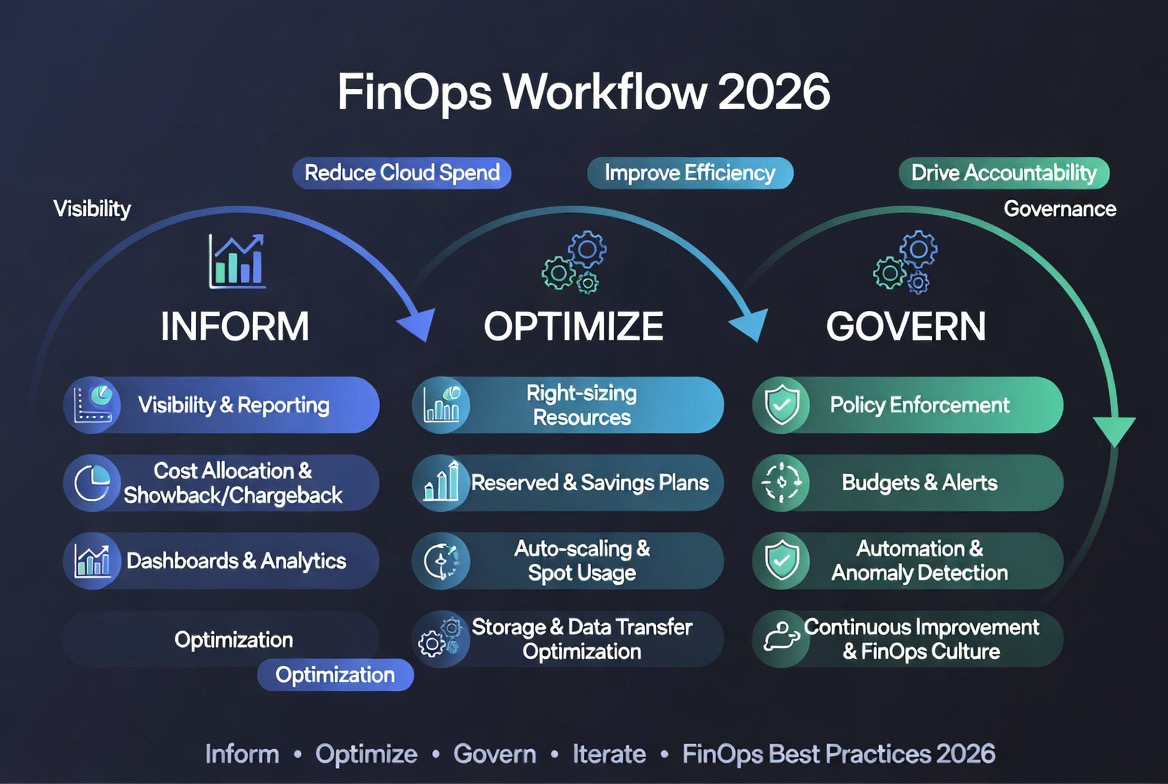
Modern cloud infrastructure teams increasingly rely on FinOps frameworks to manage AWS, Azure, and Google Cloud spending efficiently.
FinOps combines engineering, finance, and operations to improve cloud financial accountability and infrastructure efficiency.
Key FinOps strategies include:
- Cloud billing visibility
- Infrastructure cost allocation
- Tagging policies
- Engineering accountability
- Real-time usage monitoring
- Cloud governance automation
As cloud environments grow more complex, FinOps has become essential for controlling operational expenses at scale.
AWS Pricing Overview
Amazon Web Services (AWS) remains the largest cloud provider globally and offers one of the broadest infrastructure ecosystems available.
AWS pricing is highly flexible, allowing businesses to pay only for the resources they consume.
AWS Compute Pricing
AWS EC2 pricing depends on instance type, operating system, storage configuration, and region.
- On-demand pricing for flexibility
- Reserved instances for long-term savings
- Spot instances for discounted workloads
AWS can become expensive for businesses running continuously active workloads without optimization.
Learn more in our
AWS pricing for beginners guide.
AWS Storage Pricing
AWS S3 storage is widely used for object storage and offers multiple pricing tiers:
- Standard storage
- Intelligent tiering
- Glacier archival storage
Storage costs are generally affordable, but outbound data transfer charges can increase expenses significantly.
Azure Pricing Overview
Microsoft Azure is popular among enterprises already using Microsoft products such as Windows Server, Active Directory, and Microsoft 365.
Azure pricing competes closely with AWS and often provides discounts for organizations with existing Microsoft licenses.
Azure Compute Pricing
Azure Virtual Machines are priced similarly to AWS EC2 instances, but hybrid licensing benefits can lower costs for enterprise customers.
- Reserved VM instances
- Spot virtual machines
- Pay-as-you-go billing
Azure Storage Pricing
Azure Blob Storage provides scalable object storage with hot, cool, and archive tiers.
Azure pricing is often attractive for Windows-based enterprise environments due to licensing integration.
Explore our
Azure cloud pricing review.
GCP Pricing Overview
Google Cloud Platform (GCP) is known for competitive pricing, especially for analytics, AI, and containerized workloads.
GCP offers automatic sustained-use discounts that reduce costs for continuously running workloads.
GCP Compute Pricing
Google Compute Engine pricing is generally competitive with AWS and Azure.
- Sustained-use discounts
- Committed-use contracts
- Preemptible VMs for lower-cost workloads
GCP Storage Pricing
Google Cloud Storage offers multiple tiers designed for active and archival workloads.
GCP networking and data analytics pricing are often cheaper than AWS for large-scale processing workloads.
Compare more in our
Google Cloud pricing comparison.
Kubernetes Cost Optimization Across AWS, Azure, and GCP
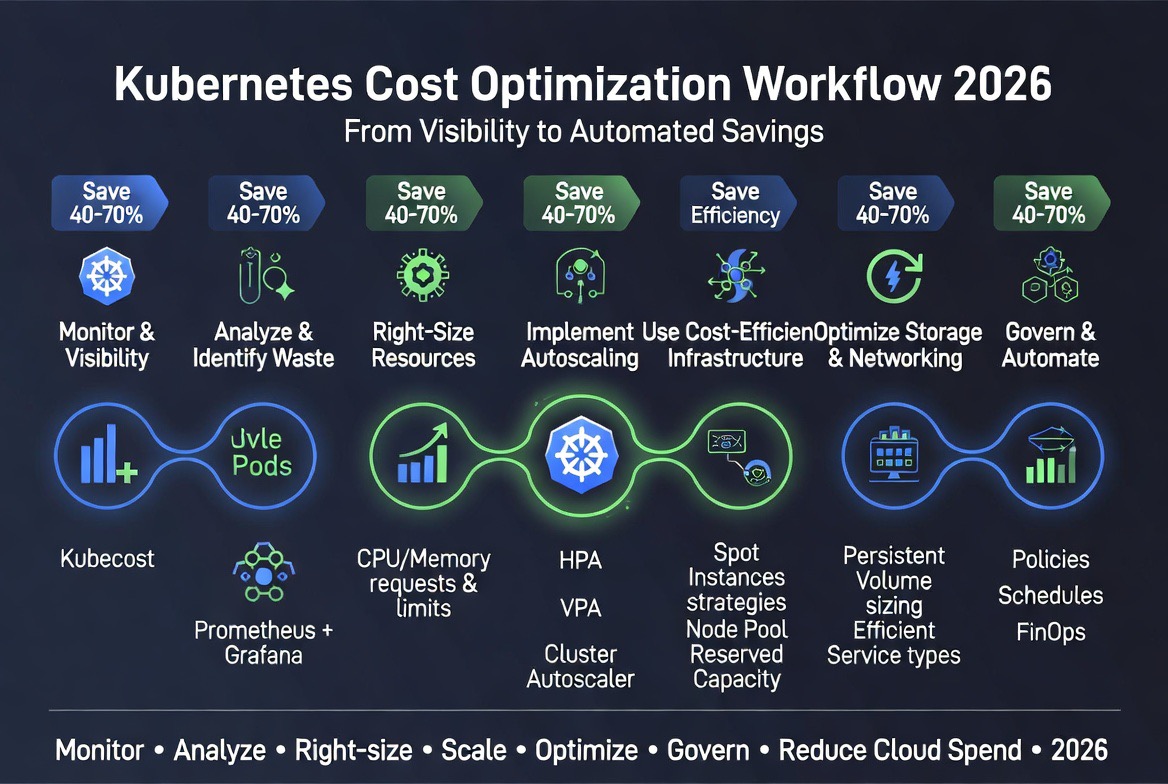
Kubernetes workloads are one of the largest drivers of cloud infrastructure costs in 2026.
Amazon EKS, Azure AKS, and Google Kubernetes Engine (GKE) all provide scalable container orchestration platforms, but poorly optimized clusters can generate significant waste.
Businesses reduce Kubernetes costs through:
- Cluster autoscaling
- Rightsizing containers
- Spot node pools
- Idle workload detection
- GPU optimization
- Container observability tools
Platforms like Kubecost, OpenCost, Grafana, and Datadog help engineering teams identify inefficient Kubernetes workloads and reduce cloud spending.
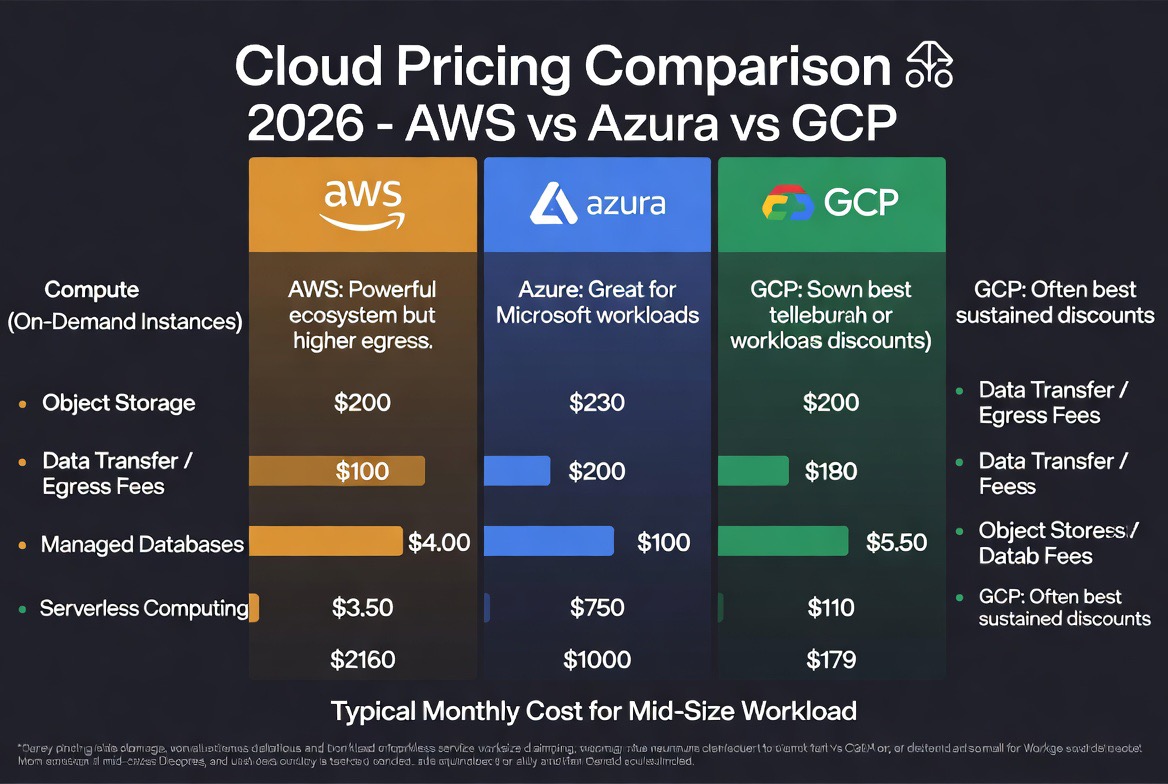
AWS vs Azure vs GCP Cost Comparison Table
| Feature | AWS | Azure | GCP |
|---|---|---|---|
| Compute Pricing | Flexible but expensive at scale | Competitive with enterprise discounts | Often cheapest for sustained workloads |
| Storage Pricing | Strong tiering options | Integrated enterprise storage | Affordable archival pricing |
| Networking Costs | Can be expensive | Moderate | Often lower for analytics traffic |
| Best For | Large-scale infrastructure | Microsoft enterprise ecosystems | AI and data analytics workloads |
| Pricing Complexity | High | Medium | Simpler discounts |
| Kubernetes Support | Strong EKS ecosystem | Enterprise AKS integration | Excellent GKE platform |
| AI Infrastructure | Excellent | Strong enterprise AI | Excellent analytics ecosystem |
| FinOps Tooling | Mature ecosystem | Strong enterprise tooling | Growing rapidly |
AWS vs Azure vs GCP Cost Comparison for Startups
Startups often prioritize low upfront costs and scalability.
GCP is frequently attractive for startups because of:
- Generous free tiers
- Automatic sustained-use discounts
- Strong Kubernetes integration
- Affordable AI infrastructure pricing
AWS also provides startup credits through programs like AWS Activate, while Azure offers startup incentives through Microsoft for Startups.
AWS vs Azure vs GCP Cost Comparison for Enterprises
Large enterprises evaluate cloud pricing differently than startups.
Factors include:
- Compliance requirements
- Global infrastructure availability
- Enterprise support contracts
- Hybrid cloud integration
- Long-term licensing agreements
Azure is often preferred by enterprises already invested in Microsoft ecosystems, while AWS dominates large-scale infrastructure deployments.
Hidden Cloud Costs Businesses Often Ignore
One of the biggest challenges in AWS vs Azure vs GCP cost comparison is understanding hidden costs.
These can include:
- Outbound bandwidth and egress fees
- NAT gateway charges
- Cloud logging and observability costs
- Managed Kubernetes control plane costs
- Idle GPU infrastructure
- Snapshot storage accumulation
- Multi-region replication expenses
- Overprovisioned storage volumes
- Serverless execution spikes
Many businesses underestimate networking costs, especially when scaling globally distributed applications.
How Businesses Reduce Cloud Costs
Organizations can dramatically reduce expenses using proven optimization strategies.
- Right-size virtual machines
- Use reserved instances
- Enable auto-scaling
- Delete unused resources
- Monitor cost dashboards
- Use spot or preemptible instances
Cloud cost optimization is now a core operational priority for engineering teams.
Real Cloud Cost Optimization Examples
Reducing Database Costs by 95%
One production workload reduced infrastructure costs by nearly 95% after migrating from Google Cloud SQL to Neon.
The workload did not require continuously provisioned database infrastructure, making serverless database scaling significantly more cost efficient.
Reducing ML Infrastructure Costs by Over 80%
Another optimization involved reducing idle cloud compute costs caused by globally loaded machine learning dependencies.
Instead of loading heavy libraries globally:
import onnxruntime
import cv2
import pandas
The application switched to lazy-loading dependencies only when required:
def remove_bg(image):
    import onnxruntime
    from rembg import remove
This optimization was applied across multiple heavy ML libraries including OpenCV, SciPy, pandas, NumPy, PyMuPDF, and pdf2image.
Combined with reducing minimum instance counts to zero for idle workloads, infrastructure costs dropped by more than 80%.
These examples demonstrate how architectural decisions often have a greater impact on cloud spending than provider pricing alone.
Expert Analysis: Which Cloud Provider Offers the Best Value?
From a practical business perspective, there is no universally cheapest cloud provider. The best value depends entirely on workload type and operational priorities.
AWS provides unmatched ecosystem depth and scalability, making it ideal for large organizations running complex global infrastructure.
Azure excels in enterprise integration, especially for businesses deeply tied to Microsoft licensing and hybrid cloud environments.
GCP stands out for AI workloads, Kubernetes deployments, and data-intensive analytics applications due to aggressive pricing and efficient infrastructure.
In many real-world deployments, businesses adopt multi-cloud strategies to leverage the strengths of multiple providers simultaneously.
Download Free Cloud Cost Optimization Checklist
Learn how businesses reduce AWS, Azure, and GCP costs with our free cloud optimization checklist.
Prefer direct download?
Download the checklist here
.
Official Cloud Pricing Resources
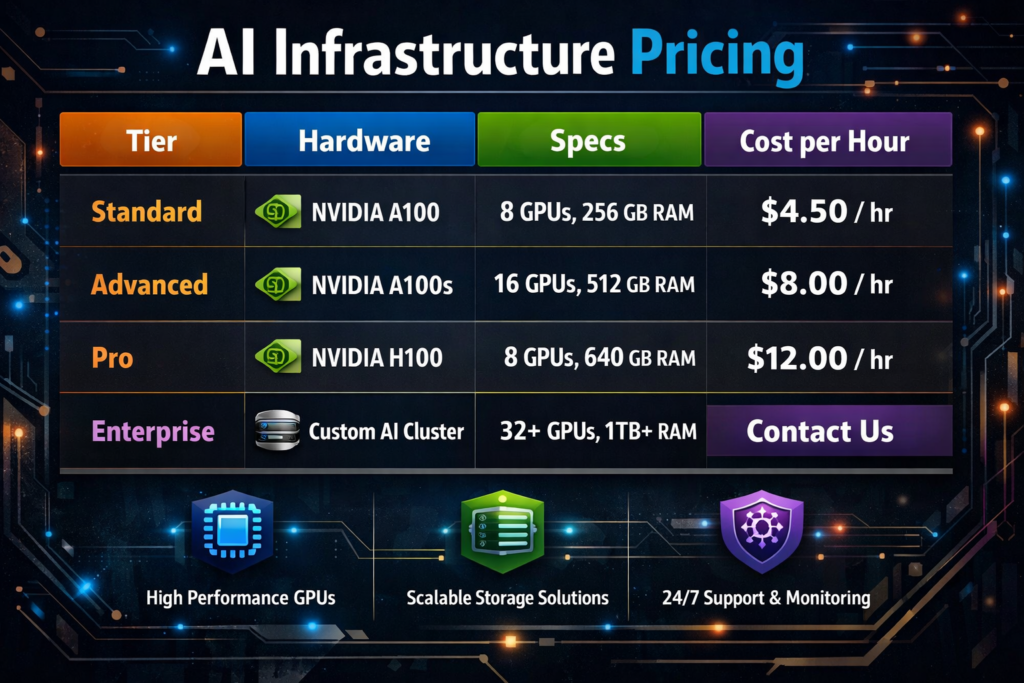
AI Infrastructure Pricing: AWS vs Azure vs GCP
AI workloads are rapidly changing cloud pricing dynamics across AWS, Azure, and Google Cloud.
GPU infrastructure, inference workloads, vector databases, and machine learning pipelines now represent some of the fastest-growing cloud expenses.
Google Cloud often performs well for AI infrastructure pricing because of its analytics ecosystem and Kubernetes efficiency.
AWS provides one of the largest AI infrastructure ecosystems, while Azure benefits from strong OpenAI and enterprise AI integrations.
Organizations optimizing AI infrastructure costs typically focus on:
- GPU utilization monitoring
- Inference optimization
- Autoscaling AI workloads
- Serverless AI execution
- Reducing idle GPU instances
Future of Cloud Pricing in 2026 and Beyond
Cloud pricing models are evolving rapidly as AI infrastructure demand increases.
Future trends include:
- AI-powered cost optimization tools
- Serverless pricing innovations
- More granular billing systems
- Predictive infrastructure scaling
- Industry-specific cloud pricing models
Businesses that continuously optimize cloud usage will gain a major competitive advantage in operational efficiency.
Conclusion
AWS vs Azure vs GCP cost comparison shows that each provider has strengths depending on workload type, scaling requirements, and enterprise priorities.
AWS offers unmatched infrastructure flexibility, Azure provides strong enterprise integration, and GCP delivers competitive pricing for AI and analytics workloads.
The best strategy is not simply choosing the cheapest provider, but selecting the cloud platform that delivers the best balance of performance, scalability, ecosystem support, and long-term cost efficiency.
For businesses looking to control infrastructure spending, continuous monitoring and cloud optimization are essential.
Explore more cloud infrastructure insights in our
Tech News section.
Best Cloud Cost Optimization Tools
- AWS Cost Explorer — AWS billing and infrastructure analysis
- Azure Cost Management — Azure spending visibility and forecasting
- Kubecost — Kubernetes cost optimization platform
- OpenCost — Open-source Kubernetes cost monitoring
- Datadog — Cloud observability and infrastructure monitoring
- Grafana — Infrastructure dashboards and metrics visualization
Cloud Cost Optimization Checklist
- Enable autoscaling
- Audit idle resources
- Monitor egress traffic costs
- Use reserved instances and savings plans
- Optimize Kubernetes workloads
- Implement tagging policies
- Track AI infrastructure usage
- Review storage lifecycle policies
- Monitor GPU utilization
- Continuously review cloud billing reports
Written by WaleSteve a cloud infrastructure engineer with experience optimizing AWS, GCP, Azure and Kubernetes environments for startups and enterprise workloads.
FAQ
Which cloud provider is cheapest?
Google Cloud Platform is often considered the cheapest for analytics and sustained workloads, while AWS and Azure provide competitive enterprise pricing options.
Is AWS more expensive than Azure?
AWS can be more expensive for certain workloads, but pricing depends on usage patterns, reserved instances, and optimization strategies.
Why do businesses choose Google Cloud?
Businesses choose Google Cloud for its strong AI infrastructure, Kubernetes integration, and competitive pricing for analytics workloads.
How can businesses reduce cloud costs?
Businesses can reduce cloud costs by right-sizing resources, using reserved instances, enabling auto-scaling, and continuously monitoring usage.

Leave a reply