
Google Cloud Pricing Comparison: Cost Analysis, Savings, and Optimization Guide for 2026
Google cloud pricing comparison is essential for organizations evaluating cloud infrastructure costs in 2026. As cloud spending continues to rise, businesses need a clear understanding of how Google Cloud Platform (GCP) pricing compares with competitors and whether it offers the best value for specific workloads.

Quick Answer: Is Google Cloud the Cheapest Cloud Provider?
Featured Snippet Answer
Google Cloud is often the cheapest cloud platform for sustained workloads, Kubernetes deployments, AI infrastructure, and analytics projects because of its automatic Sustained Use Discounts, Committed Use Discounts, and efficient networking architecture.
However, AWS may offer better pricing flexibility through Savings Plans and Spot Instances, while Azure can be more cost-effective for organizations already invested in Microsoft licensing. The cheapest cloud provider depends on workload patterns, infrastructure design, and cloud cost optimization practices.
- Best for Kubernetes: Google Cloud (GKE)
- Best for Enterprise Integration: Azure
- Best for Service Breadth: AWS
- Best for Analytics and AI: Google Cloud
Why Google Cloud Pricing Comparison Matters in 2026
Cloud costs are now one of the largest operational expenses for technology companies. Choosing the wrong platform can lead to thousands of dollars in unnecessary spending every year.
A proper Google cloud pricing comparison helps organizations:
- Reduce infrastructure costs
- Optimize cloud spending
- Select the right provider
- Improve ROI from cloud investments
- Avoid vendor lock-in mistakes
- Plan long-term cloud budgets
Companies running AI, analytics, SaaS applications, and enterprise workloads increasingly compare Google Cloud against AWS and Azure before making purchasing decisions.
For broader cloud optimization strategies, read our:
Cloud Cost Optimization Guide.
Google Cloud FinOps and Cost Governance in 2026
As cloud spending grows, organizations increasingly adopt FinOps (Cloud Financial Operations) frameworks to improve visibility, accountability, and infrastructure efficiency.
Modern FinOps practices focus on:
- Cloud cost allocation
- Engineering accountability
- Resource tagging policies
- Budget forecasting
- Cloud governance controls
- Real-time cost monitoring
Organizations using Google Cloud often combine FinOps strategies with cost management tools such as OpenCost, Kubecost, Datadog, Grafana, and Google Cloud Billing Reports to identify waste and optimize infrastructure spending.
Understanding Google Cloud’s Pricing Model
Google Cloud uses a pay-as-you-go pricing model similar to AWS and Azure.
Organizations pay only for the resources consumed, including:
- Virtual machines
- Storage
- Networking
- Databases
- AI services
- Containers and Kubernetes
- Serverless computing
Unlike some competitors, Google Cloud automatically applies discounts in many situations without requiring long-term commitments.
This is one reason many analysts consider GCP attractive for startups and fast-growing businesses.
Key Components of Google Cloud Pricing
Compute Engine
Compute Engine provides virtual machine instances similar to AWS EC2 and Azure Virtual Machines.
Pricing varies based on:
- CPU count
- Memory allocation
- Machine family
- GPU usage
- Operating system
- Region
Organizations can choose from:
- General-purpose instances
- Compute-optimized instances
- Memory-optimized instances
- GPU-enabled instances
Cloud Storage
Google Cloud Storage pricing depends on:
- Storage class
- Data retrieval frequency
- Data transfer volume
- Location
Storage classes include:
- Standard Storage
- Nearline Storage
- Coldline Storage
- Archive Storage
Businesses storing large datasets often find GCP storage highly competitive.
Networking Costs
Networking charges can significantly impact cloud bills.
Typical networking expenses include:
- Internet egress traffic
- Cross-region transfers
- Load balancing
- CDN usage
- Private networking
Many organizations underestimate networking costs when evaluating cloud providers.
Kubernetes and Containers
Google created Kubernetes and remains a leader in container orchestration.
Google Kubernetes Engine (GKE) is widely regarded as one of the strongest managed Kubernetes platforms available.
Pricing depends on:
- Node resources
- Cluster size
- Storage usage
- Networking traffic
For container-heavy environments, GCP frequently offers strong value.
Google Kubernetes Engine (GKE) Cost Optimization
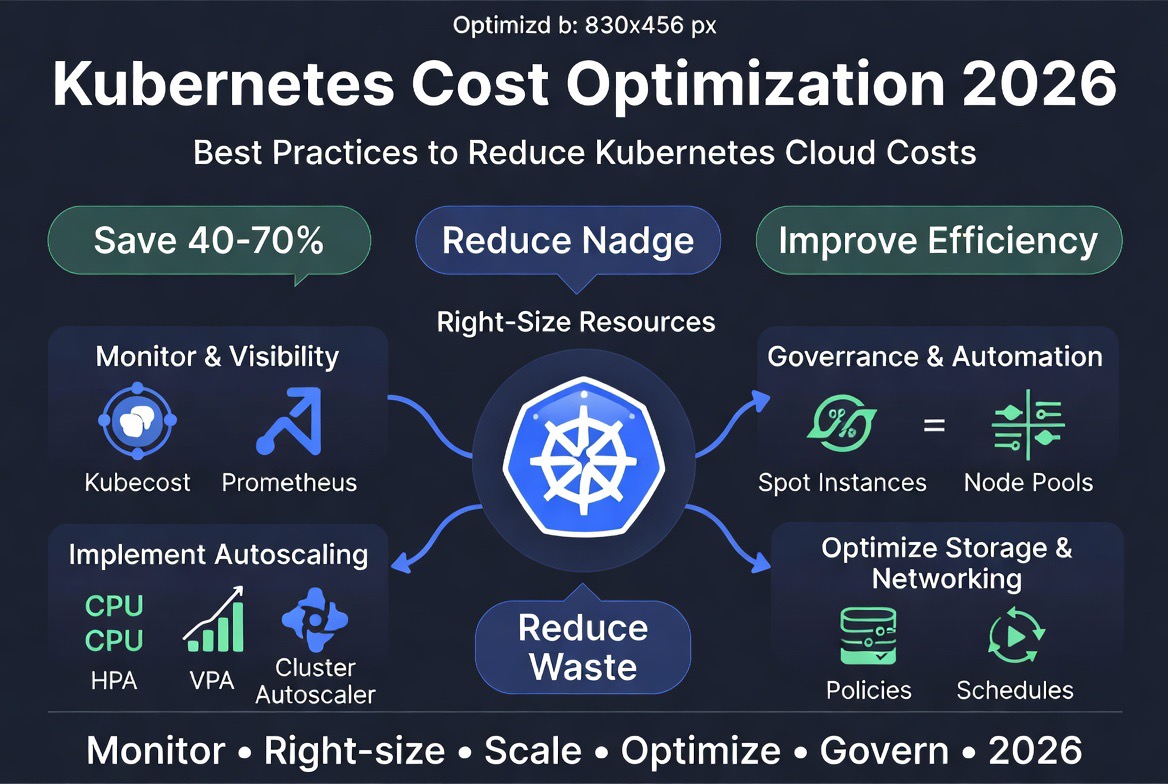
Kubernetes cost optimization has become one of the most important cloud management disciplines in 2026.
Because Google created Kubernetes, Google Kubernetes Engine (GKE) remains one of the most mature managed Kubernetes services available.
| Platform | Managed Service | Strength |
|---|---|---|
| AWS | EKS | Enterprise Scale |
| Azure | AKS | Microsoft Integration |
| Google Cloud | GKE | Kubernetes Leadership |
Organizations can reduce Kubernetes costs by:
- Rightsizing containers
- Using cluster autoscaling
- Removing idle workloads
- Optimizing persistent storage
- Using spot/preemptible nodes
- Monitoring resource utilization with OpenCost or Kubecost
Many companies discover that Kubernetes inefficiencies create larger cloud bills than virtual machine costs.
Google Cloud Pricing Comparison vs AWS
AWS remains the largest public cloud provider globally.
Compute
AWS offers the widest variety of instance types.
However, Google Cloud frequently provides:
- Simpler pricing structures
- Automatic sustained-use discounts
- Competitive VM pricing
Storage
Storage pricing between AWS S3 and Google Cloud Storage is often similar, although specific workload patterns may favor one provider.
Networking
AWS networking costs can become expensive at scale.
Many organizations report that Google Cloud networking costs are easier to predict.
Kubernetes
GCP generally holds an advantage for Kubernetes-centric environments because of Google’s deep involvement in Kubernetes development.
Google Cloud Pricing Comparison vs Azure
Azure is Microsoft’s cloud platform and a major competitor to GCP.
Enterprise Integration
Azure excels for organizations heavily invested in:
- Windows Server
- Microsoft 365
- Active Directory
- SQL Server
Licensing Benefits
Microsoft customers may receive discounts through:
- Azure Hybrid Benefit
- Enterprise Agreements
- Volume licensing programs
Analytics and AI
Google Cloud often stands out in:
- Machine learning
- Big data analytics
- Data processing workloads
- TensorFlow integration
Google Cloud Pricing Comparison Table
| Category | Google Cloud | AWS | Azure |
|---|---|---|---|
| Compute Pricing | Competitive | Broad Options | Enterprise Focused |
| Storage Pricing | Competitive | Competitive | Competitive |
| Kubernetes | Excellent | Very Good | Very Good |
| AI Services | Strong | Strong | Strong |
| Automatic Discounts | Excellent | Limited | Moderate |
| Enterprise Ecosystem | Growing | Large | Excellent |
| Ease of Pricing | High | Moderate | Moderate |
Google Cloud Sustained Use Discounts
One of the most important advantages highlighted in a Google cloud pricing comparison is sustained use discounts.
When workloads run for a significant portion of the month, Google automatically reduces costs.
Benefits include:
- No manual reservations required
- Automatic savings
- Simplified cost management
- Predictable budgeting
These discounts can significantly lower monthly bills.
Committed Use Discounts
For long-term workloads, GCP offers committed use discounts.
Organizations commit to resource consumption over a defined period in exchange for lower rates.
Benefits include:
- Reduced compute costs
- Predictable spending
- Better ROI
- Long-term savings
Best Use Cases for Google Cloud
AI and Machine Learning
Google Cloud is particularly attractive for:
- Generative AI
- Machine learning training
- Predictive analytics
- Large-scale inference
Google’s AI ecosystem remains one of the strongest in the industry.
Data Analytics
Many organizations choose GCP because of:
- BigQuery
- Dataflow
- Looker
- Vertex AI
Data-intensive businesses often see strong value from these services.
Kubernetes Deployments
Organizations using containers heavily frequently prefer Google Cloud due to:
- GKE maturity
- Strong automation
- Scalability
- Operational simplicity
Potential Drawbacks of Google Cloud
While the Google cloud pricing comparison is favorable in many areas, GCP isn’t always the best choice.
Potential limitations include:
- Smaller ecosystem than AWS
- Fewer enterprise integrations than Azure
- Limited regional presence compared with AWS
- Less third-party marketplace breadth
Businesses should evaluate total cost alongside technical requirements.
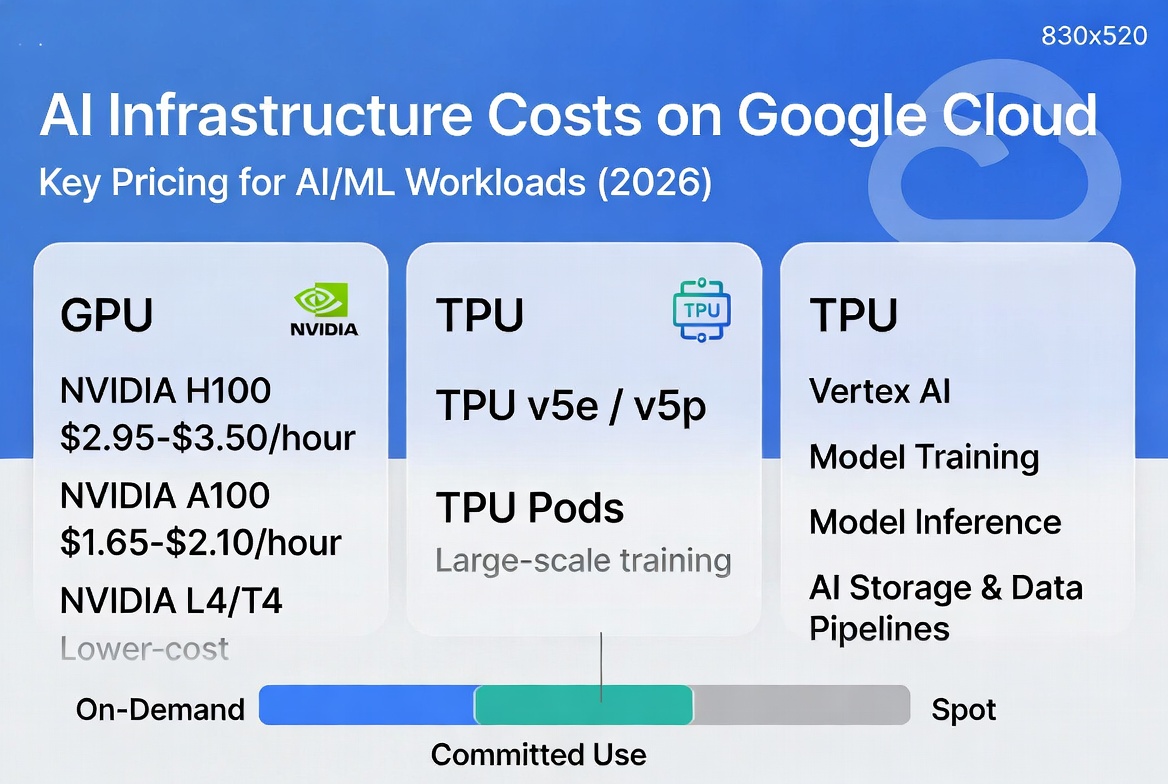
AI Infrastructure Costs on Google Cloud
AI workloads are becoming one of the fastest-growing categories of cloud spending.
Google Cloud provides infrastructure for:
- Large language models
- AI inference
- Model training
- Generative AI applications
- Machine learning pipelines
Key AI cost drivers include:
- GPU pricing
- Inference requests
- Training duration
- Storage of datasets
- Network transfer costs
Businesses deploying AI workloads should continuously monitor utilization because idle GPUs can become one of the most expensive cloud resources.
For many organizations, AI infrastructure optimization now delivers larger savings than traditional virtual machine optimization.
E-E-A-T Analysis: Is Google Cloud Worth the Cost?
Based on industry pricing patterns and enterprise adoption trends, Google Cloud offers some of the strongest value propositions for analytics, AI, and Kubernetes workloads.
For startups, developers, and data-driven organizations, GCP’s automatic discounts often simplify cloud cost management significantly.
However, enterprises already deeply integrated into Microsoft products may achieve lower total ownership costs with Azure. Organizations requiring the broadest service ecosystem may still prefer AWS.
The most effective approach is rarely selecting a provider solely based on advertised pricing. Instead, organizations should evaluate:
- Workload characteristics
- Operational expertise
- Expected growth
- Data transfer patterns
- Long-term cloud strategy
In many real-world deployments, operational efficiency has a greater financial impact than raw infrastructure pricing.
Real Cloud Cost Optimization Examples
Case Study: Reducing Database Costs by 95%
In one production deployment, we migrated a PostgreSQL workload from Google Cloud SQL to Neon.
The result was approximately 95% lower monthly database costs while maintaining performance requirements for the application.
This illustrates an important cloud optimization principle: managed cloud services are not always the most cost-effective solution for every workload.
Case Study: Reducing Serverless AI Processing Costs by 80%
During optimization of a document and image processing platform, heavy machine learning libraries were originally loaded globally during application startup.
Instead of importing packages such as onnxruntime, OpenCV, pandas, NumPy, SciPy, PyMuPDF, pdf2image, and pytesseract at startup, imports were moved inside functions and loaded only when needed.
Combined with reducing minimum instances to zero, cloud costs decreased by more than 80%.
This optimization reduced memory consumption, cold-start overhead, and idle infrastructure spending.
Decision Framework: Which Cloud Provider Should You Choose?
Choose Google Cloud If:
- You run AI workloads
- You use Kubernetes extensively
- You need advanced analytics
- You want automatic discounts
- You prioritize developer-friendly tooling
Choose AWS If:
- You need maximum service variety
- You require broad geographic coverage
- You want the largest ecosystem
- You need specialized infrastructure services
Choose Azure If:
- You use Microsoft products heavily
- You rely on Windows Server
- You need enterprise licensing advantages
- You require Microsoft ecosystem integration
Additional Resources
Internal resources:
- Cloud Cost Optimization Guide
- AWS vs Azure vs GCP Cost Comparison
- AWS Pricing for Beginners
- Azure Cloud Pricing Review
- Tech News
Outbound resources:
Cloud Cost Optimization Features Comparison
| Feature | AWS | Azure | Google Cloud |
|---|---|---|---|
| Savings Plans | Yes | Limited | No |
| Committed Use Discounts | Reserved Instances | Reserved Capacity | Yes |
| Spot Instances | Yes | Yes | Preemptible VMs |
| Kubernetes Strength | Strong | Strong | Excellent |
| AI Infrastructure | Excellent | Strong | Excellent |
| FinOps Tooling | Excellent | Excellent | Strong |
Top Cloud Cost Optimization Tools
Many organizations use specialized FinOps and observability platforms to reduce cloud spending.
- AWS Cost Explorer
- Azure Cost Management
- Google Cloud Billing Reports
- Kubecost
- OpenCost
- Datadog
- Grafana
- Prometheus
These tools help identify idle resources, optimize Kubernetes environments, monitor spending trends, and improve infrastructure efficiency.
Common Hidden Google Cloud Costs
Many organizations underestimate several categories of cloud spending.
- Data transfer and egress fees
- Idle GPU resources
- Snapshot storage costs
- Logging and monitoring charges
- Unused Kubernetes resources
- Persistent disk storage
- Load balancer fees
- Cross-region networking traffic
Regular cloud cost audits help prevent these hidden expenses from accumulating over time.
Google Cloud Cost Optimization Checklist
- Enable autoscaling wherever possible
- Use committed use discounts for predictable workloads
- Review storage lifecycle policies
- Monitor network egress charges
- Audit Kubernetes workloads monthly
- Delete unused disks and snapshots
- Implement resource tagging policies
- Monitor GPU utilization
- Use cloud billing alerts
- Perform regular FinOps reviews
Conclusion
Google cloud pricing comparison shows that GCP remains one of the most competitive cloud providers in 2026. Its automatic discounts, strong analytics platform, Kubernetes leadership, and advanced AI capabilities make it an attractive choice for startups, developers, and enterprises.
The best cloud provider ultimately depends on workload requirements, organizational goals, and long-term cloud strategy. By evaluating compute, storage, networking, and operational costs together, businesses can make more informed infrastructure decisions and maximize cloud ROI.
FAQ
What is Google Cloud pricing based on?
Google Cloud pricing is primarily based on resource consumption, including compute, storage, networking, databases, and AI services.
Is Google Cloud cheaper than AWS?
For many sustained workloads, Google Cloud can be cheaper because of automatic sustained-use discounts and competitive infrastructure pricing.
Is Google Cloud cheaper than Azure?
It depends on workload requirements. Organizations using Microsoft products extensively may find Azure more cost-effective, while AI and analytics workloads often favor Google Cloud.
What are sustained use discounts?
Sustained use discounts automatically reduce costs for workloads that run for a significant portion of the billing month.
Is Google Cloud good for AI applications?
Yes. Google Cloud is widely regarded as one of the strongest cloud platforms for AI, machine learning, analytics, and Kubernetes deployments.

Leave a reply