DevOps Automation Tools Pricing Guide (2026 Cost Breakdown)
Devops automation tools pricing is one of the most important factors teams consider when choosing a CI/CD platform. While many tools offer free tiers, the real cost depends on usage, scale, and infrastructure requirements.
In 2026, DevOps teams are balancing performance, scalability, and cost efficiency. This guide breaks down pricing models, compares popular tools, and helps you choose the best option for your workflow.

To understand the ecosystem, explore our
devops automation tools pillar guide.
Factors Affecting DevOps Automation Tools Pricing
Several factors influence devops automation tools pricing. Understanding these variables helps teams avoid unexpected costs.
1. Usage Volume
Most tools charge based on usage, including build minutes, storage, and number of pipelines. High-frequency deployments can significantly increase costs.
2. Team Size
Pricing often scales per user or per seat. Larger teams typically pay more unless they opt for enterprise plans.
3. Infrastructure Requirements
Self-hosted tools like Jenkins require servers, maintenance, and DevOps expertise, which adds indirect costs.
4. Integrations and Add-ons
Premium integrations, security features, and advanced analytics often come at an additional cost.
5. Cloud vs Self-Hosted
Cloud-based tools charge subscription or usage fees, while self-hosted tools require infrastructure investment.
DevOps Automation Tools Pricing Models
Understanding pricing models is essential when evaluating DevOps platforms.
Subscription-Based Pricing
Most SaaS tools use a monthly or yearly subscription model. Pricing depends on features and team size.
- predictable monthly cost
- scales with team size
- includes support and updates
Usage-Based Pricing
Some tools charge based on compute time, builds, or storage usage.
- pay only for what you use
- can become expensive at scale
- ideal for startups and small teams
Enterprise Licensing
Large organizations often negotiate custom pricing plans with vendors.
- tailored pricing
- advanced features included
- higher upfront cost
DevOps Automation Tools Pricing Comparison
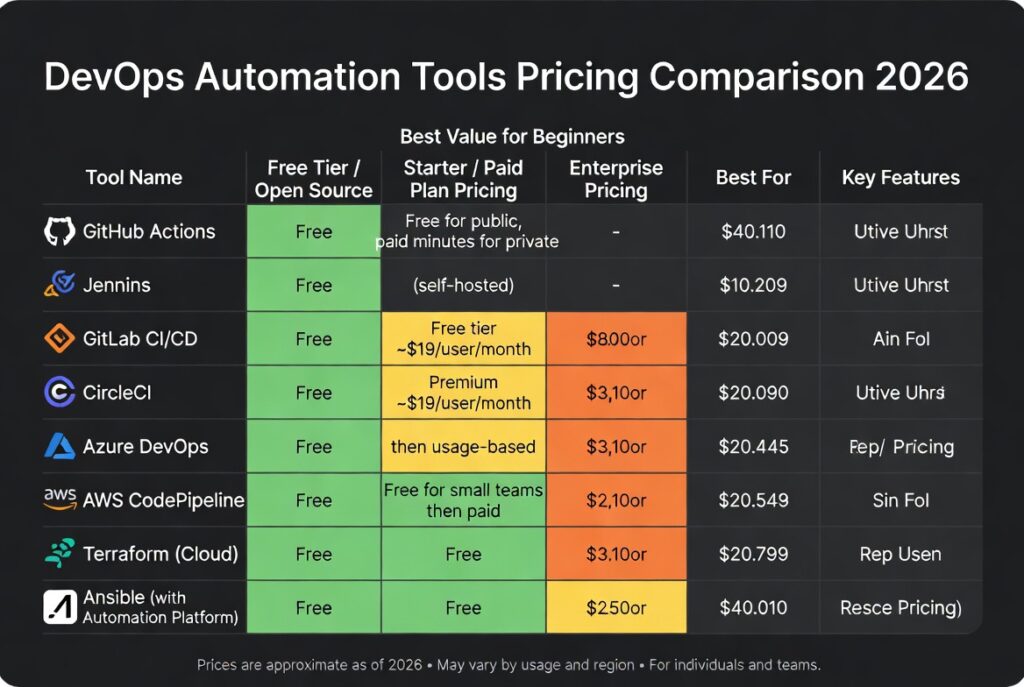
Below is a general comparison of popular DevOps tools and their pricing structures.
| Tool | Pricing Model | Free Tier | Best For |
|---|---|---|---|
| Jenkins | Free (self-hosted) | Yes | Enterprise customization |
| GitHub Actions | Usage-based | Yes | GitHub users |
| GitLab CI/CD | Subscription | Yes | All-in-one DevOps |
| CircleCI | Usage-based | Yes | Scalable pipelines |
| Bitbucket Pipelines | Subscription | Yes | Atlassian ecosystem |
Compare tools in detail:
jenkins vs github actions comparison
Real Cost Breakdown (2026 Estimates)
Small Teams (1–5 Developers)
- $0 – $50/month
- free tiers often sufficient
- limited build minutes
Growing Teams (5–20 Developers)
- $50 – $300/month
- increased usage and integrations
- need for scaling pipelines
Enterprise Teams (20+ Developers)
- $300 – $2000+/month
- custom infrastructure
- advanced security and monitoring
Hidden Costs to Consider
Devops automation tools pricing goes beyond subscription fees. Hidden costs can impact your budget significantly.
- infrastructure hosting (for Jenkins)
- maintenance and DevOps staff
- training and onboarding
- third-party integrations
Cost vs Performance Analysis
Choosing the cheapest tool is not always the best decision. Performance, reliability, and developer productivity must be considered.
For example, GitHub Actions may cost more at scale, but it reduces setup time and improves developer experience.
Jenkins may be free, but infrastructure and maintenance costs can outweigh the savings.
Is DevOps Automation Tools Pricing Worth It?
Investing in DevOps tools delivers strong ROI by improving deployment speed, reducing errors, and increasing team productivity.
- faster time to market
- reduced downtime
- automated workflows
- improved developer efficiency
Most teams recover their investment through productivity gains within months.
Best Value DevOps Tools in 2026
- GitHub Actions – best for simplicity
- Jenkins – best for customization
- GitLab CI/CD – best all-in-one platform
- CircleCI – best for scalability
Explore all tools:
devops automation tools
Official Resources (Dofollow Links)
Download Free DevOps Cost Optimization Guide
Learn how to reduce DevOps costs while scaling your infrastructure efficiently.
Prefer direct download?
Download instantly
.
Conclusion
Devops automation tools pricing varies widely depending on usage, scale, and features. While free tools exist, the real cost comes from infrastructure, integrations, and team requirements.
Choosing the right tool requires balancing cost with performance and scalability. Teams that invest wisely in DevOps automation gain a significant competitive advantage.
FAQ
How much do DevOps automation tools cost?
DevOps tools can range from free to over $2000 per month depending on usage, team size, and features.
Are DevOps tools free?
Many tools offer free tiers, but advanced features and higher usage require paid plans.
Which DevOps tool is most cost-effective?
GitHub Actions is cost-effective for small teams, while Jenkins can be cheaper for enterprises with existing infrastructure.

Leave a reply