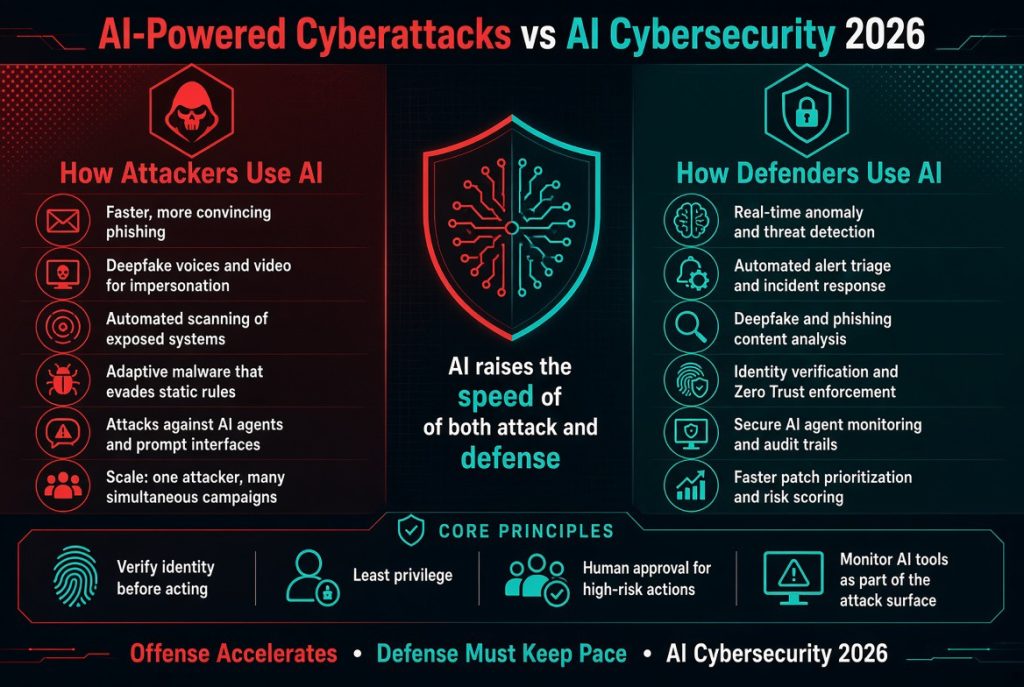
AI-Powered Cyberattacks: How AI Is Changing Cybercrime in 2026
AI-powered cyberattacks are changing how cybercriminals conduct reconnaissance, build phishing campaigns, analyze vulnerabilities, steal credentials, develop malware, and move through compromised environments.
But there is an important distinction between what is happening today and some of the more dramatic predictions surrounding AI and cybercrime.
AI has not suddenly created an army of completely autonomous hackers capable of breaking into any organization. The fundamentals of cybersecurity still matter enormously. Stolen credentials, vulnerable software, excessive permissions, exposed services, weak authentication, social engineering, and compromised supply chains continue to provide attackers with practical paths into organizations.
What AI changes is the economics and speed of those attacks.
An attacker who previously needed hours of manual research may be able to automate parts of that work. A phishing campaign that once required carefully written messages can now be personalized at scale. Security researchers and attackers alike can use AI to analyze source code and investigate vulnerabilities faster.
That is the real significance of AI-powered cyberattacks in 2026.
The technology does not necessarily invent an entirely new form of cybercrime. Instead, it can make existing techniques faster, cheaper, more scalable, and increasingly adaptive.
Quick Answer: What are AI-powered cyberattacks?
AI-powered cyberattacks are cyberattacks in which artificial intelligence is used to improve one or more stages of an attack, including reconnaissance, phishing, social engineering, vulnerability research, credential theft, malware development, data analysis, or attack automation.
The most important change in 2026 is not that cyberattacks have suddenly become fully autonomous. It is that AI can reduce the amount of human effort and time required to perform parts of the attack lifecycle. Google Threat Intelligence reported in September 2026 that some threat actors had moved from simple prompting toward agentic AI workflows, while Microsoft similarly reported that attackers were embedding AI into reconnaissance, malware development, and post-compromise operations. Google Cloud
For defenders, the practical response is equally clear: strengthen identity security, reduce the external attack surface, patch quickly, monitor behavior, secure AI systems and supply chains, and use automation to reduce detection and response time.
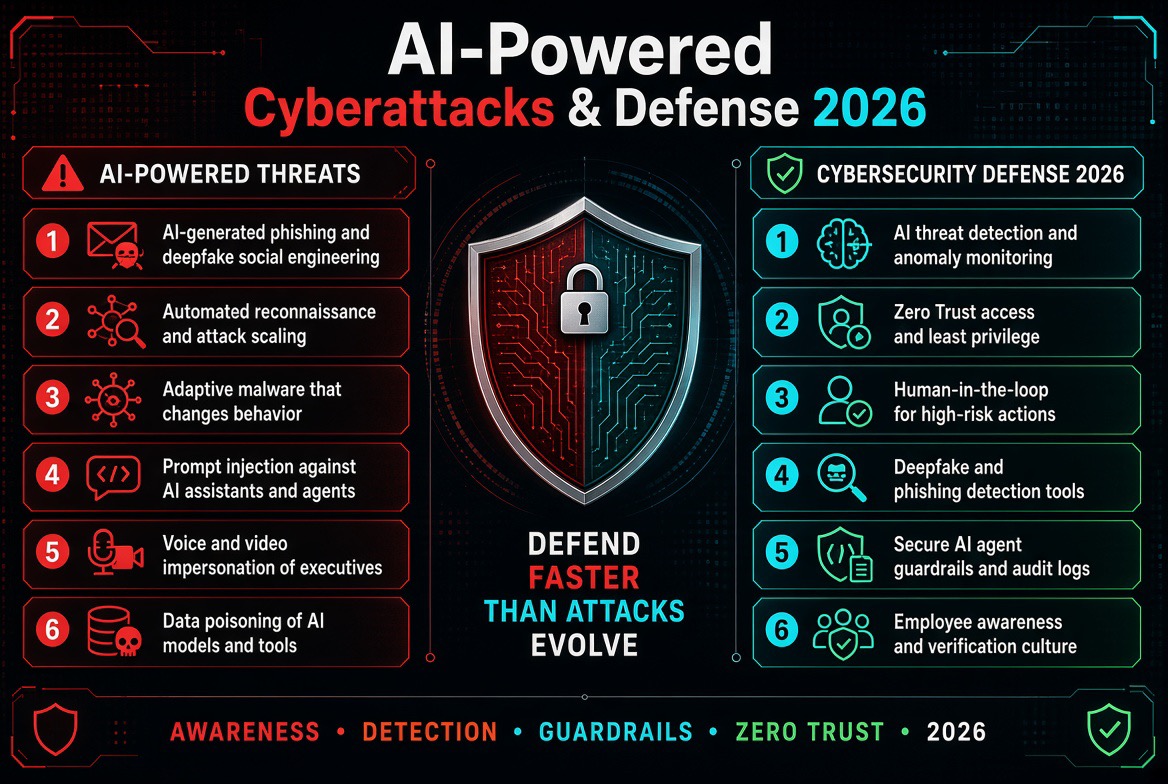
AI-powered cyberattacks are changing the speed and scale of modern cybercrime.
What Are AI-Powered Cyberattacks?
AI-powered cyberattacks are attacks where artificial intelligence is used to improve, automate, or accelerate activities within the cyberattack lifecycle.
That can include:
- Reconnaissance and target research
- Phishing and spear-phishing
- Social engineering
- Vulnerability analysis
- Source-code analysis
- Credential theft campaigns
- Malware development
- Data analysis
- Translation and localization
- Attack-path analysis
- Automation and orchestration
- Post-compromise activities
AI does not need to control an entire attack to be useful.
In fact, that is one of the most important points to understand.
Consider a conventional phishing campaign. An attacker might research a company, write a message, create a malicious link, distribute the message, monitor responses, and manually adjust the campaign.
AI can potentially assist with several of those steps.
It can help analyze publicly available information, produce different versions of a message, translate content, categorize responses, summarize collected information, and assist with the next stage of the operation.
The underlying attack technique may still be phishing.
The difference is that the attacker can potentially operate it with much less manual effort.
That is where AI changes the threat model.
Why AI-Powered Cyberattacks Matter in 2026
The discussion around AI and cybersecurity has moved beyond hypothetical demonstrations.
In September 2026, Google Threat Intelligence reported that some threat actors were moving from basic prompting toward agentic AI workflows and AI-enabled automation. According to the report, Google observed a threat actor compromise a cloud resource and then plan, build, and execute an agent-enabled mass credential-harvesting campaign in less than six hours. Google Cloud
That does not mean every cybercriminal operation is now autonomous. It does, however, demonstrate why security teams are paying attention to the combination of AI and automation.
Microsoft reached a similar conclusion in its April 2026 analysis. Microsoft said threat actors were increasingly embedding AI into how they plan, refine, and sustain attacks, while emphasizing that human involvement remained common. The company’s assessment described AI as reducing friction across the attack lifecycle rather than replacing humans entirely. Microsoft
That distinction is important because cybersecurity discussions sometimes jump directly from “AI can help attackers” to “AI hackers can independently compromise everything.”
The evidence does not support that simplistic conclusion.
The more defensible interpretation is that AI is compressing parts of the attack lifecycle.
And when defenders have fewer hours—or potentially minutes—to identify and contain suspicious activity, traditional security processes may become increasingly difficult to manage manually.
AI Is Increasing the Speed of Cybercrime
Speed may ultimately become one of AI’s biggest effects on cybersecurity.
Cyberattacks are often described as a sequence:
- Find a target.
- Research the target.
- Identify an opportunity.
- Gain initial access.
- Establish persistence.
- Escalate privileges.
- Move through the environment.
- Steal or disrupt something valuable.
Historically, many of these activities required substantial human effort.
AI can reduce the amount of manual work involved in several stages.
This matters because the security advantage often belongs to whoever can complete the attack or defense cycle faster.
Google Cloud’s H1 2026 Cloud Threat Horizons report provides another important piece of context: Google observed the window between vulnerability disclosure and active exploitation collapsing from weeks to days during the second half of 2025. The report recommends moving toward more automated defensive controls as a result. Google Cloud
AI is not the only reason that exploitation timelines are shrinking. Automation, better attacker tooling, exposed infrastructure, and the availability of public vulnerability information all contribute.
But AI adds another accelerator to an already fast-moving environment.
How Attackers Are Using AI
1. AI-Powered Phishing
Phishing is not new.
What is changing is the quality and scalability of the messages used in phishing campaigns.
Traditional phishing emails often contained obvious warning signs: strange grammar, awkward wording, generic greetings, suspicious formatting, or poor translations.
Those clues are becoming less reliable.
Generative AI can produce fluent and contextually appropriate communication in seconds. It can also help create different versions of a message for different audiences.
ENISA’s 2025 Threat Landscape identified phishing—including vishing, malspam and malvertising—as the leading initial intrusion vector in its dataset, accounting for approximately 60% of observed cases. ENISA also highlighted the growing use of AI to enhance phishing and automate social engineering. ENISA
Microsoft’s research into an AI-enabled device-code phishing campaign provides a more recent example. Microsoft reported that generative AI was used to create hyper-personalized phishing emails aligned with victims’ roles, while automation supported the wider attack infrastructure. Microsoft
This leads to a practical lesson:
Employees should not be trained to identify phishing primarily through spelling mistakes.
A well-written message can still be malicious.
The better question is whether the request makes sense and whether it should be independently verified.
2. AI-Enhanced Social Engineering
Social engineering attacks exploit trust rather than software vulnerabilities.
AI makes that trust exploitation easier to personalize.
An attacker can potentially use publicly available information to understand a person’s role, company, interests, business relationships, or communication style.
AI can then assist in producing content that appears more contextually appropriate.
Potential applications include:
- Personalized emails
- Fake business communications
- Impersonation scripts
- Multilingual communication
- Voice-based social engineering
- Fake documents
- AI-generated images
- Deepfake-assisted impersonation
The risk is bigger than fake content itself.
Organizations have historically relied on subtle human signals to establish trust. If convincing text, audio, images, and video can be generated cheaply, those signals become less reliable.
That means high-value requests increasingly need process-based verification rather than relying on familiarity.
For example, a request to change a bank account should be verified through an established process—even if the request appears to come from the CEO.
3. AI-Assisted Vulnerability Research
Security researchers have used automated vulnerability scanners and static-analysis tools for decades.
AI adds another layer.
Modern models can analyze large amounts of source code, identify suspicious patterns, reason about application behavior, and help researchers investigate possible attack paths.
The same capability can be used defensively or offensively.
Microsoft reported in April 2026 that advances in AI model capabilities were changing how vulnerabilities could be discovered and exploited. Microsoft specifically discussed models that can discover weaknesses, chain multiple lower-severity issues into an end-to-end exploit, and produce working proof-of-concept code. Microsoft
This creates a genuine race.
Defenders want AI to discover vulnerabilities before attackers do.
Attackers want to discover exploitable weaknesses before organizations can fix them.
The strategic implication is straightforward: organizations cannot assume that a vulnerability is safe simply because exploitation has not yet been observed.
4. AI-Generated and Adaptive Malware
Malware has traditionally been developed using predetermined code and logic.
AI introduces the possibility of more adaptive behavior.
Google’s 2026 AI Risk and Resilience research discusses malicious use of AI in malware and broader attack operations, while its threat-intelligence reporting describes increasingly automated workflows involving AI-enabled tooling. Google Cloud
It is important not to overstate what this means.
Not every malware sample is an intelligent autonomous program. Traditional malware remains extremely relevant.
The important shift is that AI can potentially assist malware development, modify operational behavior, analyze environments, or generate commands.
That makes behavioral detection increasingly important.
Security teams should look not only for known malicious files but also for suspicious activity such as unusual process execution, unexpected network communication, abnormal privilege use, and unauthorized access to sensitive systems.
5. Automated Reconnaissance
Attackers need information before they can make informed decisions.
Reconnaissance can involve discovering:
- Internet-facing systems
- Employee information
- Technology stacks
- Cloud services
- Potential vulnerabilities
- Exposed credentials
- Third-party relationships
- Public source-code repositories
AI can help organize and analyze large amounts of information.
The arrival of agentic systems makes this more significant because an agent can potentially perform a sequence of research activities rather than simply respond to a single prompt.
Google Threat Intelligence reported in September 2026 that threat actors were using agentic workflows to reduce human-in-the-loop latency and automate parts of reconnaissance and other operational tasks. Google Cloud
For defenders, this makes external attack-surface management more important.
If your organization does not know what is exposed to the internet, an attacker may discover it before your security team does.
6. AI-Assisted Credential Theft
Credentials remain one of the most valuable targets in cybercrime.
AI can improve the campaigns designed to steal them.
This may involve more convincing phishing messages, dynamic lures, better targeting, automated response analysis, and faster campaign iteration.
Google Cloud’s H1 2026 threat research found identity compromise to be involved in 83% of compromises in the cloud and SaaS environments represented in its Mandiant incident-response dataset. Google Cloud
That number should not be interpreted as a universal statistic for every organization. It comes from a specific set of observed incidents.
But it illustrates a broader point: identity remains a critical security boundary even in an AI-driven threat landscape.
AI Agents Are Changing the Cybersecurity Threat Model
The most significant development may not be generative AI by itself.
It may be the combination of AI with agency.
A conventional chatbot waits for a person to provide instructions.
An agent can potentially interpret a goal, use tools, make decisions, call APIs, inspect results, and continue through multiple steps.
That changes the security implications.
An attacker could potentially build a workflow that:
- Identifies a target.
- Collects publicly available information.
- Analyzes potential weaknesses.
- Prioritizes possible attack paths.
- Performs selected actions.
- Analyzes the results.
- Adjusts the next action.
Human involvement may still exist, but fewer manual decisions may be necessary.
This is why developments in agent-to-agent communication and multi-agent systems matter beyond normal software automation.
The same architectures that allow legitimate AI agents to coordinate business processes could potentially be adapted for malicious purposes.
Google’s September 2026 threat research provides evidence that this transition is already being observed in limited real-world operations. Google Cloud
My view is that the word autonomous can sometimes distract from the more important security issue.
An attack does not need to be completely autonomous to become significantly harder to defend against.
If AI reduces a four-hour manual process to 20 minutes, that alone changes the defender’s response window.
AI-Powered Cyberattacks vs. Traditional Cyberattacks
| Area | Traditional approach | AI-enhanced approach |
|---|---|---|
| Phishing | Mass-produced messages | Highly personalized messages generated at scale |
| Reconnaissance | Manual research and scripts | Automated research, classification and analysis |
| Vulnerability research | Manual analysis plus scanners | AI-assisted source-code and vulnerability analysis |
| Social engineering | Human-written communication | Personalized AI-generated communication |
| Malware development | Manually developed code | AI-assisted development and modification |
| Data analysis | Manual investigation | Automated classification and summarization |
| Attack operations | Mostly human-driven workflows | Increasingly automated and agentic workflows |
The key point is that AI does not necessarily replace traditional cybercrime.
It can industrialize it.
AI Is Also Making Cybersecurity Stronger
There is another side of the story that deserves equal attention.
The same capabilities that can help attackers can help defenders.
Security teams can use AI to:
- Analyze security alerts
- Summarize incidents
- Search large volumes of logs
- Identify suspicious behavior
- Analyze source code
- Investigate vulnerabilities
- Prioritize security findings
- Generate detection rules
- Assist incident investigations
- Correlate threat intelligence
- Automate low-risk response actions
Microsoft’s April 2026 security research explicitly describes AI-assisted vulnerability discovery, detection engineering, validation, prioritization, and mitigation as part of its defensive strategy. Microsoft
Google is also developing AI-powered security capabilities and has described using AI to help security teams process and respond to increasingly complex threats. Google Cloud
This produces an interesting arms race.
Attackers are trying to reduce the time required to identify and exploit weaknesses.
Defenders are trying to reduce the time required to identify, investigate, and contain attacks.
That does not mean whoever has “more AI” automatically wins.
AI is only as useful as the data, permissions, security controls, and human processes surrounding it.
Why Traditional Security Controls Still Matter
One of the easiest mistakes organizations can make is responding to AI-powered cyberattacks by buying another AI security product while leaving basic weaknesses unresolved.
That is backwards.
AI does not make multi-factor authentication irrelevant.
AI does not make patch management irrelevant.
AI does not make backups irrelevant.
AI does not make least privilege irrelevant.
In many cases, it makes those controls even more important.
Google’s threat research continues to highlight identity, vulnerable software, exposed infrastructure, and security hygiene as major factors in cloud compromises. Google Cloud
Organizations should therefore prioritize:
- Strong identity management
- Phishing-resistant authentication where practical
- Multi-factor authentication
- Least-privilege access
- Rapid patching
- Secure configuration
- Endpoint protection
- Network segmentation
- Secure backups
- Email security
- Cloud security
- Continuous asset discovery
- Security monitoring
- Incident-response planning
These controls may not sound futuristic.
That is precisely the point.
The arrival of AI does not eliminate the fundamentals. It increases the consequences of ignoring them.
The Vulnerability Window Is Getting Smaller
One of the most important cybersecurity trends in 2026 is the shrinking gap between vulnerability disclosure and exploitation.
Google Cloud’s H1 2026 Cloud Threat Horizons report found that the vulnerability-to-exploitation window had collapsed from weeks to days in parts of the threat landscape. Google also documented examples where exploitation occurred within roughly 48 hours of public disclosure. Google Cloud
This creates a problem for organizations that still rely heavily on manual vulnerability-management processes.
If a security team discovers a critical vulnerability and takes several weeks to investigate, approve, schedule, and deploy the fix, an attacker may have already exploited it.
AI can make that problem worse by helping attackers process vulnerability information faster.
But it can also help defenders prioritize vulnerabilities based on exploitability, exposure, and business impact.
The practical lesson is simple:
Vulnerability management increasingly needs to become an operational process rather than a periodic compliance exercise.
The New Risk of AI Supply Chains
Modern AI systems rarely operate in isolation.
An enterprise AI application might depend on:
- Foundation models
- Model providers
- Open-source libraries
- Agent frameworks
- Plugins
- External APIs
- Data sources
- Vector databases
- Developer tools
- AI coding assistants
- Model extensions
Every additional component creates another trust relationship.
That creates an emerging AI supply-chain security problem.
Google’s September 2026 reporting describes threat activity involving AI coding assistants and software supply-chain compromise, while Google’s AI Risk and Resilience report warns that poisoned data sources, model dependencies, and extension hooks can become attack paths into trusted AI systems. Google Cloud
The implications extend beyond AI models themselves.
If an AI coding assistant has access to a repository, an attacker may not need to compromise the AI provider directly. Manipulating a dependency, repository, prompt, extension, or development workflow may provide another path into the organization.
This is why organizations should treat AI components as part of their software supply chain rather than as isolated productivity tools.
Shadow AI Is Becoming a Security Problem
Another risk is developing inside organizations themselves.
Employees increasingly use AI tools to write code, summarize documents, analyze data, create presentations, translate information, and automate repetitive work.
Some of these tools may never have been approved by the organization’s IT or security team.
This is commonly called Shadow AI.
The problem is not that AI is inherently unsafe.
The problem is lack of visibility.
Security teams may not know:
- Which AI tools employees are using
- What company information is being submitted
- Which AI extensions are installed
- Which accounts have access
- Which agents can take actions
- Where generated or uploaded data is stored
- Which third-party integrations are connected
Google’s 2026 AI Risk and Resilience research identifies visibility into AI assets and uncontrolled AI usage as important organizational security challenges. Google Cloud
Organizations therefore need an AI governance strategy that covers both sanctioned and unsanctioned AI use.
Simply banning AI is unlikely to solve the problem.
Employees may continue using it privately, making the organization even less visible to security teams.
A better approach is to establish clear policies around acceptable tools, sensitive information, authentication, integrations, data retention, and agent permissions.
AI Agents Create a New Privilege Problem
There is a major difference between an AI system that answers questions and an AI agent that can perform actions.
An agent may have permission to:
- Read documents
- Access databases
- Call APIs
- Create tickets
- Modify records
- Execute code
- Access cloud resources
- Send emails
- Interact with business systems
That means the agent itself becomes part of the organization’s privileged computing environment.
This is why our AI Agent Security Risks guide covers issues such as prompt injection, excessive permissions, credential exposure, tool abuse, and uncontrolled agent actions in greater depth.
An AI agent should not receive broad permissions simply because the underlying model is intelligent.
In fact, intelligence is not a substitute for authorization.
A useful principle for organizations is:
Give an agent only the permissions required to perform its specific job, and assume its inputs may eventually be manipulated.
Prompt Injection Becomes More Important in Agentic Systems
Prompt injection is particularly relevant when AI systems can access external information and then act on it.
Imagine an enterprise agent that reads documents, emails, websites, support tickets, or repository files.
If untrusted content contains instructions designed to manipulate the model, the agent may interpret those instructions as part of its task.
The problem becomes more serious when the agent has permission to take real-world actions.
A chatbot producing an incorrect answer is one problem.
An agent incorrectly calling an API, modifying a database, exposing information, or executing a workflow is another.
That is why AI security needs to combine model-level controls with traditional application security principles:
- Authentication
- Authorization
- Input validation
- Output validation
- Least privilege
- Network isolation
- Secrets management
- Audit logging
- Human approval for high-impact actions
How Businesses Can Defend Against AI-Powered Cyberattacks
1. Strengthen Identity Security
Identity is one of the most important security boundaries in a modern organization.
Use MFA, preferably phishing-resistant authentication where practical. Remove unnecessary administrative privileges. Review dormant accounts. Monitor unusual authentication patterns.
For cloud environments, pay particular attention to service accounts, API keys, workload identities, CI/CD credentials, and machine-to-machine access.
A compromised human account is dangerous.
A compromised machine identity with excessive permissions can be even worse.
2. Treat Every High-Value Request as a Verification Event
Do not train employees simply to identify suspicious-looking emails.
Teach them to verify unusual requests.
Particular caution should apply to requests involving:
- Money transfers
- Bank-account changes
- Password resets
- MFA codes
- Credential requests
- Sensitive documents
- New payment beneficiaries
- Emergency executive requests
AI can make a fraudulent request look authentic.
A verification process is much harder to fake than writing style.
3. Reduce the External Attack Surface
AI-assisted reconnaissance makes unnecessary internet exposure more dangerous.
Maintain an inventory of public-facing systems.
Ask:
- What domains do we own?
- Which subdomains are active?
- Which IP addresses are exposed?
- Which ports are accessible?
- Which applications are publicly reachable?
- Which administrative interfaces are exposed?
- Which cloud storage resources are publicly accessible?
If a service does not need to be public, it should not be public.
4. Patch Faster
AI-assisted vulnerability discovery makes slow patching increasingly risky.
Google’s cloud threat research recommends moving toward automated controls and rapid mitigation because exploitation windows are shrinking. Google Cloud
Organizations should prioritize vulnerabilities according to exposure, exploitability, business impact, and whether active exploitation has been observed.
Not every vulnerability deserves the same response.
But critical vulnerabilities affecting internet-facing systems should not sit in a queue for weeks.
5. Monitor Behavior, Not Just Signatures
Traditional signatures remain valuable.
But organizations should also monitor behavior.
Useful signals include:
- Unexpected API activity
- Abnormal authentication patterns
- Impossible-travel or unusual login behavior
- Unexpected privilege escalation
- Large data transfers
- Unusual process execution
- Unexpected cloud-resource creation
- New administrative accounts
- Unexpected access to secrets
- Abnormal agent activity
The goal is to identify what a compromised identity or system is doing, not simply whether a known malicious file exists.
6. Secure AI Systems as Production Applications
Do not treat an AI agent as a harmless chatbot if it has access to business systems.
Apply normal application-security principles.
Use authentication, authorization, secrets management, logging, rate limiting, network controls, input validation, and least privilege.
For high-impact operations, consider human approval before the agent can complete the action.
7. Protect Backups
Backups remain one of the most important defenses against destructive attacks.
Maintain tested backups and consider protection against unauthorized deletion or modification.
A backup that an attacker can easily encrypt or delete is not much of a recovery strategy.
8. Build an Incident-Response Plan Before the Incident
Organizations often discover during an attack that nobody knows who has authority to isolate systems, disable accounts, contact vendors, notify customers, or communicate with management.
Document those decisions beforehand.
At minimum, establish procedures for:
- Compromised accounts
- Ransomware
- Data theft
- Cloud compromise
- Supply-chain compromise
- Credential leakage
- AI-agent abuse
What AI-Powered Cyberattacks Mean for Small Businesses
Small businesses sometimes assume that AI-powered attacks are primarily a problem for banks, governments, and large technology companies.
That assumption can be dangerous.
Automation allows attackers to target organizations at scale.
A small company may have:
- A handful of employees
- A cloud productivity platform
- A website
- Online payment systems
- Customer databases
- Remote workers
- Cloud infrastructure
- Limited security monitoring
An attacker does not necessarily need to manually research the company for days.
Automated systems can discover exposed services and weak accounts across thousands of organizations.
For small businesses, the fundamentals therefore provide an unusually strong return on investment.
Enable MFA.
Patch systems.
Back up important information.
Limit administrative access.
Protect email accounts.
Train employees to verify unusual requests.
Monitor critical accounts.
Remove unnecessary public-facing services.
These measures are not exciting, but they remove many of the opportunities an automated attacker is looking for.
AI-Powered Cyberattacks and the Software Supply Chain
The software supply chain deserves particular attention in 2026.
Organizations increasingly depend on open-source packages, cloud services, CI/CD platforms, development plugins, AI coding assistants, and third-party APIs.
A compromise upstream can therefore become a compromise downstream.
Google Cloud documented a 2025 incident in which attackers used a compromised developer workflow and stolen credentials to move through trusted cloud relationships, ultimately gaining highly privileged cloud access. The case illustrates why developer identities, CI/CD systems, tokens, and cloud trust relationships need to be treated as security boundaries. Google Cloud
The lesson extends beyond Google Cloud.
Every organization should understand which third-party systems can:
- Read source code
- Deploy software
- Access production
- Access secrets
- Create cloud resources
- Modify infrastructure
- Publish packages
Security teams should then ask whether those permissions are actually necessary.
Will AI Make Cyberattacks Fully Autonomous?
This is where it is important to separate documented capability from speculation.
AI-assisted cyber operations are real.
Increasingly automated and agentic workflows are also real.
But completely autonomous cybercrime is not the normal operating model.
Microsoft’s April 2026 analysis explicitly noted that human involvement remained common even as attackers increasingly incorporated AI into their operations. Microsoft
At the same time, Google’s September 2026 threat research shows that some actors are moving toward workflows that significantly reduce human-in-the-loop latency. Google Cloud
So the important question is not really whether cyberattacks have become “fully autonomous.”
The more useful question is:
How much of an attack can now be automated, and how quickly can the attacker move from one stage to the next?
That is the metric security teams should care about.
The Future of AI-Powered Cyberattacks
The next phase of AI-powered cybercrime is likely to involve increasing automation across familiar attack techniques.
We can expect continued development around:
- Automated reconnaissance
- AI-assisted vulnerability discovery
- Personalized social engineering
- Credential harvesting
- Malware development
- Cloud-environment discovery
- Attack-path analysis
- Agentic orchestration
- Automated data analysis
Defenders will simultaneously increase their use of AI for:
- Threat detection
- Automated investigation
- Vulnerability prioritization
- Incident response
- Security testing
- Identity protection
- Threat intelligence
- Detection engineering
- Automated remediation
This creates an increasingly automated cybersecurity environment.
But I do not think the answer is to remove humans from the equation.
The more sensible model is machine-speed assistance with human accountability.
Machines are good at processing enormous quantities of data and identifying patterns.
Humans remain responsible for business context, risk tolerance, legal obligations, ethics, and high-impact decisions.
What Security Teams Should Do Now
Organizations do not need to predict exactly what the next AI-powered attack will look like.
They need to become resilient to faster attacks.
A practical security review should ask:
- What AI systems are currently being used across the organization?
- Which AI systems can access confidential information?
- Which AI agents can take actions?
- What permissions do those agents have?
- Can the organization identify unsanctioned AI tools?
- What internet-facing assets are currently exposed?
- How quickly can critical vulnerabilities be patched?
- How strong is identity security?
- Can abnormal authentication behavior be detected?
- Can compromised accounts be disabled quickly?
- Are cloud and CI/CD identities protected?
- Are important backups isolated from ordinary administrative accounts?
- Can security logs support a forensic investigation?
- Has the incident-response process actually been tested?
The answers to these questions tell an organization more about its AI-era security maturity than simply asking whether it owns an AI security product.
A Practical AI Cybersecurity Checklist for 2026
| Security area | What organizations should review |
|---|---|
| Identity | MFA, privileged accounts, service accounts, API keys and excessive permissions |
| Attack surface | Internet-facing domains, applications, APIs, ports and cloud resources |
| Vulnerabilities | Critical vulnerabilities, exposed software and patching speed |
| Phishing protection, authentication and business-email-compromise controls | |
| AI governance | Approved tools, sensitive-data rules and third-party AI services |
| AI agents | Permissions, tools, secrets, logs and human approval controls |
| Supply chain | Dependencies, repositories, CI/CD systems and third-party integrations |
| Monitoring | Identity, endpoint, cloud, API and data-access behavior |
| Backups | Isolation, recovery testing and protection against unauthorized deletion |
| Incident response | Escalation procedures, containment authority and forensic readiness |
Final Thoughts: AI Is Changing the Economics of Cybercrime
AI-powered cyberattacks are not science fiction.
They are already part of the modern cybersecurity landscape.
But the reality is more nuanced than the idea of “unstoppable AI hackers.”
Attackers are using AI to improve familiar techniques. They are automating reconnaissance, improving social engineering, assisting vulnerability research, analyzing stolen information, developing malicious tooling, and increasingly experimenting with agentic workflows.
Google Threat Intelligence’s September 2026 research provides particularly strong evidence that the industry is moving from simple AI assistance toward more automated and agentic attack operations.Google Cloud
Microsoft’s research provides an important counterbalance: despite this progress, human involvement remains common, and many attack objectives themselves have not changed. AI is primarily increasing the tempo, iteration, scale, and efficiency of familiar cybercrime techniques. Microsoft
That distinction matters.
Organizations should not respond to AI-powered cyberattacks with panic.
They should respond by becoming harder to compromise and faster to recover.
That means strong identity security, rapid patching, reduced attack surfaces, secure software supply chains, behavioral monitoring, protected backups, AI governance, least-privilege access, and tested incident-response processes.
It also means recognizing that AI itself is becoming part of the security boundary.
An AI agent with access to company data, source code, cloud infrastructure, financial systems, customer information, or internal applications should be treated as a privileged software component—not simply as another chatbot.
The future of cybersecurity will therefore involve two parallel developments.
Attackers will use AI to automate more of the attack lifecycle.
Defenders will use AI to automate more of the defense lifecycle.
The organizations best prepared for that environment will not necessarily be the organizations with the most AI.
They will be the organizations that understand where AI fits into their security architecture, what permissions it has, what data it can access, how its actions are monitored, and how quickly humans can intervene when something goes wrong.
In other words, the future of cybersecurity is not simply AI versus AI.
It is about building systems where automation increases defensive speed without removing accountability.
Frequently Asked Questions
What are AI-powered cyberattacks?
AI-powered cyberattacks are cyberattacks in which artificial intelligence is used to improve or automate activities such as reconnaissance, phishing, social engineering, vulnerability research, malware development, credential theft, data analysis, or attack operations.
Are AI-powered cyberattacks fully autonomous?
Not generally. Human involvement remains common, although threat-intelligence reporting in 2026 shows increasing experimentation with agentic workflows that can perform multiple attack-related tasks with less direct human intervention. (Microsoft)
How does AI make cyberattacks more dangerous?
AI can increase the speed, scale, personalization, and adaptability of attacks. It can also reduce the amount of manual effort required for reconnaissance, social engineering, vulnerability analysis, malware development, and data analysis.
Can AI also defend against cyberattacks?
Yes. Security teams can use AI for threat detection, vulnerability analysis, source-code review, incident investigation, threat intelligence, detection engineering, and automated response. Microsoft and Google are both actively developing AI-assisted defensive capabilities.Microsoft
How can businesses protect themselves from AI-powered attacks?
Businesses should strengthen identity security, use MFA, reduce unnecessary internet exposure, patch vulnerabilities quickly, monitor abnormal behavior, secure cloud and software supply chains, protect backups, control AI access to sensitive data, and establish clear AI governance.
Are small businesses at risk from AI-powered cyberattacks?
Yes. Automated attacks can target organizations at scale, so small businesses should prioritize strong authentication, timely patching, backups, least-privilege access, employee awareness, email security, and monitoring of critical accounts.
What is the biggest cybersecurity risk from AI in 2026?
There is no single risk that applies equally to every organization. However, the combination of faster attack automation, identity compromise, vulnerability exploitation, social engineering, AI supply-chain risks, and excessive permissions for AI agents is particularly important for organizations to assess.
Should businesses ban employees from using AI tools?
A blanket ban does not necessarily solve the underlying security problem. Organizations should establish clear AI-use policies, identify approved tools, restrict sensitive data sharing, control integrations, monitor high-risk usage, and educate employees about the risks of unapproved AI services.
Will AI replace cybersecurity professionals?
AI is likely to automate more repetitive security work, but cybersecurity still requires human judgment around risk, business context, incident decisions, governance, and accountability. The more realistic shift is toward security professionals working with increasingly capable AI-assisted tools.

Leave a reply