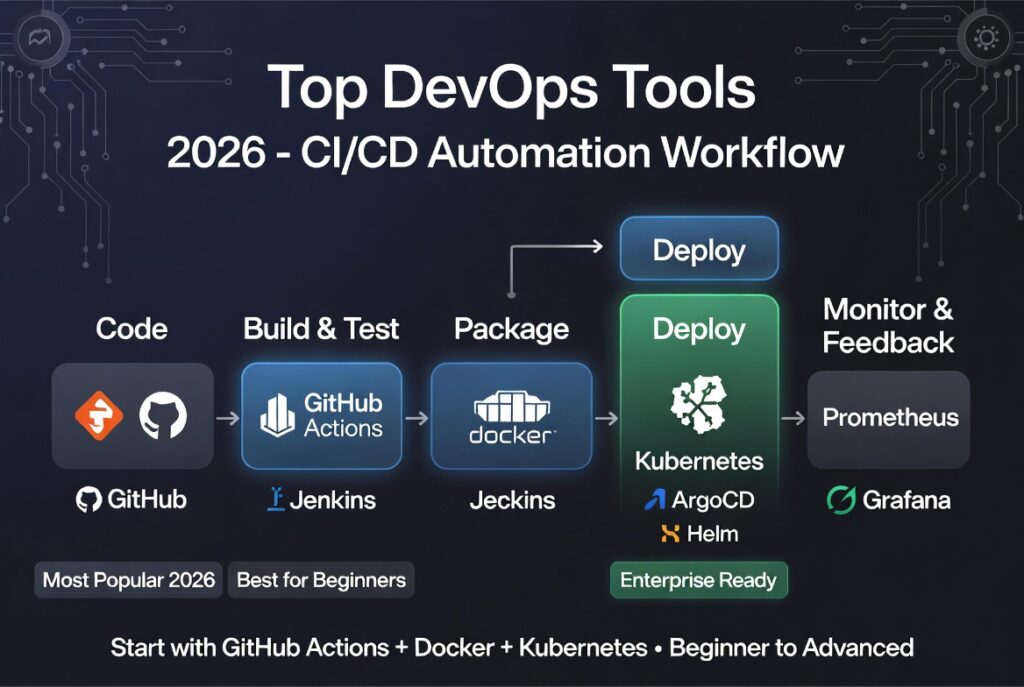
Top 10 DevOps Tools in 2026 (Ultimate List for Developers)
Top DevOps tools in 2026 are essential for modern software development, enabling teams to automate workflows, improve deployment speed, and scale infrastructure efficiently. As software delivery cycles become faster, using the right DevOps tools is no longer optional—it is critical for staying competitive.
This guide covers the top DevOps tools in 2026 used by developers for CI/CD, automation, monitoring, and infrastructure management. Whether you are a beginner or an experienced engineer, these tools will help you build efficient and scalable systems.
If you’re new, start with our
best DevOps tools for beginners guide.
Why Top DevOps Tools in 2026 Matter
Top DevOps tools in 2026 play a crucial role in reducing manual work and increasing software delivery speed. Teams that adopt DevOps practices can release updates faster, fix bugs quickly, and maintain higher reliability.
- Automated deployments and pipelines
- Continuous integration and delivery
- Scalable cloud infrastructure
- Improved collaboration between teams

For a deeper understanding, explore our full
devops automation tools pillar guide.
Top 10 DevOps Tools in 2026
1. Jenkins
Jenkins remains one of the most popular open-source CI/CD tools. It offers thousands of plugins, making it highly flexible for building custom automation pipelines.
Best for: Custom CI/CD pipelines
Pricing: Free (open-source)
2. GitHub Actions
GitHub Actions integrates seamlessly with GitHub repositories, enabling developers to automate testing and deployments directly from their codebase.
Best for: GitHub-native workflows
Pricing: Free tier + usage-based
3. Docker
Docker simplifies application deployment by packaging code into containers. This ensures consistency across development, testing, and production environments.
Best for: Containerization
4. Kubernetes
Kubernetes is the leading container orchestration platform. It automates scaling, deployment, and management of containerized applications.
Best for: Container orchestration
5. Terraform
Terraform enables Infrastructure as Code (IaC), allowing teams to manage infrastructure using configuration files instead of manual processes.
Best for: Infrastructure automation
6. Ansible
Ansible is widely used for configuration management and automation. It simplifies server provisioning and deployment workflows.
Best for: Configuration management
7. Prometheus
Prometheus is a monitoring and alerting toolkit used to track system metrics and ensure performance reliability.
Best for: Monitoring and alerting
8. Grafana
Grafana provides powerful dashboards and visualization for metrics collected from tools like Prometheus.
Best for: Data visualization
9. CircleCI
CircleCI is a cloud-based CI/CD platform that automates builds and deployments with high performance and scalability.
Best for: Fast CI/CD pipelines
10. AWS CodePipeline
AWS CodePipeline integrates seamlessly with AWS services, making it ideal for cloud-native applications.
Best for: AWS-based workflows
How to Choose the Right DevOps Tool
Choosing the right DevOps tool depends on your project requirements, team size, and infrastructure setup. Not every tool fits every workflow, so it’s important to evaluate your needs carefully.
- Project size and complexity
- Cloud provider compatibility
- Team expertise
- Budget constraints
Compare CI/CD platforms in our
Jenkins vs GitHub Actions comparison.
Best DevOps Tool Combinations
Most high-performing teams combine multiple DevOps tools to build efficient workflows. Instead of relying on a single platform, they create integrated pipelines using complementary tools.
- GitHub Actions + Docker + Kubernetes
- Jenkins + Terraform + Ansible
- CircleCI + AWS CodePipeline
This approach improves flexibility, scalability, and reliability across environments.
Future Trends for Top DevOps Tools in 2026
Top DevOps tools in 2026 are evolving rapidly with the integration of artificial intelligence and automation. These trends are shaping the future of software development.
- AI-driven CI/CD pipelines
- Self-healing infrastructure
- Serverless DevOps workflows
- Enhanced security automation (DevSecOps)
As these trends continue, developers who master DevOps tools will gain a strong competitive advantage.
🚀 Download DevOps Automation Roadmap
Want to master DevOps faster? Download our free DevOps Automation Roadmap and learn the exact tools and workflows used by professionals.
Conclusion
Top DevOps tools in 2026 are the backbone of modern software development. From CI/CD automation to infrastructure management, these tools help teams deliver software faster and more reliably.
Whether you’re just starting or scaling enterprise systems, mastering these tools will significantly improve your workflow and career growth.
FAQ
What are the top DevOps tools in 2026?
Top DevOps tools in 2026 include Jenkins, GitHub Actions, Docker, Kubernetes, Terraform, Prometheus, and Grafana.
Which DevOps tool is best for beginners?
GitHub Actions and Docker are beginner-friendly due to ease of use and strong documentation.
Are DevOps tools free?
Many DevOps tools offer free tiers, while advanced features require paid subscriptions depending on usage.

Leave a reply