
Cloud Cost Optimization in 2026: How to Cut AWS, Azure, and GCP Costs Without Hurting Performance
Cloud cost optimization guide for AWS, Azure, and GCP. Learn how businesses reduce cloud spending, optimize Kubernetes workloads, improve FinOps governance, and lower AI infrastructure costs in 2026.
Cloud spending is no longer just an IT concern. In 2026, companies are under pressure to reduce infrastructure waste, improve efficiency, and scale profitably across AWS, Azure, and Google Cloud.
This cloud cost optimization guide explains how modern businesses lower cloud bills, improve resource utilization, and maintain high performance without sacrificing growth.
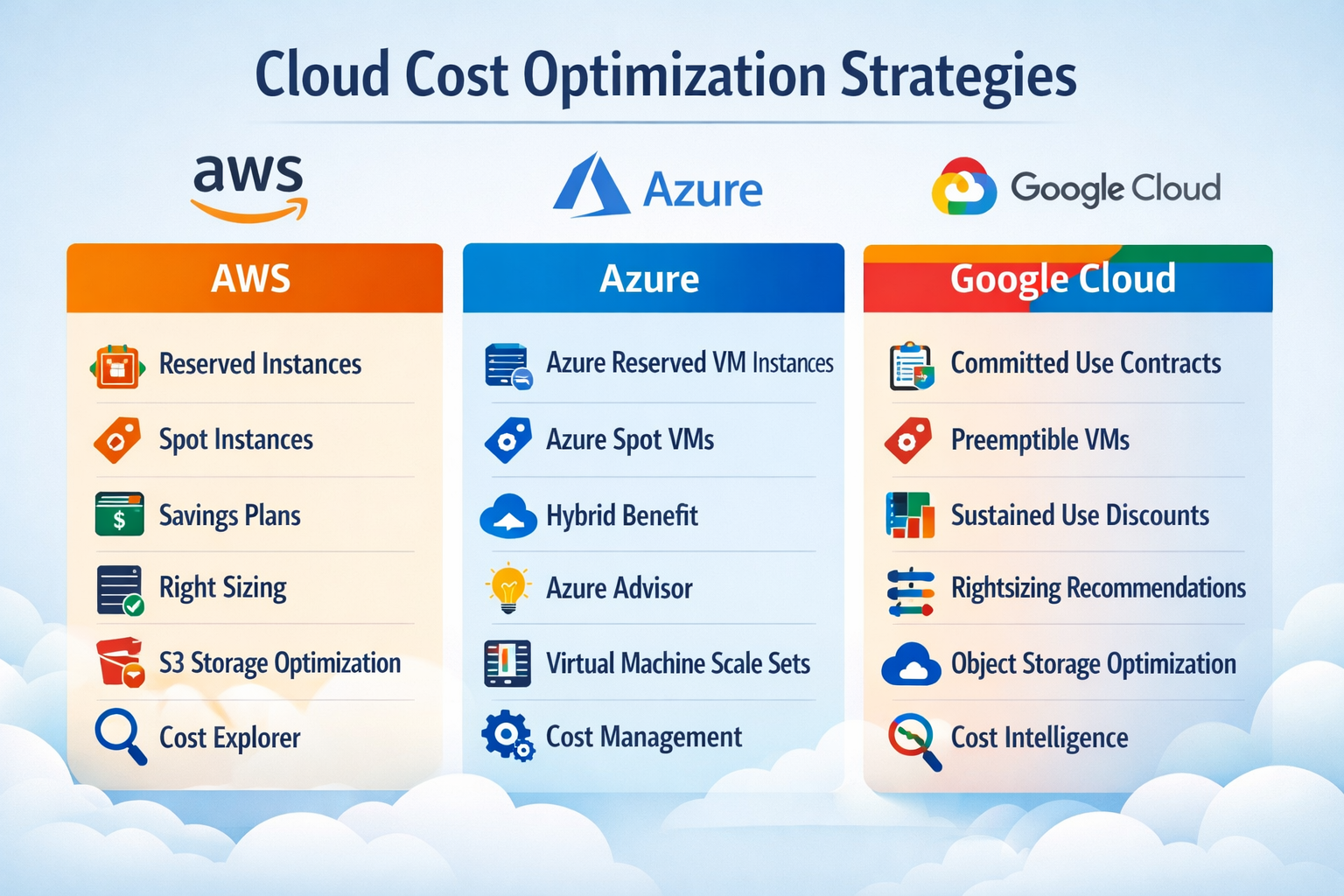 Cloud cost optimization strategies for AWS Azure and Google Cloud
Quick Answer: Cloud cost optimization is the process of reducing AWS, Azure, and Google Cloud infrastructure costs without sacrificing performance, scalability, or reliability. Businesses optimize cloud spending by right-sizing resources, enabling autoscaling, using reserved instances, improving Kubernetes efficiency, eliminating idle workloads, and implementing FinOps cost governance strategies.
Why Cloud Cost Optimization Matters More Than Ever in 2026
Cloud adoption continues to accelerate, but many businesses are still overspending on unused resources, inefficient workloads, and poorly managed scaling.
Without a clear optimization strategy, cloud costs can quietly become one of the largest operational expenses for startups and enterprises alike.
- Reduce unnecessary cloud spending
- Improve workload efficiency
- Prevent resource waste
- Scale applications more sustainably
- Increase return on cloud investments
For many organizations, optimizing cloud costs can reduce infrastructure expenses by 20% to 40% without affecting application performance.
What Is Cloud Cost Optimization?
Cloud cost optimization is the process of analyzing, managing, and reducing cloud infrastructure expenses while maintaining performance, reliability, and scalability.
It involves identifying wasted resources, choosing the right pricing models, automating infrastructure scaling, and continuously monitoring cloud usage across platforms like AWS, Azure, and GCP.
FinOps in 2026: Why Cloud Financial Operations Matter
Cloud cost optimization in 2026 is no longer handled only by DevOps teams. Modern organizations now rely on FinOps — a cloud financial operations framework that combines engineering, finance, and operations to improve cloud spending efficiency.
FinOps helps businesses create accountability around infrastructure costs while maintaining scalability and performance.
A strong FinOps strategy typically includes:
- Cloud cost governance policies
- Real-time cloud billing visibility
- Engineering accountability for infrastructure spending
- Cost allocation and tagging policies
- Budget forecasting and optimization workflows
- Continuous monitoring of cloud resource utilization
As multi-cloud adoption increases, FinOps has become essential for organizations managing AWS, Azure, and Google Cloud environments simultaneously.
Companies that successfully implement FinOps often reduce unnecessary cloud spending while improving infrastructure efficiency across teams.
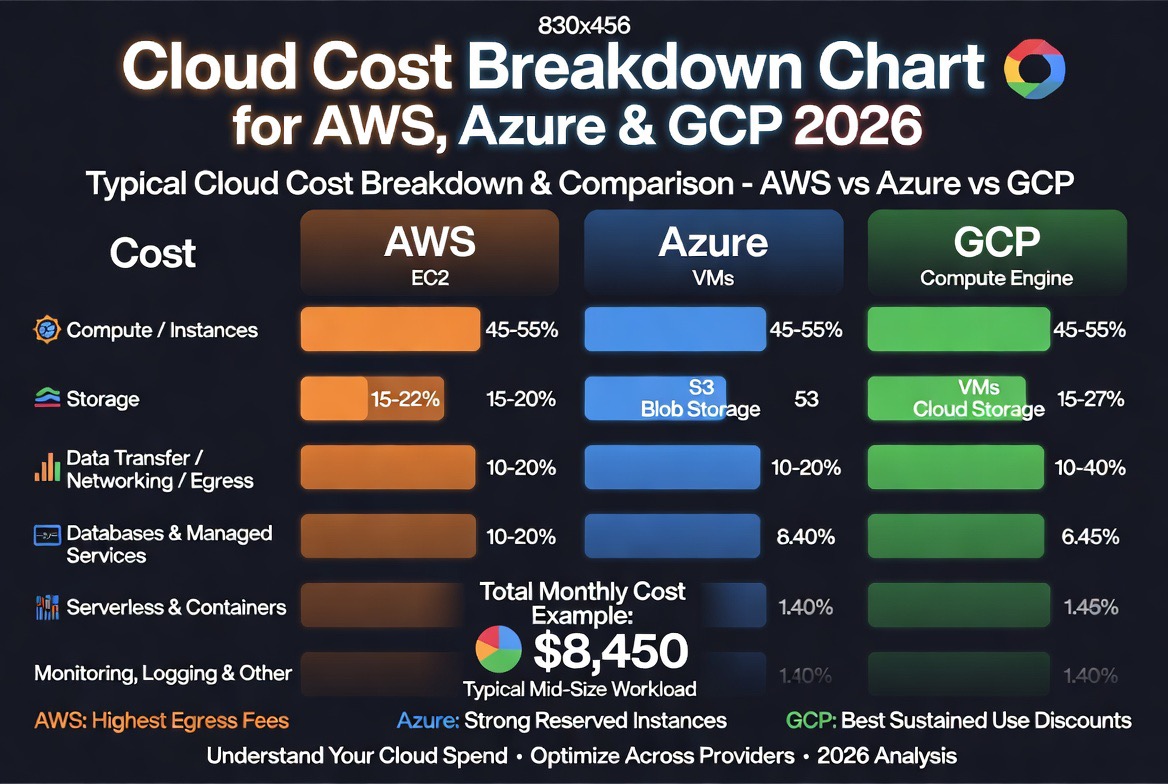 Cloud cost breakdown chart for AWS Azure and GCP
Top Cloud Cost Optimization Strategies That Actually Work
1. Right-Size Your Cloud Resources
One of the biggest causes of cloud waste is overprovisioning.
Many companies run virtual machines, databases, and containers that are far larger than necessary. Right-sizing ensures workloads only consume the resources they actually need.
Focus on:
- Reducing oversized compute instances
- Removing idle storage volumes
- Optimizing Kubernetes clusters
- Downscaling underutilized databases
2. Use Reserved Instances and Savings Plans
On-demand pricing is flexible, but it is also expensive.
AWS Reserved Instances, Azure Reserved VM Instances, and Google Cloud committed-use discounts can significantly reduce long-term compute costs.
Businesses with predictable workloads often save up to 70% by switching from purely on-demand pricing.
3. Enable Auto-Scaling
Auto-scaling automatically adjusts infrastructure capacity based on real-time traffic and workload demand.
This prevents businesses from paying for unused resources during low-traffic periods while still maintaining performance during spikes.
Modern cloud-native applications rely heavily on auto-scaling to balance performance and cost efficiency.
Kubernetes Cost Optimization for EKS, AKS, and GKE
Kubernetes environments are one of the largest sources of cloud waste in modern infrastructure.
Many organizations overprovision Kubernetes clusters, leave idle containers running, or fail to optimize node scaling policies across Amazon EKS, Azure AKS, and Google Kubernetes Engine (GKE).
Effective Kubernetes optimization strategies include:
- Rightsizing pods and node pools
- Using cluster autoscaling
- Reducing idle workloads
- Optimizing container orchestration policies
- Using spot instances for non-critical workloads
- Monitoring cluster utilization with observability tools
Tools like Kubecost, OpenCost, Grafana, and Datadog help engineering teams identify inefficient workloads and reduce container infrastructure costs significantly.
For many businesses, Kubernetes optimization becomes one of the highest-impact areas for long-term cloud cost reduction.
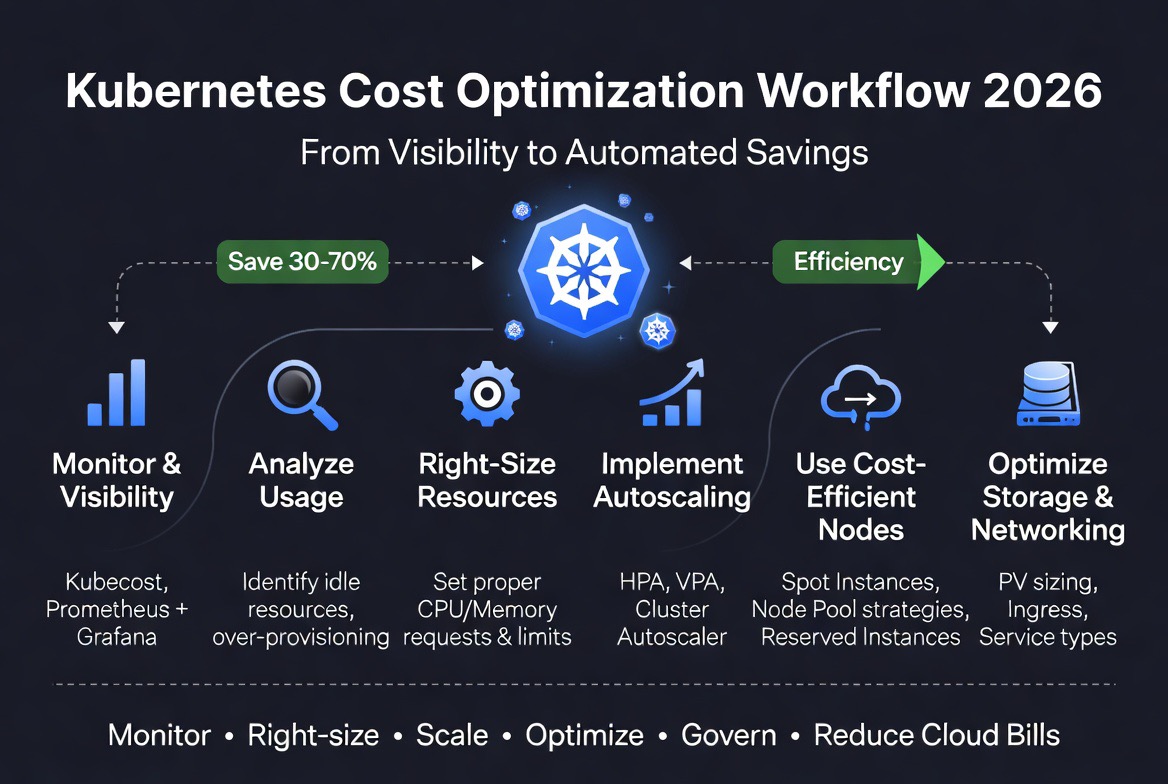 Kubernetes cost optimization workflow
In many Kubernetes environments, idle workloads account for 20–30% of unnecessary cloud spending.
4. Monitor Usage and Set Cost Alerts
Cloud costs become difficult to control when visibility is limited.
Use monitoring tools to track spending patterns, identify anomalies, and detect sudden increases before they become expensive problems.
Important areas to monitor include:
- Unexpected data transfer costs
- Idle resources
- Storage growth
- Container utilization
- Multi-region traffic expenses
5. Eliminate Unused Resources
Unused resources silently increase monthly cloud bills.
Organizations commonly forget inactive virtual machines, unattached storage volumes, old snapshots, and abandoned development environments.
Regular infrastructure audits can uncover thousands of dollars in unnecessary spending.
AWS vs Azure vs GCP: Which Cloud Platform Is Most Cost Effective?
There is no single cheapest cloud provider. Pricing depends on workload type, storage usage, compute requirements, networking, and scaling patterns.
In general:
- AWS offers the largest ecosystem and advanced enterprise tooling
- Azure integrates well with Microsoft environments
- Google Cloud often provides strong pricing for analytics and Kubernetes workloads
For a deeper breakdown, read our full comparison:
AWS vs Azure vs GCP Cost Comparison
AWS Pricing Explained for Beginners
AWS pricing can become complex because of its large number of services and billing models.
Understanding EC2 pricing, storage costs, bandwidth charges, and Savings Plans is essential for avoiding unexpected bills.
Read the beginner guide here:
AWS Pricing for Beginners
Azure Cloud Pricing Review
Microsoft Azure provides flexible enterprise pricing, especially for businesses already using Windows Server, Microsoft 365, and enterprise Microsoft products.
Explore the full breakdown here:
Azure Cloud Pricing Review
Google Cloud Pricing Comparison
Google Cloud Platform is widely known for its strengths in AI infrastructure, analytics, and Kubernetes-based workloads.
Its sustained-use discounts and efficient container tooling can make it cost-effective for modern applications.
Learn more here:
Google Cloud Pricing Comparison
Multi-Cloud Cost Management Challenges
Many enterprises now operate across AWS, Azure, and Google Cloud simultaneously. While multi-cloud strategies improve flexibility and redundancy, they also increase cloud billing complexity.
Without centralized visibility, organizations often struggle with:
- Duplicate infrastructure spending
- Inconsistent cost allocation policies
- Cloud governance fragmentation
- Resource sprawl across providers
- Unexpected networking and egress fees
Modern cloud cost management platforms help organizations monitor spending across providers while improving governance and operational efficiency.
Successful multi-cloud optimization depends heavily on automation, observability, and standardized tagging policies.
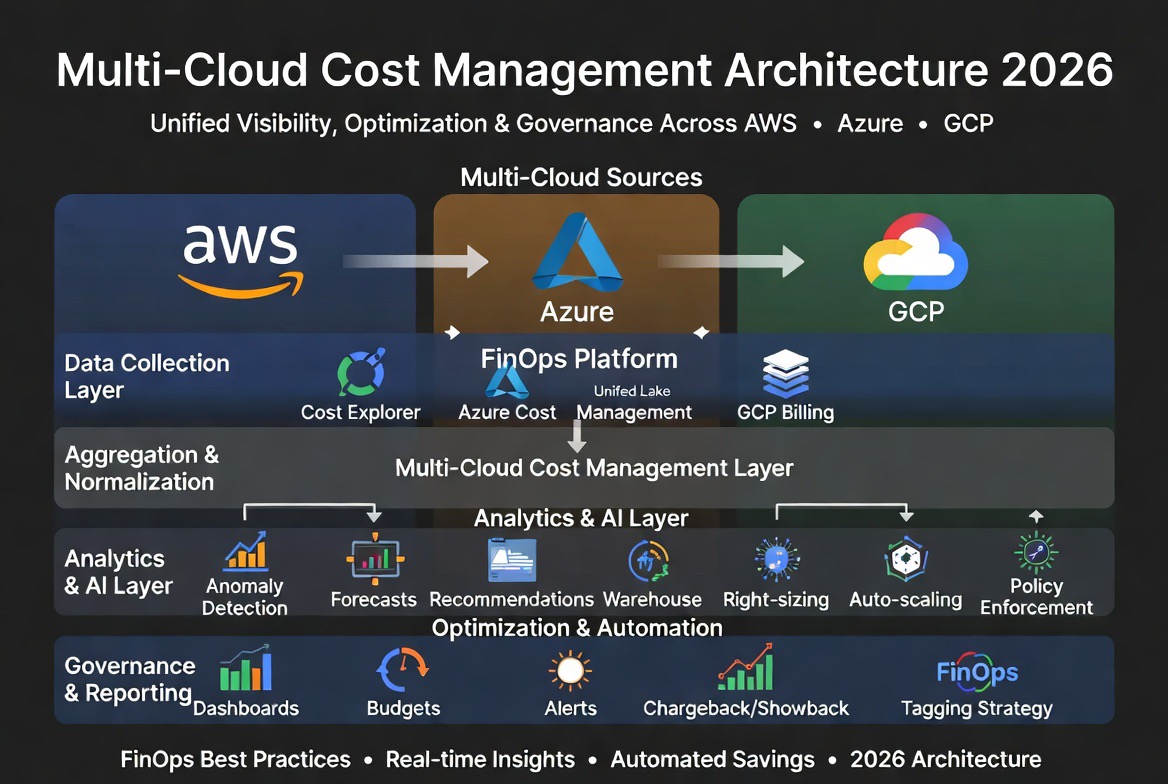 Multi-cloud cost management architecture
AI Infrastructure Costs and GPU Optimization in 2026
AI workloads are rapidly becoming one of the most expensive areas of cloud infrastructure spending.
Large language models, GPU inference systems, vector databases, and AI training pipelines can generate significant monthly costs if not optimized properly.
Modern AI infrastructure optimization strategies include:
- Using serverless inference where possible
- Reducing idle GPU instances
- Optimizing inference workloads
- Using autoscaling GPU clusters
- Separating training and production environments
- Monitoring GPU utilization continuously
GPU pricing on AWS, Azure, and Google Cloud can vary significantly depending on workload requirements and regional availability.
As AI adoption accelerates, controlling inference costs and infrastructure efficiency has become a critical part of modern cloud optimization strategies.
Best Practices for Long-Term Cloud Cost Optimization
- Use cloud cost monitoring and FinOps tools
- Automate infrastructure scaling
- Continuously audit unused resources
- Use spot instances for non-critical workloads
- Optimize storage lifecycle policies
- Review cloud architecture regularly
- Implement budget alerts and governance policies
Common Cloud Cost Mistakes Businesses Make
- Leaving test environments running 24/7
- Ignoring bandwidth and data transfer costs
- Overprovisioning compute resources
- Failing to monitor multi-cloud environments
- Not using reserved pricing models
- Scaling infrastructure manually instead of automatically
Real Cloud Cost Optimization Examples
1. Reducing Database Costs by Moving from Cloud SQL to Neon
One of our projects, Nexa, significantly reduced infrastructure costs by migrating from Google Cloud SQL to Neon.
The move reduced database costs by almost 95% while still maintaining scalability and performance requirements.
This optimization worked because the application workload did not require continuously provisioned database resources at the same scale as traditional managed SQL infrastructure.
For many startups, modern serverless database platforms can dramatically reduce operational cloud expenses.
2. Reducing ML Infrastructure Costs by Over 80%
Another major optimization came from improving how heavy machine learning libraries were loaded in production workloads.
Initially, the application imported large dependencies globally:
import onnxruntime
import cv2
import pandas
Instead, heavy ML libraries were moved into function-level imports:
def remove_bg(image):
    import onnxruntime
    from rembg import remove
This approach was applied across multiple heavy packages including:
- onnxruntime
- rembg
- opencv
- scipy
- numpy
- pytesseract
- PyMuPDF
- pdf2image
- pandas
Additionally, minimum cloud instances were reduced to zero for idle workloads.
Together, these changes reduced infrastructure costs by more than 80% while improving resource efficiency.
This is a strong example of how application-level optimization can dramatically lower cloud costs without reducing functionality.
AWS vs Azure vs GCP Cost Optimization Comparison
| Feature | AWS | Azure | GCP |
|---|---|---|---|
| Savings Plans | Yes | Yes | Limited |
| Spot Instances | Yes | Yes | Yes |
| Kubernetes Strength | Strong | Strong | Excellent |
| AI Infrastructure | Excellent | Strong | Excellent |
| Serverless Ecosystem | Mature | Strong | Strong |
| Enterprise Integration | Strong | Excellent | Moderate |
Top Cloud Cost Optimization Tools
Modern cloud infrastructure teams rely heavily on observability, billing, and FinOps tools to control spending efficiently.
- AWS Cost Explorer — AWS cloud billing and usage analysis
- Azure Cost Management — Microsoft Azure spending visibility and forecasting
- Kubecost — Kubernetes cost monitoring and optimization
- OpenCost — Open-source Kubernetes cost allocation platform
- Datadog — Infrastructure monitoring and cloud observability
- Grafana — Cloud monitoring dashboards and infrastructure analytics
These platforms help engineering teams improve cloud visibility, reduce waste, and optimize infrastructure performance at scale.
Cloud Cost Optimization Checklist
- Remove idle cloud resources
- Enable autoscaling for workloads
- Use reserved instances and committed-use discounts
- Monitor Kubernetes cluster utilization
- Review storage lifecycle policies regularly
- Track cloud billing anomalies
- Audit networking and egress traffic costs
- Optimize serverless workloads
- Implement tagging and cost allocation policies
- Continuously monitor GPU utilization for AI workloads
Common Hidden Cloud Costs Businesses Overlook
Many organizations focus only on compute pricing while ignoring secondary infrastructure costs that significantly increase monthly cloud bills.
Common hidden cloud expenses include:
- Data transfer and egress fees
- NAT gateway charges
- Idle GPU instances
- Snapshot and backup storage
- Cloud logging and observability costs
- Unused Kubernetes resources
- Overprovisioned storage volumes
- Multi-region replication expenses
Identifying hidden infrastructure costs is often one of the fastest ways to reduce overall cloud spending.
Final Thoughts
Cloud cost optimization is no longer optional in 2026. As infrastructure spending increases, businesses that actively manage cloud efficiency gain a significant competitive advantage.
The companies that succeed are not necessarily the ones spending the most on cloud infrastructure — they are the ones using it most efficiently.
Whether you use AWS, Azure, Google Cloud, or a multi-cloud strategy, continuous optimization is essential for controlling costs, improving scalability, and maximizing long-term ROI.
What Is Cloud Cost Optimization?
Cloud cost optimization is the process of reducing cloud infrastructure expenses while maintaining application performance and scalability.
Common cloud optimization strategies include:
- Right-sizing compute resources
- Using reserved instances and savings plans
- Enabling autoscaling
- Optimizing Kubernetes workloads
- Monitoring cloud billing and usage
- Eliminating unused infrastructure
Modern businesses use FinOps frameworks, observability tools, and automation platforms to optimize AWS, Azure, and Google Cloud environments efficiently.
Written by WaleSteve a cloud infrastructure engineer with experience optimizing AWS, GCP, Azure and Kubernetes environments for startups and enterprise workloads.
Frequently Asked Questions
What is cloud cost optimization?
Cloud cost optimization is the process of reducing cloud infrastructure expenses while maintaining performance, scalability, and operational efficiency.
How much can businesses save through cloud optimization?
Many businesses reduce cloud costs by 20% to 40% through right-sizing, automation, reserved pricing models, and removing unused resources.
Which cloud provider is cheapest: AWS, Azure, or GCP?
Pricing depends on workload requirements, storage usage, networking, and scaling needs. AWS, Azure, and Google Cloud each offer competitive pricing models for different use cases.
What are the best ways to reduce cloud costs?
The most effective strategies include right-sizing resources, enabling auto-scaling, using reserved instances, monitoring usage, and removing idle infrastructure.

Leave a reply