
Azure Cloud Pricing Review (2026): Microsoft Azure Cost Breakdown, Hidden Fees, and Optimization Strategies
Azure cloud pricing review for virtual machines, AKS Kubernetes, AI infrastructure, cloud networking, Microsoft licensing, and Azure cost optimization in 2026.
Azure cloud pricing review helps businesses understand Microsoft Azure costs, pricing structures, and optimization strategies for modern cloud infrastructure.

Quick Answer: Is Azure Expensive in 2026?
Microsoft Azure uses a pay-as-you-go pricing model where businesses are charged based on compute usage, storage consumption, networking traffic, AI workloads, and cloud infrastructure services.
Azure can be highly cost effective for organizations already using Microsoft products because of hybrid licensing discounts and enterprise integration benefits.
However, Azure networking charges, AI GPU pricing, and unmanaged infrastructure scaling can significantly increase cloud costs without proper optimization and governance.
Cloud computing costs continue to rise as organizations adopt artificial intelligence, big data analytics, and scalable infrastructure. This Azure cloud pricing review explains how Azure billing works, what affects pricing, and how businesses can optimize cloud spending in 2026.
Organizations evaluating Microsoft Azure should also explore our
cloud cost optimization guide for broader cloud savings strategies.
Why Azure Cloud Pricing Review Matters in 2026
Cloud costs have become one of the largest operational expenses for modern businesses. Without proper management, Azure usage can grow rapidly and create unexpected bills.
This Azure cloud pricing review is important because businesses now depend heavily on:
- AI workloads and machine learning infrastructure
- Cloud storage and backup systems
- Containerized applications
- Remote work environments
- Enterprise SaaS integrations
- Hybrid cloud infrastructure
Companies migrating from on-premise infrastructure often underestimate networking, storage, and monitoring expenses. A strong understanding of Azure pricing helps organizations avoid overspending while maintaining performance.
Why Azure Pricing Feels Complicated for Many Businesses
Azure pricing complexity comes from the platform’s massive enterprise ecosystem and flexible infrastructure options.
Unlike traditional hosting providers with fixed monthly plans, Azure pricing changes dynamically based on usage patterns, networking traffic, storage tiers, infrastructure scaling, and licensing configurations.
Many organizations underestimate:
- Bandwidth and egress fees
- Idle cloud infrastructure
- Monitoring and logging costs
- Kubernetes networking expenses
- Cross-region replication pricing
- AI GPU infrastructure costs
Understanding these hidden variables is essential for long-term Azure cost optimization.
How Microsoft Azure Pricing Works
Microsoft Azure primarily uses a consumption-based pricing model. Businesses pay for the resources they use instead of purchasing physical infrastructure upfront.
Azure pricing generally falls into these categories:
- Compute services
- Storage services
- Networking usage
- Databases
- AI and analytics services
- Security and monitoring tools
Pricing depends on several factors:
- Region and geographic location
- Resource size and performance tier
- Usage duration
- Traffic and bandwidth consumption
- Operating system licensing
- Reserved capacity commitments
Microsoft provides calculators and pricing estimators through the official
Azure Pricing Calculator
.
FinOps and Azure Cloud Governance
Modern enterprises increasingly use FinOps frameworks to manage Azure infrastructure spending efficiently.
FinOps combines engineering, finance, and operations to improve cloud financial accountability and reduce infrastructure waste.
Key Azure FinOps strategies include:
- Resource tagging policies
- Department-level cost allocation
- Cloud billing visibility
- Infrastructure rightsizing
- Budget forecasting
- Usage anomaly detection
- Engineering accountability
Large Azure environments often rely on Azure Cost Management, Datadog, Grafana, and cloud governance automation tools to monitor infrastructure efficiency.

Azure Compute Pricing Analysis
Compute resources are usually the largest portion of Azure cloud spending. Azure Virtual Machines (VMs) are priced based on CPU, memory, storage, and operating system selection.
Virtual Machines
Azure VMs support Windows and Linux workloads. Costs vary depending on VM family and region.
| VM Type | Best Use Case | Relative Cost |
|---|---|---|
| B-Series | Low-traffic workloads | Low |
| D-Series | General applications | Medium |
| F-Series | Compute-intensive apps | Medium-High |
| GPU VMs | AI and machine learning | High |
Businesses running AI workloads should compare Azure GPU pricing against AWS and Google Cloud offerings.
See our full comparison:
AWS vs Azure vs GCP cost comparison.
Azure Kubernetes Service (AKS) Pricing
Azure Kubernetes Service (AKS) is Microsoft’s managed Kubernetes platform for container orchestration and cloud-native applications.
AKS pricing depends on:
- worker node infrastructure
- persistent storage
- networking traffic
- load balancers
- monitoring services
- GPU node pools
Poorly optimized Kubernetes clusters are one of the largest sources of cloud waste in enterprise Azure environments.
Organizations reduce AKS costs through:
- cluster autoscaling
- spot VM node pools
- container rightsizing
- idle workload detection
- GPU optimization
- OpenCost and Kubecost monitoring
AKS remains highly attractive for organizations already invested in Microsoft enterprise ecosystems and hybrid cloud deployments.
Azure Storage Pricing Breakdown
Storage pricing varies based on performance, redundancy, and access frequency.
Blob Storage
Azure Blob Storage is commonly used for backups, media files, analytics data, and AI datasets.
| Storage Tier | Purpose | Cost Level |
|---|---|---|
| Hot | Frequently accessed data | High |
| Cool | Occasional access | Medium |
| Archive | Long-term storage | Low |
One of the most overlooked expenses in Azure storage is outbound data transfer. Businesses transferring large volumes of data between regions or cloud providers may experience higher networking charges.
Managed Disks
Azure managed disks are billed separately from compute resources. SSD storage delivers better performance but costs significantly more than HDD storage.
Businesses should align disk performance with workload requirements to avoid unnecessary costs.

Azure Networking Costs Explained
Networking costs are often underestimated during cloud migration planning.
Azure networking charges may include:
- Outbound bandwidth and egress fees
- Load balancer pricing
- NAT gateway charges
- VPN gateway infrastructure
- Private networking
- Cross-region replication traffic
- CDN usage
- ExpressRoute connectivity
- Kubernetes networking overhead
Organizations using global applications or multi-region deployments should carefully monitor bandwidth consumption.
According to our analysis, networking costs become a major factor once applications scale internationally.
Azure AI and Machine Learning Pricing
Azure has invested heavily in artificial intelligence infrastructure, including OpenAI integrations, machine learning platforms, and AI APIs.
Azure AI pricing depends on:
- GPU usage
- training duration
- inference requests
- API consumption
- model deployment scale
AI workloads can become expensive quickly, especially when using premium GPU infrastructure for large language models.
Developers exploring AI infrastructure should compare pricing across providers and optimize workloads using:
- autoscaling
- batch inference
- serverless AI services
- reserved GPU capacity
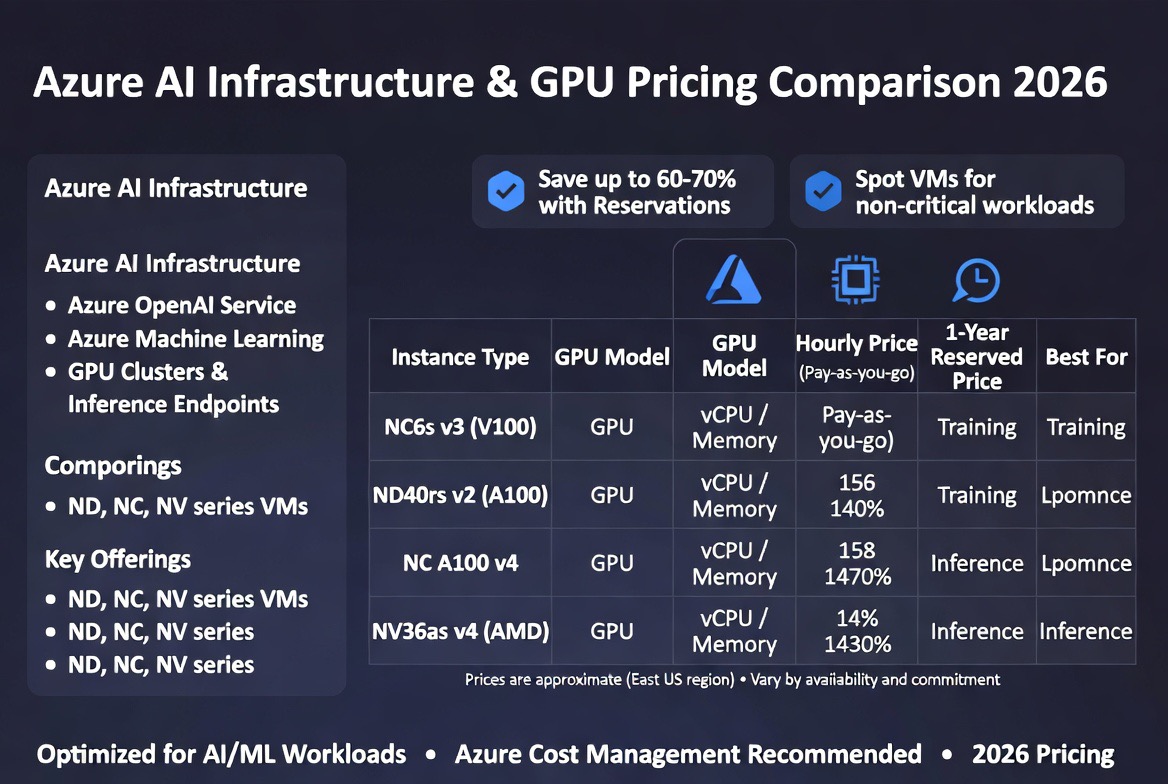
Azure OpenAI and GPU Infrastructure Costs
Azure AI infrastructure pricing has become a major operational consideration as businesses deploy large language models, AI assistants, and GPU-intensive workloads.
Azure OpenAI pricing depends on:
- token usage
- GPU infrastructure
- model deployment scale
- inference requests
- embedding generation
Organizations increasingly optimize Azure AI costs through:
- serverless inference
- GPU autoscaling
- batch processing
- model quantization
- intelligent workload scheduling
Idle GPU infrastructure is now one of the fastest-growing sources of cloud waste across enterprise AI deployments.
Azure Cloud Pricing Review: Pros and Cons
Advantages of Azure Pricing
- strong enterprise licensing benefits
- excellent Microsoft ecosystem integration
- hybrid cloud flexibility
- competitive reserved instance pricing
- broad global infrastructure
Disadvantages of Azure Pricing
- complex billing structure
- networking costs can increase rapidly
- AI GPU resources are expensive
- resource sprawl may lead to overspending
Azure vs AWS vs Google Cloud Pricing Comparison
This Azure cloud pricing review would be incomplete without comparing Azure to competing cloud providers.
| Feature | Azure | AWS | Google Cloud |
|---|---|---|---|
| Enterprise Integration | Excellent | Strong | Moderate |
| AI Infrastructure | Strong | Excellent | Excellent |
| Pricing Complexity | High | High | Moderate |
| Hybrid Cloud | Excellent | Good | Moderate |
| Startup Friendliness | Good | Good | Excellent |
In our analysis, Azure performs especially well for organizations already invested in Microsoft products like Windows Server, Active Directory, and Microsoft 365.
For startups prioritizing analytics and AI experimentation, Google Cloud may offer better simplicity and credits. AWS remains dominant for large-scale infrastructure flexibility.
How to Reduce Azure Cloud Costs
Businesses can dramatically lower Azure expenses with proper optimization strategies.
1. Use Reserved Instances
Reserved instances provide discounts for long-term workloads compared to pay-as-you-go pricing.
2. Implement Autoscaling
Autoscaling prevents overprovisioning and ensures resources scale dynamically based on demand.
3. Remove Unused Resources
Unused virtual machines, snapshots, disks, and public IPs frequently generate hidden costs.
4. Use Azure Hybrid Benefit
Businesses with existing Microsoft licenses can reduce Azure costs significantly using Azure Hybrid Benefit.
5. Monitor Costs Continuously
Azure Cost Management tools provide visibility into spending patterns and optimization opportunities.
Microsoft documentation:
Azure Cost Management Documentation
Real Cloud Cost Optimization Examples
Reducing Database Costs by Nearly 95%
One production workload significantly reduced infrastructure spending after migrating from Google Cloud SQL to Neon.
The application did not require permanently provisioned database infrastructure, making serverless database scaling substantially more cost efficient.
The migration reduced operational database costs by almost 95%.
Reducing Machine Learning Infrastructure Costs by Over 80%
Another optimization focused on reducing idle compute costs caused by globally loaded machine learning dependencies.
Initially, heavy ML libraries were loaded globally:
import onnxruntime
import cv2
import pandas
The architecture was optimized by lazy-loading dependencies only when required:
def remove_bg(image):
    import onnxruntime
    from rembg import remove
Combined with reducing minimum cloud instance counts to zero during idle periods, infrastructure costs dropped by more than 80%.
These examples show that architecture optimization often has a larger financial impact than cloud provider pricing alone.
E-E-A-T Analysis: Is Azure Worth the Cost?
From our analysis of enterprise cloud deployments, Azure provides strong value for businesses operating within the Microsoft ecosystem.
Organizations using Microsoft 365, Active Directory, Windows Server, and enterprise Microsoft licensing often achieve better operational efficiency with Azure compared to migrating to unfamiliar ecosystems.
However, Azure pricing complexity can become challenging for smaller teams without cloud governance expertise.
Our recommendation:
- Choose Azure for enterprise integration and hybrid cloud
- Choose AWS for maximum flexibility and ecosystem depth
- Choose GCP for analytics-heavy or startup environments
Cost optimization success depends more on governance and monitoring than the provider itself.
Decision Guide: Who Should Use Azure?
| Business Type | Recommendation |
|---|---|
| Enterprise companies | Strong fit |
| Microsoft-based organizations | Excellent fit |
| AI startups | Moderate fit |
| Small businesses | Good with optimization |
| Hybrid cloud deployments | Excellent fit |
Download Free Cloud Cost Optimization Checklist
Learn how businesses reduce Azure, AWS, and GCP costs with our cloud optimization framework.
Direct download:
Download the checklist here
Best Azure Cost Optimization Tools
- Azure Cost Management — cloud billing analysis and forecasting
- Azure Advisor — infrastructure optimization recommendations
- Kubecost — AKS Kubernetes cost monitoring
- OpenCost — open-source Kubernetes cost allocation
- Datadog — cloud observability and infrastructure monitoring
- Grafana — metrics dashboards and infrastructure analytics
Related Cloud Pricing Guides
- AWS pricing for beginners
- Google cloud pricing comparison
- cloud cost optimization guide
- AWS vs Azure vs GCP cost comparison
- Tech News
Azure Cost Optimization Checklist
- Enable autoscaling
- Delete idle virtual machines
- Optimize AKS clusters
- Review Blob Storage lifecycle policies
- Monitor networking and egress traffic
- Use Reserved Instances
- Enable Azure Hybrid Benefit
- Track GPU infrastructure utilization
- Implement tagging policies
- Audit cloud spending regularly
Conclusion
This Azure cloud pricing review shows that Microsoft Azure offers competitive enterprise cloud pricing with strong hybrid infrastructure capabilities and deep Microsoft ecosystem integration.
Azure pricing can become complex at scale, but organizations that implement governance, automation, and cost optimization strategies can significantly reduce cloud spending.
Businesses evaluating cloud platforms should compare workloads, pricing models, and long-term operational goals before choosing a provider.
Written by WaleSteve a cloud infrastructure engineer with experience optimizing Azure and Kubernetes environments for startups and enterprise workloads.
FAQ
What is Azure cloud pricing?
Azure cloud pricing is a pay-as-you-go model where businesses are charged based on compute, storage, networking, and cloud resource usage.
Is Azure cheaper than AWS?
Azure can be cheaper for organizations already using Microsoft licenses, while AWS may provide better flexibility for certain workloads.
How can businesses reduce Azure costs?
Businesses can reduce Azure costs by using reserved instances, autoscaling, monitoring tools, and removing unused resources.
Does Azure charge for bandwidth?
Yes. Azure charges for outbound data transfer and networking usage depending on region and traffic volume.

Leave a reply