Essential DevOps Automation Tools Developers Must Use in 2026
DevOps automation tools are transforming how developers build, test, and deploy software by streamlining workflows and reducing manual intervention. In 2026, automation is no longer optional—it is a core requirement for scalable and efficient software delivery.
Modern engineering teams rely on automation to ship features faster, reduce downtime, and maintain system reliability. Whether you’re working in a startup or enterprise environment, adopting the right DevOps tools can dramatically improve productivity.

If you’re new to the ecosystem, start with our guide on
best DevOps tools for beginners.
Why DevOps Automation Tools Matter in 2026
The software development lifecycle has become increasingly complex. Applications now run across distributed systems, cloud environments, and microservices architectures. Without automation, managing these systems would be inefficient and error-prone.
- Faster deployments with continuous delivery pipelines
- Reduced human error through automated testing
- Improved scalability using infrastructure automation
- Better collaboration between development and operations teams
Organizations that embrace DevOps automation tools can release updates multiple times per day while maintaining high system stability.
What Are DevOps Automation Tools
DevOps automation tools are platforms that help automate various stages of the software development lifecycle, including integration, testing, deployment, monitoring, and infrastructure provisioning.
These tools reduce manual work and enable developers to focus on building features rather than managing systems.
Categories of DevOps Automation Tools
CI/CD Tools
Continuous Integration and Continuous Deployment (CI/CD) tools automate code integration, testing, and deployment processes.
- Jenkins – Open-source automation server
- GitHub Actions – Native CI/CD for GitHub repositories
- GitLab CI/CD – Built-in DevOps pipeline tool
Compare two major tools here:
Jenkins vs GitHub Actions comparison.
Infrastructure as Code Tools
Infrastructure as Code (IaC) tools allow developers to define and manage infrastructure using code instead of manual configuration.
- Terraform
- AWS CloudFormation
- Ansible
Official resources:
Terraform,
AWS CloudFormation
Containerization and Orchestration Tools
Containerization tools package applications and dependencies into portable environments, while orchestration tools manage deployment at scale.
- Docker
- Kubernetes
Learn more:
Kubernetes official docs
Monitoring and Logging Tools
Monitoring tools provide visibility into application performance and infrastructure health.
- Prometheus
- Grafana
- Datadog
Top DevOps Automation Tools Developers Use
Here are some of the most widely used DevOps automation tools in 2026:
- Jenkins for flexible CI/CD pipelines
- GitHub Actions for seamless repository integration
- Docker for containerization
- Kubernetes for orchestration
- Terraform for infrastructure automation
- Prometheus for monitoring
Each tool serves a specific purpose, and most teams use a combination of these tools to build a complete DevOps pipeline.
How DevOps Automation Improves Productivity
Automation significantly reduces repetitive tasks such as testing, deployment, and environment setup. Developers can focus on writing code instead of managing infrastructure.
Key benefits include:
- Faster release cycles
- Improved code quality
- Reduced downtime
- Better team collaboration
Automation also ensures consistency across environments, reducing bugs caused by configuration differences.
Choosing the Right DevOps Automation Tools
Selecting the right tools depends on your project requirements, team size, and infrastructure.
- Choose CI/CD tools based on repository platform
- Use Kubernetes for large-scale deployments
- Adopt Terraform for multi-cloud infrastructure
- Select monitoring tools based on performance needs
For cost considerations, explore:
DevOps automation tools pricing.
DevOps Tools Review
For a detailed breakdown of tools and real-world performance, check our full:
DevOps tools review.
Future Trends in DevOps Automation
The future of DevOps automation tools is being shaped by AI and cloud-native technologies.
- AI-driven DevOps pipelines
- Self-healing infrastructure systems
- Serverless deployment models
- Automated security testing (DevSecOps)
AI-powered tools will soon predict failures, optimize deployments, and automatically fix issues before they impact users.
Real-World Use Cases of DevOps Automation Tools
DevOps automation tools are used across industries to streamline development workflows and improve operational efficiency. From startups to enterprise organizations, automation plays a critical role in delivering reliable software at scale.
1. Continuous Integration and Deployment Pipelines
One of the most common use cases of devops automation tools is building CI/CD pipelines. These pipelines automatically test and deploy code whenever changes are made to a repository.
For example, when a developer pushes code to GitHub, tools like Jenkins or GitHub Actions can automatically:
- run unit tests
- build the application
- deploy to staging or production
This reduces manual work and ensures faster release cycles.
2. Infrastructure Automation
Infrastructure as Code tools like Terraform allow developers to provision servers, networks, and databases automatically.
Instead of manually configuring servers, teams define infrastructure in code, making deployments consistent and repeatable.
3. Monitoring and Incident Response
Monitoring tools such as Prometheus and Grafana help teams track system performance in real time. Alerts can be triggered automatically when issues arise, allowing teams to respond quickly.
Advanced DevOps automation tools can even trigger automated recovery actions, reducing downtime.
4. Microservices and Container Management
Modern applications often use microservices architecture. Tools like Docker and Kubernetes automate the deployment, scaling, and management of these services.
This enables teams to manage complex systems efficiently without manual intervention.
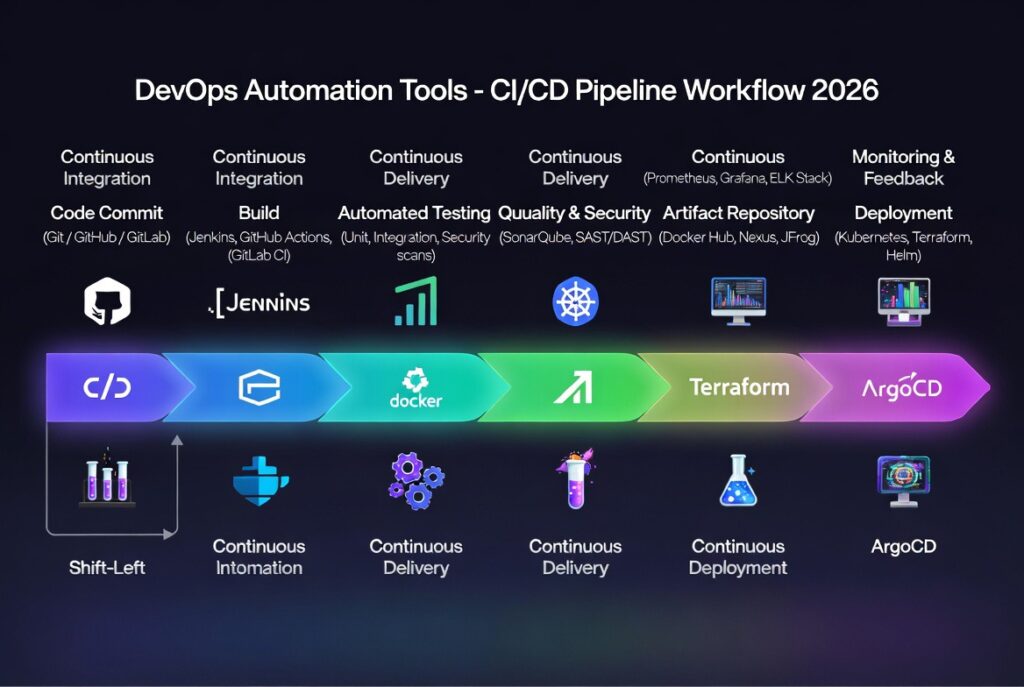
DevOps Automation Workflow Explained
Understanding how devops automation tools fit into a workflow is key to maximizing their value.
A typical DevOps automation workflow includes:
- code development
- continuous integration
- automated testing
- deployment
- monitoring and feedback
Each stage is powered by automation tools that reduce friction and improve speed.
For example:
- GitHub Actions handles CI/CD
- Docker packages applications
- Kubernetes manages deployment
- Prometheus monitors performance
This integrated workflow ensures seamless software delivery from development to production.
Common Challenges When Using DevOps Automation Tools
While devops automation tools provide significant benefits, they also come with challenges that teams must address.
1. Tool Overload
With hundreds of DevOps tools available, teams often struggle to choose the right combination. Using too many tools can increase complexity rather than reduce it.
2. Learning Curve
Many DevOps tools require specialized knowledge. Developers must invest time in learning how to configure and manage these tools effectively.
3. Integration Issues
Not all tools integrate seamlessly. Poor integration can create bottlenecks in the development pipeline.
4. Security Risks
Automation introduces new security challenges. Misconfigured pipelines or credentials can expose sensitive data.
To mitigate these risks, teams should adopt DevSecOps practices and automate security checks.
Best Practices for Using DevOps Automation Tools
To get the most out of devops automation tools, developers should follow best practices that improve efficiency and reliability.
- start with simple pipelines and scale gradually
- automate testing early in the development cycle
- use version control for infrastructure
- monitor performance continuously
- implement security checks in pipelines
These practices help teams build robust automation systems that scale with their applications.
DevOps Automation Tools for Different Team Sizes
The choice of devops automation tools depends heavily on team size and project complexity.
Small Teams and Startups
Startups typically prefer simple and integrated tools like GitHub Actions and Docker because they are easy to set up and require minimal infrastructure.
Mid-Sized Teams
Growing teams often adopt tools like Jenkins and Kubernetes to handle more complex workflows and scaling requirements.
Enterprise Organizations
Large organizations use advanced DevOps automation tools with custom pipelines, multi-cloud infrastructure, and enterprise-grade monitoring solutions.
Cloud Providers and DevOps Automation
Cloud platforms play a major role in DevOps automation by providing managed services and tools.
- AWS offers CodePipeline and CloudFormation
- Google Cloud provides Cloud Build and deployment tools
- Microsoft Azure includes Azure DevOps services
Official resources:
AWS DevOps,
Azure DevOps
These platforms simplify infrastructure management and integrate seamlessly with other DevOps tools.
DevOps Automation and AI Integration
Artificial intelligence is increasingly being integrated into devops automation tools. AI-powered systems can analyze logs, predict failures, and optimize performance automatically.
Examples include:
- AI-driven monitoring systems
- automated anomaly detection
- predictive scaling
This evolution is transforming DevOps into a more intelligent and autonomous process.
How to Get Started with DevOps Automation Tools
If you’re new to DevOps, the best approach is to start small and build gradually.
- learn version control with Git
- set up a simple CI/CD pipeline
- containerize applications using Docker
- deploy using cloud platforms
- monitor performance with basic tools
As your skills grow, you can adopt more advanced DevOps automation tools and workflows.
For beginners, explore:
best devops tools for beginners.
DevOps Automation Tools Ecosystem in 2026
The DevOps ecosystem continues to expand, with new tools emerging to address specific challenges.
Key trends include:
- low-code DevOps platforms
- AI-assisted automation
- serverless deployment tools
- enhanced security automation
Developers who stay updated with these trends will be better positioned to build scalable and efficient systems.
Conclusion
DevOps automation tools are essential for modern development teams aiming to scale efficiently and deliver software faster. By adopting the right combination of tools, developers can streamline workflows, reduce errors, and improve system reliability.
As the industry evolves, teams that invest in automation early will gain a significant competitive advantage.
FAQ
What are DevOps automation tools?
DevOps automation tools streamline development workflows including CI/CD, testing, deployment, and infrastructure management.
Which DevOps tool is best?
Popular tools include Jenkins, GitHub Actions, Docker, and Kubernetes depending on use case.
Are DevOps tools free?
Many DevOps tools offer free tiers, but enterprise features require paid plans.

Leave a reply