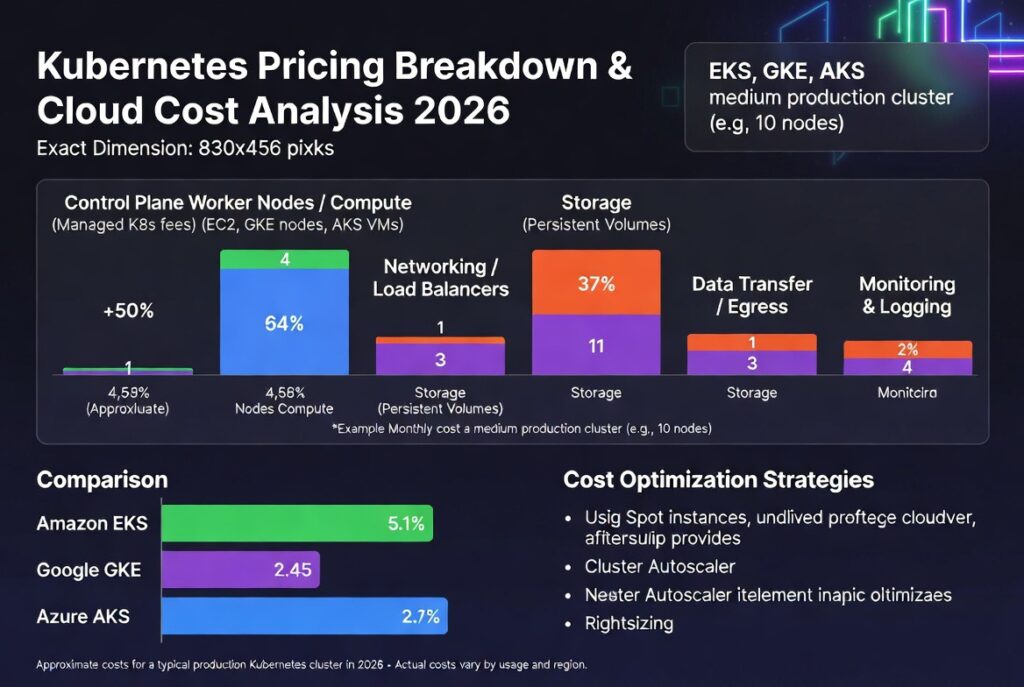
Kubernetes Pricing Guide: Cost Breakdown for 2026
Kubernetes pricing in 2026 varies significantly depending on infrastructure, cloud provider, and workload complexity. While Kubernetes itself is open-source, the total cost of running clusters can increase quickly due to compute, storage, networking, and operational overhead.
Understanding kubernetes pricing is essential for developers, startups, and enterprises looking to optimize cloud spending while maintaining scalability and performance.

If you’re new to DevOps, start with our
devops automation tools guide.
Google Cloud Pricing Comparison.
What Is Kubernetes Pricing
Kubernetes pricing refers to the total cost of running containerized applications using Kubernetes clusters. Although Kubernetes is free, organizations pay for the infrastructure and services required to operate it.
- Compute resources (nodes, VMs)
- Storage (persistent volumes)
- Networking and load balancing
- Managed Kubernetes services
- Monitoring and logging tools
Factors Affecting Kubernetes Pricing
Several key factors influence kubernetes pricing, and understanding them helps you control costs effectively.
1. Compute Resources
The biggest cost driver is compute power. Kubernetes clusters run on virtual machines or physical servers, and pricing depends on CPU, RAM, and usage duration.
2. Cluster Size
Larger clusters with more nodes increase costs. Scaling horizontally improves performance but also increases infrastructure spending.
3. Storage Costs
Persistent storage volumes used by applications add to overall costs, especially for data-heavy workloads.
4. Networking
Ingress traffic, load balancers, and inter-zone data transfer fees can significantly impact kubernetes pricing.
5. Managed vs Self-Managed
Managed Kubernetes services simplify operations but come with additional fees compared to self-hosted clusters.
Cloud Provider Kubernetes Pricing Comparison
Major cloud providers offer managed Kubernetes services, each with its own pricing model.
Amazon EKS (AWS)
Amazon EKS pricing charges per cluster (~$0.10/hour) plus underlying EC2, storage, and networking costs.
Google Kubernetes Engine (GKE)
Google GKE pricing includes a free tier, then charges per cluster and node usage.
Azure Kubernetes Service (AKS)
Azure AKS pricing offers free control plane with charges applied to compute and storage resources.
👉 In most cases, the control plane cost is small compared to compute infrastructure costs.
Kubernetes Pricing Example (Real Cost Breakdown)
Here’s a typical kubernetes pricing scenario for a small production setup:
- 3 nodes (2 vCPU, 8GB RAM each)
- Managed Kubernetes cluster
- Load balancer + storage
Estimated monthly cost:
- Compute: $150–$300
- Storage: $20–$50
- Networking: $10–$40
- Cluster fee: $70–$75
Total: ~$250–$450/month
Costs scale quickly as traffic and workloads increase.
Get Free Cloud Credits for Kubernetes
Running Kubernetes can get expensive — but these cloud providers offer generous free credits to get started:
- AWS Activate — Get up to $100,000 in credits for startups
Apply for AWS Credits →
- Google Cloud Credits — Free $300 trial for new users
Claim GCP Free Credits →
- Microsoft Azure Credits — Free credits + Kubernetes (AKS) free control plane
Start with Azure Free →
👉 Using cloud credits can reduce your Kubernetes pricing to near $0 in the early stages.
📈 Typical Kubernetes Architecture (Cost Breakdown View)
Understanding how Kubernetes components interact helps you identify where costs come from.
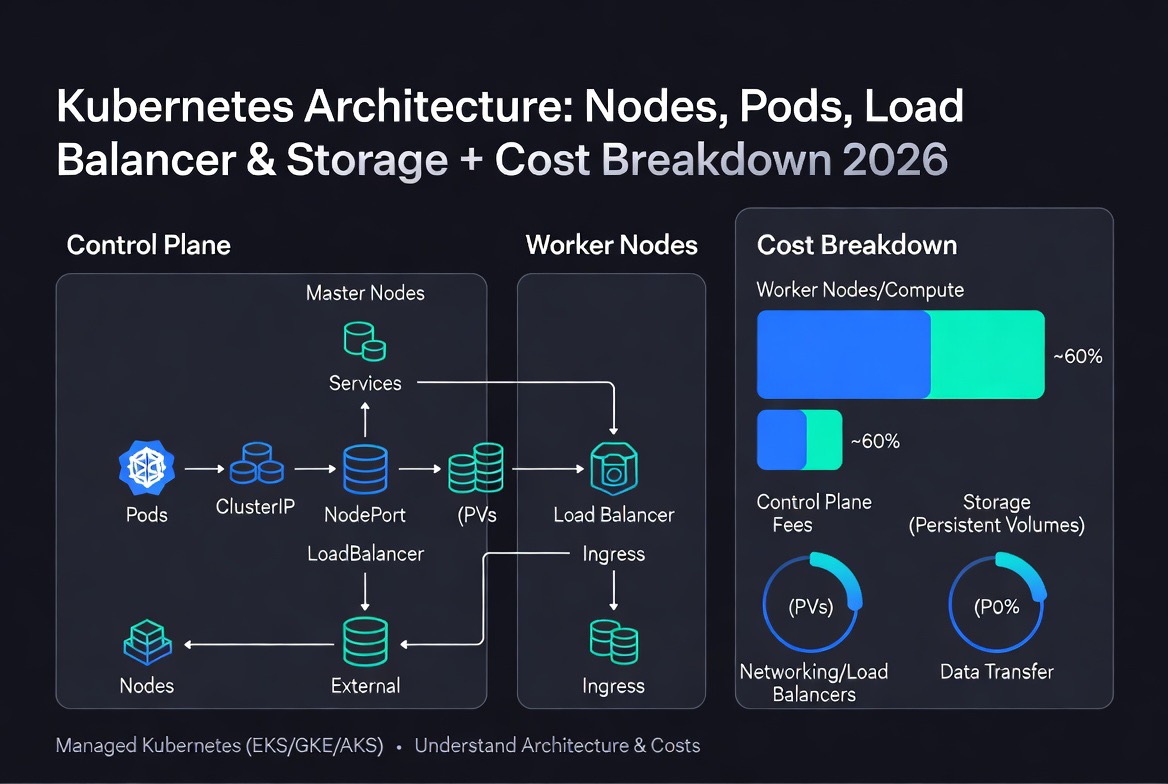
- Nodes: Primary compute cost (biggest expense)
- Pods: Workloads running on nodes
- Load Balancer: Adds networking cost
- Storage Volumes: Persistent data cost
- Control Plane: Free or fixed cost depending on provider
💡 Insight: Most Kubernetes pricing comes from nodes — optimizing compute usage gives the biggest savings.
Where Does Kubernetes Cost the Most?
Top Kubernetes cost drivers:
- Compute (nodes): 60–80%
- Storage: 10–20%
- Networking: 5–15%
- Control plane: minimal
Optimizing compute usage (auto-scaling, spot instances) delivers the highest cost savings.
Kubernetes Pricing vs Traditional Hosting
Compared to traditional hosting, kubernetes pricing can be higher initially but offers better scalability and automation.
- Traditional hosting: lower cost, less flexibility
- Kubernetes: higher cost, better scalability
- Long-term: Kubernetes often reduces operational overhead
Compare architectures in our
Docker vs Kubernetes comparison.
How to Reduce Kubernetes Pricing
Optimizing kubernetes pricing is critical for maintaining cost efficiency.
1. Use Auto-Scaling
Scale nodes dynamically based on workload demand to avoid over-provisioning.
2. Spot Instances
Use cheaper spot or preemptible instances to reduce compute costs significantly.
3. Optimize Resource Requests
Avoid allocating more CPU and memory than necessary for containers.
4. Use Managed Services Wisely
Managed Kubernetes reduces operational overhead but should be balanced with cost considerations.
5. Monitor Usage
Use tools like
Prometheus and
Grafana to track resource usage and optimize spending.
Is Kubernetes Pricing Worth It
Kubernetes pricing is justified for teams that require scalability, automation, and high availability.
It is ideal for:
- Growing startups
- Microservices architectures
- High-traffic applications
- Cloud-native platforms
However, for small projects or simple applications, Kubernetes may be overkill and more expensive than necessary.
Best Kubernetes Setup for Cost Efficiency
Cheapest Kubernetes setup in 2026:
- Use managed control plane (AKS free tier)
- Deploy on spot instances
- Enable auto-scaling
- Use minimal node configuration
This setup can reduce kubernetes pricing by up to 40–60%.
Reduce Your Kubernetes Costs
Want to optimize your Kubernetes infrastructure and reduce cloud spending? Learn the exact strategies used by high-performance DevOps teams.
Conclusion
Kubernetes pricing in 2026 depends heavily on infrastructure choices, scaling strategy, and optimization practices. While Kubernetes offers unmatched flexibility and scalability, managing costs requires careful planning and monitoring.
By understanding cost drivers and applying optimization strategies, teams can fully leverage Kubernetes without overspending.
Insight: High-performing systems often achieve costs as low as $0.000001–$0.00001 per request.
What Is a Good Kubernetes Cost Per Request?
Typical benchmarks:
- Excellent: $0.000001 – $0.00001 per request
- Average: $0.00001 – $0.0001 per request
- High: $0.0001+ per request
Lower cost per request means better infrastructure efficiency and higher ROI.
Reduce Your Cost Per Request
Want to lower your Kubernetes cost per request? Learn how top teams optimize performance and reduce infrastructure waste.
FAQ
Is Kubernetes free to use?
Kubernetes is open-source and free, but you pay for infrastructure, compute, and cloud services required to run it.
How much does Kubernetes cost per month?
Kubernetes pricing typically ranges from $200 to $1,000+ per month depending on cluster size and usage.
Which cloud provider is cheapest for Kubernetes?
Azure AKS often offers the lowest entry cost due to its free control plane, while AWS and GCP provide more advanced features.

Leave a reply