AI Agent Ecosystems: OpenAI, Anthropic, Google, and Microsoft Compared in 2026
AI agent ecosystems are becoming one of the most important battlegrounds in artificial intelligence in 2026. OpenAI, Anthropic, Google, and Microsoft are no longer competing only on which company has the strongest AI model. They are increasingly competing on the infrastructure surrounding those models: agent frameworks, tools, APIs, memory, identity, security, observability, interoperability, cloud infrastructure, and enterprise applications.
A few years ago, choosing an AI platform was relatively simple. You compared models, pricing, context windows, benchmarks, and perhaps an API.
Agentic AI changes the decision.
Once an AI system can search the web, read files, call APIs, execute code, interact with software, access business systems, communicate with other agents, and perform actions on behalf of a user, the model becomes only one component of a much larger system.
That is why the competition between OpenAI, Anthropic, Google, and Microsoft deserves to be viewed as an ecosystem competition rather than a simple model comparison.
And there is an important lesson for developers and businesses: the best AI agent ecosystem is not necessarily the one with the best model. It is the one that gives your particular agents the right combination of intelligence, tools, control, security, integrations, economics, and operational infrastructure.
Quick Answer: Which AI Agent Ecosystem Is Best in 2026?
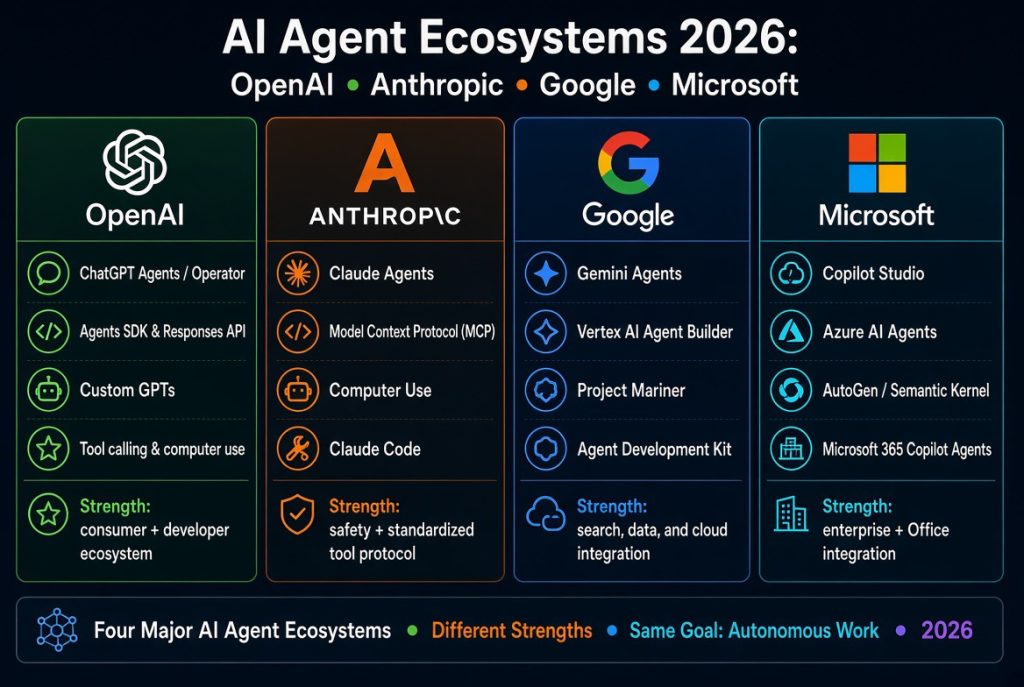
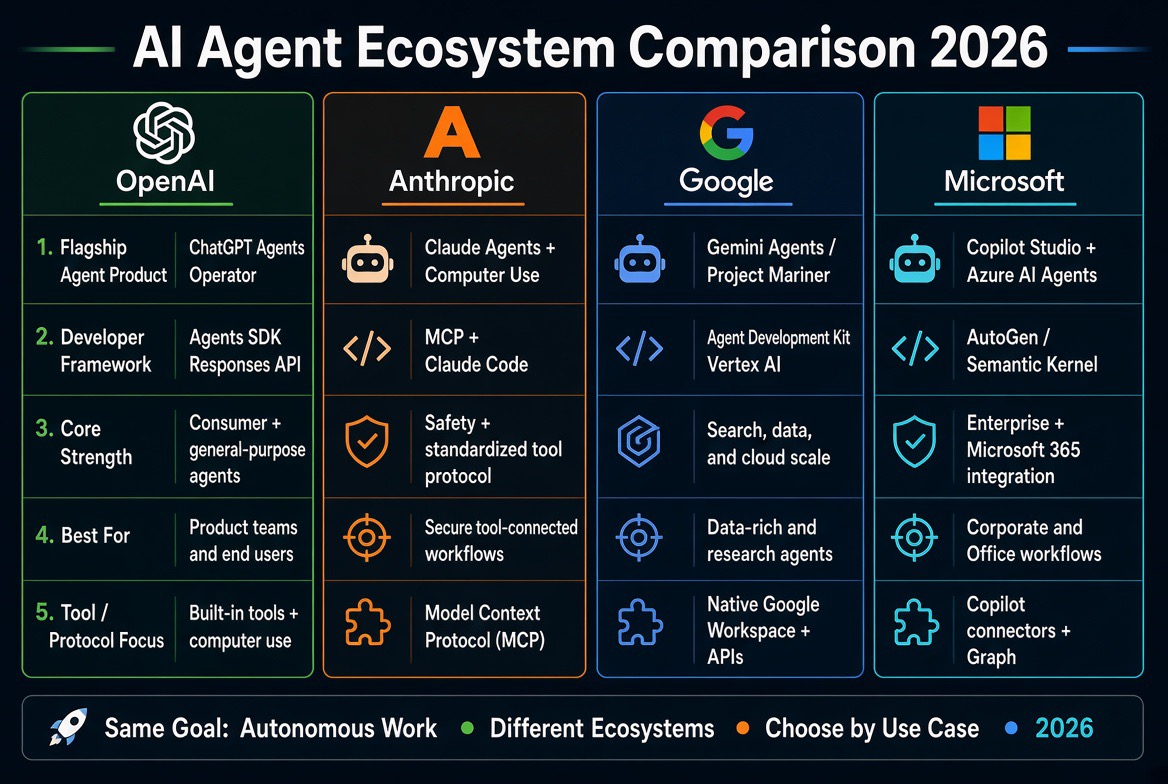
There is no universal winner among OpenAI, Anthropic, Google, and Microsoft. OpenAI is particularly strong for developers building agent-powered applications and products. Anthropic stands out for coding, long-running workflows, Claude-based agents, and the growing MCP ecosystem. Google has a strong position in cloud-native, multimodal, and multi-agent architectures through Gemini, Google Cloud, ADK, and A2A. Microsoft has a major advantage in enterprise deployment through Azure, Microsoft 365, Entra, GitHub, Copilot, and Microsoft Foundry.
For most organizations, the right question is not “Which company has the smartest AI?” but “Which ecosystem gives our agents the tools, permissions, integrations, security, observability, and deployment environment they actually need?”
What Are AI Agent Ecosystems?
An AI agent ecosystem is the collection of models, APIs, agent frameworks, tools, integrations, runtimes, memory systems, identity controls, security mechanisms, observability platforms, and applications that allow AI agents to perform useful tasks.
A useful way to think about it is this:
The model is the reasoning engine. The ecosystem is everything that allows that reasoning engine to interact with the real world.
A traditional AI application might send a prompt to a model and display the response.
An agentic application can involve a much longer chain:
- Receive a goal from the user.
- Understand the request.
- Break the goal into smaller tasks.
- Retrieve information.
- Call one or more tools.
- Evaluate the results.
- Decide what to do next.
- Interact with another system or agent.
- Produce an output or take an action.
- Record what happened for monitoring and auditing.
That requires considerably more infrastructure than a simple chatbot.
What Can an AI Agent Ecosystem Include?
- Foundation models and reasoning models
- Agent SDKs and frameworks
- Tool calling
- Web search
- File and document retrieval
- Code execution
- Computer-use capabilities
- Databases and knowledge stores
- Memory and state management
- APIs and business applications
- MCP servers and connectors
- Agent-to-agent communication
- Authentication and authorization
- Secrets management
- Sandboxes
- Tracing and observability
- Evaluation systems
- Guardrails and policy enforcement
- Cloud infrastructure
- Enterprise governance
This distinction is important because a model that performs extremely well in a benchmark may still be a poor choice for a production agent if the surrounding platform makes deployment, monitoring, security, or integration unnecessarily difficult.
Why AI Agent Ecosystems Matter in 2026
The AI industry is moving from systems that primarily generate information toward systems that can plan, use tools, execute tasks, and participate in workflows.
That shift changes the buying decision.
When an AI only answers questions, model quality dominates the conversation.
When an AI agent can access a company’s CRM, modify records, send emails, query financial systems, write code, deploy infrastructure, or initiate transactions, the surrounding architecture becomes just as important as the model.
Developers therefore need to consider questions such as:
- Which models are available?
- How good is the agent framework?
- Which tools are built in?
- Can I bring my own tools?
- How does the platform handle memory?
- How are agents authenticated?
- How are permissions enforced?
- Can humans approve high-impact actions?
- How can agent execution be traced?
- How easily can I evaluate agent performance?
- Can agents communicate with other agents?
- Can I use models from multiple vendors?
- What happens when an agent fails?
- Can the architecture scale beyond a prototype?
- How difficult will it be to migrate away later?
These are architecture questions, not simply model questions.
AI Agent Ecosystem at a Glance
| Ecosystem | Primary Strength | Agent Orientation | Best Fit | Key Differentiator |
|---|---|---|---|---|
| OpenAI | Developer platform and agent tooling | Application and tool-using agents | Startups, SaaS, developers | Integrated agent building blocks |
| Anthropic | Coding, reasoning and agent workflows | Long-running technical and knowledge work | Developers and technical teams | Claude Code, Agent SDK and MCP |
| Gemini, cloud and interoperability | Multi-agent and cloud-native systems | Google Cloud organizations | ADK and A2A ecosystem | |
| Microsoft | Enterprise infrastructure | Business and workplace agents | Large organizations | Azure, Microsoft 365, Entra and Foundry |
This is a useful starting point, but it should not be interpreted as a permanent ranking. Agent platforms are evolving quickly, and the best option depends heavily on the workload.
OpenAI Agent Ecosystem
OpenAI’s agent strategy is increasingly focused on providing developers with the building blocks required to create agents without forcing every engineering team to assemble the entire infrastructure stack themselves.
The Responses API became a major foundation for this approach, providing access to tool-oriented capabilities such as web search, file search, and computer use. OpenAI also introduced the Agents SDK for orchestrating agent workflows, including handoffs, guardrails, and tracing. ([OpenAI](https://openai.com/index/new-tools-for-building-agents/?utm_source=chatgpt.com))
By 2026, OpenAI has also pushed the Agents SDK further toward agents that can work with files, execute commands, edit code, use tools, and operate within controlled sandbox environments. ([OpenAI](https://openai.com/index/the-next-evolution-of-the-agents-sdk/?utm_source=chatgpt.com))
That matters because one of the biggest challenges in agent development is not simply getting an LLM to reason. It is creating a safe environment in which the model can actually do something.
OpenAI’s Major Agent Building Blocks
- Responses API
- Agents SDK
- Built-in web search
- File search and retrieval
- Computer-use capabilities
- Tool calling
- MCP connectivity
- Tracing and observability
- Guardrails
- Sandbox execution
- Multi-agent orchestration
OpenAI has also added support for remote MCP servers in the Responses API, giving developers another way to connect agents with external tools and data. ([OpenAI](https://openai.com/index/new-tools-and-features-in-the-responses-api/?utm_source=chatgpt.com))
Where OpenAI Is Strong
- Developer experience: OpenAI has made agent development increasingly accessible through integrated APIs and SDKs.
- Built-in tools: Developers can access capabilities without building every integration from scratch.
- Agent orchestration: The Agents SDK provides abstractions for workflows, handoffs, guardrails and tracing.
- Computer use: OpenAI’s agent stack can support workflows that require interaction with computer environments.
- MCP support: OpenAI has embraced an increasingly important interoperability layer.
- Sandboxing: Controlled execution environments are becoming an important part of OpenAI’s agent architecture.
OpenAI’s Strategic Advantage
OpenAI’s biggest advantage may be the distance between idea and working application.
For a startup or SaaS team, reducing the amount of infrastructure that has to be designed before an agent can do useful work is extremely valuable.
There is a major difference between telling a team, “Build an agent,” and giving that team a model, tools, orchestration primitives, tracing, guardrails, and execution environments.
That does not eliminate engineering work, but it can significantly reduce the amount of plumbing required.
Where OpenAI May Be Less Attractive
The trade-off is that developers who want deep control over infrastructure, model routing, execution environments, or vendor independence may prefer a more modular architecture.
This is a recurring pattern across all four ecosystems: convenience and integration are valuable, but they can also increase dependency on a particular vendor’s way of doing things.
Read our complete guide to AI agents for business.
Explore the official OpenAI API platform.
Anthropic Agent Ecosystem
Anthropic’s agent ecosystem has developed a particularly strong identity around coding, technical work, long-running tasks, and tool-connected AI.
Claude Code is perhaps the clearest expression of that strategy. Rather than treating AI as a question-and-answer interface, the model can operate within a development environment and work through larger technical objectives.
Anthropic has also made the Claude Agent SDK an important part of its developer ecosystem. The SDK provides infrastructure for building agents using the same general agentic approach behind Claude Code, including capabilities such as tools, subagents, permissions and longer-running workflows.
In 2026, the Claude Agent SDK has also expanded into other developer environments. For example, Apple integrated the SDK into Xcode, enabling more autonomous coding workflows inside the development environment. ([Anthropic](https://www.anthropic.com/news/apple-xcode-claude-agent-sdk?p=2&utm_source=chatgpt.com))
Where Anthropic Is Strong
- Coding agents: Claude has established a strong presence in software-development workflows.
- Long-running work: Anthropic has focused heavily on agents capable of working through substantial tasks.
- Agent SDK: Developers can build applications around the same general architecture powering Claude Code.
- MCP: Anthropic created the Model Context Protocol, an open standard for connecting AI applications with tools and data.
- Developer workflows: Claude’s ecosystem is particularly attractive to technically sophisticated teams.
MCP: One of Anthropic’s Most Important Contributions
One of the most consequential things Anthropic has contributed to the agent ecosystem is arguably not a model.
It is MCP.
The Model Context Protocol provides a standardized way for AI applications to connect to external tools and data sources. Anthropic describes MCP as an open protocol for connecting applications to the systems where data lives. ([Claude Platform Docs](https://docs.anthropic.com/en/docs/mcp?utm_source=chatgpt.com))
The significance becomes obvious when you consider the alternative.
Without common protocols, every AI application potentially needs a custom integration for every database, SaaS application, development tool, or internal service it wants to access.
That approach does not scale particularly well.
MCP moves the ecosystem toward reusable interfaces.
Importantly, MCP is no longer simply an Anthropic-only concept. Anthropic announced in late 2025 that it was donating MCP to the Agentic AI Foundation under the Linux Foundation, with support from organizations including OpenAI, Google and Microsoft. ([Anthropic](https://www.anthropic.com/news/donating-the-model-context-protocol-and-establishing-of-the-agentic-ai-foundation?aff=47lw0&utm_source=chatgpt.com))
That makes MCP strategically interesting because interoperability standards can reduce the importance of which individual vendor originally created a protocol.
Read our complete MCP (Model Context Protocol) explained guide.
Read Anthropic’s original MCP announcement.
Google Agent Ecosystem
Google’s AI agent ecosystem is broader than a single agent product.
It spans Gemini, Google Cloud, Agent Development Kit, agent interoperability, data infrastructure, enterprise services, and multimodal AI.
This makes Google potentially very attractive to organizations that already operate heavily within Google Cloud.
The Agent Development Kit (ADK) is particularly important because it gives developers a framework for building agentic and multi-agent applications.
Google has continued expanding ADK, including examples where agents written in different programming languages collaborate through the Agent2Agent protocol. ([Google Developers Blog](https://developers.googleblog.com/build-cross-language-multi-agent-team-with-google-agent-development-kit-and-a2a/?utm_source=chatgpt.com))
Where Google Is Strong
- Gemini: Google’s model family provides the intelligence layer.
- Google Cloud: Organizations can build around established cloud infrastructure.
- ADK: Provides an agent-development framework.
- Multimodal capabilities: Google’s ecosystem is well suited to applications involving multiple data types.
- Multi-agent architecture: Google is strongly invested in systems involving multiple specialized agents.
- Interoperability: A2A is designed to allow agents to communicate across organizational and technical boundaries.
Google and the Rise of Agent-to-Agent Communication
One of Google’s most interesting strategic bets is Agent2Agent (A2A).
The premise is straightforward: agents should be able to communicate and collaborate without requiring every agent to have been built by the same vendor or framework.
Google introduced A2A in 2025 as a protocol intended to support interoperability between agents. ([Google Developers Blog](https://developers.googleblog.com/en/a2a-a-new-era-of-agent-interoperability/?utm_source=chatgpt.com))
The importance of this becomes clearer in an enterprise environment.
Imagine a company with:
- A customer-service agent
- A finance agent
- A procurement agent
- A legal agent
- A data-analysis agent
- A software-development agent
- A cybersecurity agent
There is little reason for every one of those agents to be built by the same team, use the same programming language, or run on the same model.
A2A-style interoperability can therefore become important as organizations move from individual agents toward agent networks.
This is one reason our guide to agent-to-agent communication is an important companion to this article.
Read Google’s official introduction to A2A.
Microsoft Agent Ecosystem
Microsoft’s strategy is arguably the most obviously enterprise-centric of the four.
Microsoft is not starting from an empty environment. It already has an enormous installed base of business software, identity systems, cloud infrastructure, collaboration tools and developer platforms.
That includes:
- Azure
- Microsoft 365
- Microsoft Teams
- GitHub
- Microsoft Entra
- Copilot
- Microsoft Foundry
- Power Platform
This gives Microsoft an important advantage: agents can potentially be deployed closer to the systems businesses already use every day.
Microsoft Foundry
Microsoft Foundry Agent Service is a managed platform for building, deploying and scaling AI agents. Microsoft’s current documentation describes support for different development approaches, supported models from the Foundry catalog, tools, lifecycle management, and enterprise security, privacy and compliance capabilities. ([Microsoft Learn](https://learn.microsoft.com/en-us/azure/foundry/agents/overview?utm_source=chatgpt.com))
This is significant because Microsoft is positioning the agent layer as part of a broader enterprise AI operating environment.
Where Microsoft Is Strong
- Enterprise integration: Microsoft already sits deeply inside many organizations.
- Identity: Microsoft Entra provides an established identity foundation.
- Governance: Enterprise teams can integrate agent deployments with broader security and governance processes.
- Microsoft 365: Agents can operate closer to documents, collaboration and business workflows.
- Azure: Organizations can deploy agent workloads within an established cloud environment.
- Model flexibility: Foundry supports models from a broader ecosystem rather than requiring every workload to use one model family.
Microsoft’s Strategic Advantage
Microsoft’s strongest argument is not necessarily that it has the best individual AI model.
Its strongest argument is that businesses already have infrastructure there.
If a company already uses Microsoft 365, Azure, Entra, GitHub and related enterprise services, adding AI agents to that environment may be considerably easier than building an entirely separate AI estate.
That is a powerful distribution advantage.
Explore Microsoft Foundry Agent Service.
Explore Microsoft Copilot Studio.
OpenAI vs Anthropic vs Google vs Microsoft: The Real Difference
Comparing these companies purely by model benchmark misses the more important strategic difference.
Each company appears to be positioning agents slightly differently.
| Company | Agent Philosophy | Strongest Use Case | Strategic Advantage |
|---|---|---|---|
| OpenAI | Agents as applications | AI-powered products and workflows | Integrated developer tooling |
| Anthropic | Agents as capable workers | Coding and complex knowledge work | Claude Code, Agent SDK and MCP |
| Agents as an interconnected network | Cloud-native and multi-agent systems | Gemini, ADK and A2A | |
| Microsoft | Agents as enterprise infrastructure | Business and workplace automation | Azure, Microsoft 365 and Foundry |
OpenAI: Agents as Applications
OpenAI’s approach makes particular sense if you are a developer building an AI-first application.
You have a product. You need an agent inside that product. You need models, tools, orchestration and execution capabilities. You would prefer not to build every component yourself.
OpenAI’s ecosystem is designed to shorten that journey.
Its 2025 agent tooling introduced the Responses API, built-in tools and Agents SDK, while its subsequent development has moved toward more capable execution environments and long-running tasks. ([OpenAI](https://openai.com/index/new-tools-for-building-agents/?utm_source=chatgpt.com))
Anthropic: Agents as Capable Workers
Anthropic’s ecosystem feels particularly focused on giving AI the ability to perform substantial technical or professional work.
Claude Code is an obvious example.
The interesting shift is from:
“Ask the AI to write this function.”
to:
“Here is the repository, here is the objective, investigate the problem and implement the solution.”
That difference is fundamental to agentic computing.
The longer the task, the more important context management, permissions, tools, memory, failure recovery, evaluation and observability become.
Google: Agents as an Interconnected Network
Google’s ADK and A2A investments suggest a future in which businesses operate collections of specialized agents instead of relying on one giant general-purpose agent.
That approach aligns naturally with multi-agent systems.
A procurement agent does not necessarily need to understand every customer-support workflow. A finance agent does not need access to every engineering tool.
Specialization can make systems easier to reason about, although it also introduces additional communication, security and orchestration complexity.
Google’s own developer guidance now discusses a growing collection of agent protocols, reflecting how quickly this architecture is developing. ([Google Developers Blog](https://developers.googleblog.com/en/developers-guide-to-ai-agent-protocols/?utm_source=chatgpt.com))
Microsoft: Agents as Enterprise Infrastructure
Microsoft’s approach is perhaps easiest to understand if you think about the enterprise IT environment.
Employees already have identities.
Documents already exist.
Business processes already exist.
Applications already exist.
Cloud infrastructure already exists.
The challenge is connecting intelligent agents to those systems without creating a security and governance nightmare.
That makes identity, policy, compliance, observability and administration extremely important.
Microsoft is therefore competing not just to provide the “brain” of an agent but to become part of the operating environment in which enterprise agents live.
MCP vs A2A: Why Agent Protocols Matter
Two terms are particularly important when discussing the future of AI agent ecosystems: MCP and A2A.
They should not be treated as competing versions of exactly the same technology.
| Protocol | Primary Purpose | Simple Explanation |
|---|---|---|
| MCP | Connecting AI applications to tools and data | How an agent accesses capabilities and context |
| A2A | Agent interoperability | How agents communicate and collaborate |
Think of MCP as solving more of the agent-to-tool/data problem, while A2A addresses more of the agent-to-agent problem.
These layers can complement each other.
Imagine a financial research agent.
It communicates with another specialized financial-analysis agent using an agent interoperability protocol. The financial-analysis agent then uses MCP-connected tools to access approved databases and internal systems.
That produces a much more modular architecture than building one enormous agent with direct access to everything.
The practical implication is important: interoperability may become one of the biggest defenses against AI vendor lock-in.
Our Take: The Model Is No Longer the Whole Product
This is where our view differs from a lot of conventional AI comparisons.
It is tempting to ask which model is smarter.
For agents, we think that is increasingly the wrong first question.
If an agent cannot safely access the systems it needs, model intelligence does not matter.
If an agent can access everything but cannot be monitored, that intelligence becomes a liability.
If an agent performs a task brilliantly but costs five times more than an alternative that is 95% as effective, the benchmark winner may not be the business winner.
And if an organization cannot migrate its tools, data or workflows without rebuilding everything from scratch, the platform’s convenience today may become technical debt tomorrow.
Our view is that the real product is the complete agent runtime, not the model alone.
This is why developers should evaluate:
- Model quality
- Tool reliability
- Agent orchestration
- Identity and permissions
- Memory and state
- Observability
- Evaluation
- Security
- Interoperability
- Cost per completed task
- Operational complexity
- Vendor portability
Which AI Agent Ecosystem Should Developers Choose?
The right choice depends on the workload rather than brand popularity.
Choose OpenAI If…
- You are building an AI-first SaaS product.
- You want an integrated developer experience.
- You need tool-using agents inside an application.
- You want built-in agent capabilities instead of assembling everything yourself.
- You want access to OpenAI’s agent tooling and APIs.
Choose Anthropic If…
- Your workload involves substantial coding.
- You need long-running technical workflows.
- You want to build around Claude’s agent-oriented tooling.
- MCP is an important part of your integration strategy.
- Your engineering team values direct control over agent workflows.
Choose Google If…
- You already rely heavily on Google Cloud.
- Your application is highly multimodal.
- You are building multi-agent systems.
- You want to explore agent interoperability.
- You need cloud-native infrastructure for agent workloads.
Choose Microsoft If…
- You are building for a large enterprise.
- Your organization already uses Azure and Microsoft 365.
- Identity, governance and compliance are major priorities.
- You want managed agent infrastructure.
- Your agents need to interact with existing Microsoft business systems.
Should Businesses Use Multiple AI Agent Ecosystems?
Yes, in some cases.
In fact, a multi-vendor strategy could become increasingly normal.
A company might use:
- Microsoft for enterprise identity and governance.
- Anthropic for a specialized software-development agent.
- OpenAI for a customer-facing AI product.
- Google Cloud for a multimodal analytics workflow.
There is nothing inherently wrong with that architecture.
But there is a cost.
Every additional platform introduces another set of APIs, billing models, security policies, monitoring systems, SDKs and operational dependencies.
Multi-vendor AI can reduce model lock-in while simultaneously increasing operational complexity.
That is why interoperability standards matter so much.
AI Agent Ecosystem Lock-In: The Risk Developers Should Think About Now
Vendor lock-in is not a new problem, but agentic AI introduces another layer of it.
Imagine spending two years building:
- Agent prompts
- Tool integrations
- Memory systems
- Evaluation pipelines
- Guardrails
- Agent workflows
- Custom connectors
- Monitoring infrastructure
If all of those components depend heavily on one vendor’s proprietary architecture, moving later could be expensive.
Developers should therefore separate the parts of the system that genuinely need vendor-specific capabilities from the parts that can remain portable.
Open protocols such as MCP can help with this. So can conventional engineering practices such as clean service boundaries, API abstractions, independent data layers and model-routing architectures.
The goal is not to eliminate vendor dependencies completely.
That is often unrealistic.
The goal is to make sure your business architecture does not become inseparable from a single AI provider.
Security Is the Part You Should Not Ignore
The more capable the agent becomes, the more important security becomes.
A chatbot that generates an incorrect answer is inconvenient.
An agent that incorrectly modifies a database, sends confidential information, approves a transaction, changes infrastructure or exposes credentials is a completely different problem.
This is why AI agent security needs to be treated as a systems problem.
Organizations should examine:
- Authentication
- Authorization
- Least-privilege permissions
- Tool allowlists
- Input validation
- Output validation
- Human approval workflows
- Data isolation
- Secrets management
- Prompt-injection defenses
- Agent-to-agent trust
- Audit logging
- Runtime monitoring
- Red-team testing
OWASP’s Top 10 for Agentic Applications 2026 specifically addresses security risks associated with autonomous and agentic AI systems. OWASP describes the framework as a practical starting point for builders, defenders and decision-makers working with agents that plan, act and make decisions across workflows.
For a broader AI security perspective, the OWASP GenAI LLM Top 10 2026 provides current guidance on security risks affecting applications powered by large language models.
MITRE’s ATLAS knowledge base is another useful resource because it maps adversary tactics and techniques involving AI-enabled and agentic systems.
For a deeper treatment, read our guide to AI agent security risks.
Agent Risk Should Be Measured by Capability, Not Just Intelligence
One of the most useful ways to evaluate an agent is to ask:
“What can this agent actually do if it makes a mistake?”
| Agent Type | Typical Access | Risk Level |
|---|---|---|
| Public research agent | Public web information | Low |
| Internal knowledge agent | Company documents and knowledge bases | Moderate |
| Business workflow agent | CRM, email, ticketing and internal systems | High |
| Financial or infrastructure agent | Payments, production systems or administrative controls | Critical |
This is why “autonomous” should not automatically mean “unrestricted.”
The safest production architectures usually constrain what the agent can see, what it can call, where it can execute, and which actions require approval.
How to Evaluate an AI Agent Ecosystem Before Choosing It
1. Start With the Workflow
Do not start by choosing a model.
Write down what the agent actually needs to accomplish.
For example:
“Read incoming customer requests, identify the issue, check the CRM, determine the appropriate response, draft an answer, and escalate unusual cases.”
Now you can identify the required tools, data sources, permissions and approval points.
2. Identify Required Integrations
List every system the agent needs to access.
- CRM
- ERP
- Database
- Cloud storage
- Ticketing system
- Internal APIs
- External APIs
Then determine how each ecosystem connects to those systems.
3. Evaluate Security Before Convenience
Ask how identities, permissions, secrets and tool calls are controlled.
This is particularly important for agents that can take actions rather than merely generate recommendations.
4. Test Observability
You should be able to answer questions such as:
- What did the agent do?
- Why did it call this tool?
- What data did it retrieve?
- Which model produced the decision?
- Which user initiated the task?
- How long did the workflow take?
- What failed?
- How much did the task cost?
If your team cannot answer those questions, production troubleshooting will become painful.
5. Measure Cost Per Completed Task
Do not evaluate pricing only by token cost.
An agent may make multiple model calls, invoke tools, retrieve documents, execute code and run for several minutes.
The meaningful business metric is therefore often cost per successfully completed workflow, not simply cost per million tokens.
AI Agent Evaluation Is Becoming as Important as Model Evaluation
Traditional model evaluation often asks whether an AI produces the correct answer.
Agent evaluation needs to ask something broader.
Did the agent:
- Choose the correct tool?
- Use the tool correctly?
- Respect permissions?
- Avoid unnecessary actions?
- Recover from failures?
- Stop when the task was complete?
- Escalate when uncertain?
- Protect sensitive information?
- Complete the workflow within the required budget?
This is a major shift.
An agent can produce a technically correct final answer while still behaving badly during the process.
For example, it might retrieve ten times more data than necessary, expose sensitive information in intermediate logs, call an unnecessary API, or repeatedly retry an expensive operation.
Therefore, agent evaluation needs to consider the trajectory, not just the final response.
Security and Governance: Why NIST Matters
Organizations that are serious about deploying agents should also think beyond individual technical controls.
The NIST AI Risk Management Framework provides a broader framework for managing AI risks across design, development, deployment, use and evaluation.
NIST’s Generative AI Profile provides additional guidance focused specifically on generative AI risks.
The practical lesson is that agent governance should not be treated as something added after deployment.
Organizations should determine:
- Who owns the agent?
- What is its approved purpose?
- What data can it access?
- What tools can it use?
- What actions can it take?
- What actions require human approval?
- How is performance evaluated?
- How is activity logged?
- What happens when the agent behaves unexpectedly?
- Who can disable it?
This becomes increasingly important as businesses move from experimenting with AI to deploying agents in operational environments.
Multi-Agent Systems Add Another Layer of Complexity
A single agent can be complicated.
A collection of agents can be considerably more complicated.
In a multi-agent system, you now have to think about:
- Agent identity
- Agent discovery
- Inter-agent communication
- Message validation
- Delegation
- Trust boundaries
- Permissions
- Shared memory
- Failure propagation
- Observability
For example, if a customer-support agent asks a finance agent to issue a refund, what prevents a compromised or confused support agent from requesting a refund above the permitted limit?
The finance agent needs its own authorization policy.
This is a crucial architectural principle:
Never assume that because one agent is trusted, everything it requests from another agent should automatically be trusted.
Read our deeper guide to multi-agent systems and agent-to-agent communication.
MCP Security Still Matters
Standardization does not automatically equal security.
MCP can make integrations more reusable, but developers still need to evaluate the servers, tools, permissions and data exposed through those connections.
A malicious or poorly designed integration can create problems even when the underlying protocol is standardized.
This is why MCP deployments should still use:
- Authentication
- Authorization
- Tool allowlists
- Scoped credentials
- Input validation
- Output validation
- Logging
- Dependency review
- Network controls
The protocol can standardize communication; it cannot replace good security architecture.
What the Winning AI Agent Ecosystem May Look Like
The long-term winner may not be the company with the single most capable model.
It may be the company that creates the most useful combination of:
- Intelligent models
- Reliable tools
- Developer-friendly frameworks
- Secure execution
- Interoperability
- Enterprise integration
- Identity
- Observability
- Evaluation
- Competitive economics
There is another possibility, however.
There may not be one winner.
The industry could evolve into a heterogeneous agent environment where different providers dominate different layers.
One company could dominate models. Another could dominate enterprise identity. Another could dominate agent development. Open protocols could provide the connective tissue.
That outcome would actually be healthier for developers than a world in which every component is controlled by one vendor.
The Future: From AI Assistants to Agent Networks
The most interesting development over the next several years may be the transition from individual agents to networks of specialized agents.
Consider a large company with hundreds of digital workers:
- Sales agents
- Customer-service agents
- Finance agents
- Procurement agents
- Legal research agents
- Software engineering agents
- DevOps agents
- Security agents
- Marketing agents
- Data-analysis agents
These agents will need to communicate.
They will need to discover capabilities.
They will need to authenticate one another.
They will need to respect organizational policies.
They will need to share context selectively.
And they will need to operate without turning the enterprise into an uncontrollable collection of autonomous processes.
That is why agent protocols, identity, security and observability could become as important as the models themselves.
AI Agent Ecosystems and the Developer Opportunity
This ecosystem shift creates opportunities beyond building agents themselves.
There will be demand for infrastructure around agents:
- Agent observability platforms
- Agent security products
- Identity systems
- Tool registries
- Evaluation platforms
- Memory systems
- Agent gateways
- Sandbox infrastructure
- Protocol adapters
- Agent governance systems
- Workflow orchestration
This is similar to what happened during previous platform transitions.
When computing moved to the cloud, the opportunity was not limited to cloud applications. Entire industries formed around monitoring, security, databases, networking, deployment and infrastructure.
Agentic AI could produce a similar ecosystem.
How AI Agent Ecosystems Compare for Different Businesses
| Business Type | Potentially Strong Ecosystem | Why |
|---|---|---|
| AI-first startup | OpenAI | Fast application development and integrated agent tooling |
| Software engineering organization | Anthropic | Strong coding-agent orientation and developer workflows |
| Google Cloud organization | Gemini, cloud infrastructure, ADK and multi-agent capabilities | |
| Microsoft enterprise | Microsoft | Azure, Microsoft 365, identity and governance |
| Multi-vendor architecture | Depends on workload | Allows teams to select different models and platforms |
Again, these are architectural tendencies rather than absolute rankings.
Our Final Evaluation Framework
If we were evaluating an AI agent ecosystem for a real production project, we would not rank the vendors using model benchmarks alone.
We would score them across at least eight dimensions:
| Category | Key Question |
|---|---|
| Intelligence | Can the model reliably solve the workload? |
| Tools | Can the agent access everything it needs? |
| Security | Can access and actions be tightly controlled? |
| Observability | Can we understand what the agent did? |
| Evaluation | Can we measure whether the agent actually works? |
| Integration | Can it connect to our existing systems? |
| Economics | What does a completed workflow actually cost? |
| Portability | How difficult would it be to change providers? |
This framework produces a much more useful answer than simply asking which model has the highest benchmark score.
Final Verdict: Which AI Agent Ecosystem Is Best in 2026?
There is no universal winner.
OpenAI is particularly compelling for developers building agent-powered applications and SaaS products. Its Responses API, Agents SDK, built-in tools and evolving sandbox capabilities make it a strong developer-focused ecosystem.
Anthropic is particularly compelling for coding, technical work and longer-running agent workflows. Claude Code, the Claude Agent SDK and MCP give Anthropic a distinctive position in the agent-development ecosystem.
Google has a strong position for cloud-native, multimodal and multi-agent architectures. Gemini, Google Cloud, ADK and A2A give it a broader platform story than simply selling an AI model.
Microsoft has a major advantage in enterprise deployment. Azure, Microsoft 365, Entra, GitHub and Foundry give organizations an established environment in which agents can be governed and integrated with existing business systems.
But the bigger conclusion is more important.
The AI agent race is becoming an ecosystem race.
The winning platform will not necessarily be the one that produces the most impressive demo.
It will be the one that allows organizations to build agents that are capable, reliable, secure, observable, affordable and genuinely useful in production.
For developers, that means choosing an AI agent platform based on the complete architecture rather than the model alone.
And for businesses, the most important question is not:
“Which AI company has the best agent?”
It is:
“Which ecosystem gives our agents the right intelligence, tools, access, security, interoperability and infrastructure to get real work done?”
AI Agent Ecosystem Checklist
Before adopting an agent platform, ask:
- Does it support the models we need?
- Does it support the tools and APIs our workflow requires?
- Can we control agent permissions?
- Does it provide strong identity and authentication?
- Can we monitor agent activity?
- Can we audit tool calls?
- Does it support human approval for sensitive actions?
- Can agents communicate with other agents?
- Does it support MCP or other useful interoperability standards?
- Can we evaluate complete agent workflows?
- Can we control execution environments?
- What does each completed task actually cost?
- How difficult would migration be if the vendor changed pricing or capabilities?
- Can the platform meet our security and compliance requirements?
Related AI Agent Resources
- AI Agents for Business
- AI Agent Security Risks
- MCP (Model Context Protocol) Explained
- Agent-to-Agent Communication
- Multi-Agent Systems
- AI Agent Frameworks Comparison
- AI Agent Development Tools
- AI Tools for Developers in 2026
- DevOps Automation Tools
- Tech News
Frequently Asked Questions
What are AI agent ecosystems?
AI agent ecosystems are the combination of AI models, agent frameworks, APIs, tools, integrations, memory systems, security controls, runtimes, observability platforms and infrastructure used to build and operate AI agents.
Which company has the best AI agent ecosystem?
There is no universal winner. OpenAI is particularly strong for developer-focused agent applications, Anthropic for coding and long-running technical workflows, Google for cloud-native and multi-agent architectures, and Microsoft for enterprise deployment, identity and governance.
What is the difference between MCP and A2A?
MCP primarily standardizes how AI applications connect with tools and data, while A2A focuses on communication and interoperability between AI agents. They address different parts of the agent ecosystem and can complement each other.
Should businesses use multiple AI agent platforms?
Businesses can use multiple AI agent platforms when different workloads benefit from different models, tools or infrastructure. However, a multi-vendor strategy also introduces additional integration, security, monitoring and governance complexity.
Are AI agent ecosystems replacing traditional AI APIs?
Not exactly. APIs remain an important foundation for AI applications. Agent ecosystems build on top of those APIs by adding orchestration, tools, memory, permissions, execution environments, observability and workflow management.
Why is security so important for AI agents?
AI agents can do more than generate text. When connected to tools and business systems, they may access data, call APIs, modify records, execute code or perform other actions. This makes identity, authorization, least privilege, monitoring and human approval important parts of an agent architecture.
Can OpenAI, Anthropic, Google and Microsoft agents work together?
Increasing interoperability makes cross-vendor agent architectures increasingly practical. Protocols such as MCP and A2A are designed to reduce the need for every agent, tool and application to use completely proprietary integration methods.
What should developers consider before choosing an AI agent platform?
Developers should evaluate model quality, tool support, agent orchestration, security, identity, observability, evaluation, integration, cost per completed task, scalability and vendor portability rather than relying on model benchmarks alone.

Leave a reply