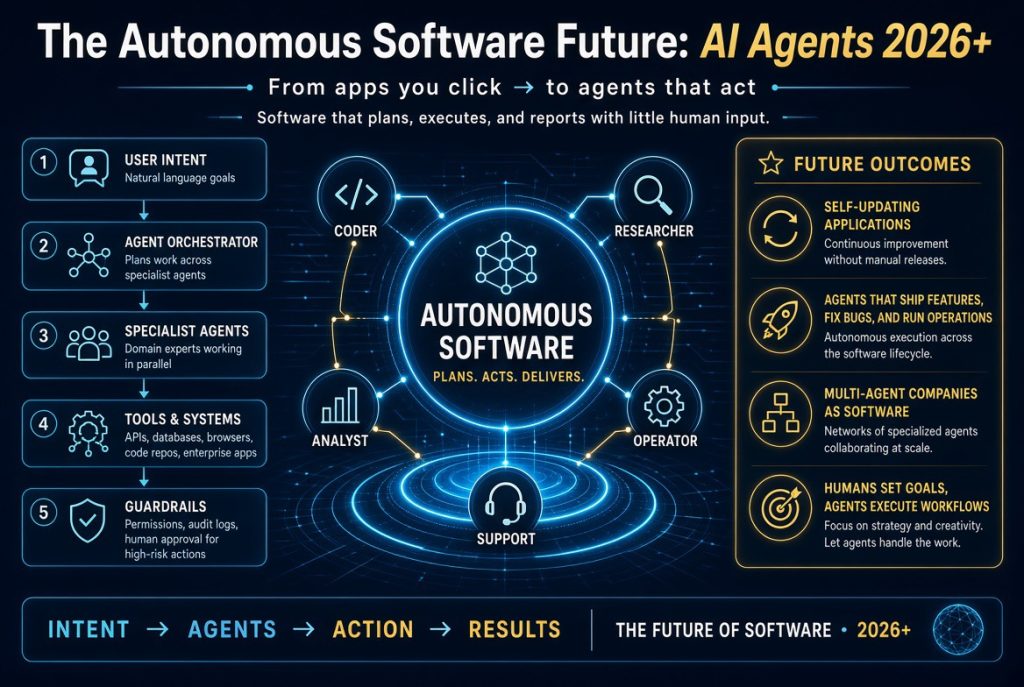
The Future of Autonomous Software: How AI Will Change Software in 2026 and Beyond
Autonomous software is moving from an interesting AI experiment toward a new way of building and operating applications, where software can increasingly interpret goals, make decisions, use tools, and complete tasks with limited human intervention.
For decades, most software worked because someone explicitly told it what to do.
A developer wrote the rules. A user clicked a button. The application executed a predefined process and returned a result.
AI agents are beginning to change that model.
Instead of telling software every individual step, users can increasingly describe an objective and allow an AI-powered system to determine which steps may be necessary to accomplish it.
That does not mean software is suddenly becoming completely independent. In fact, the most useful autonomous systems will probably remain heavily constrained by permissions, business rules, security controls, human approvals, monitoring, and deterministic software.
The important change is that software is becoming better at deciding what to do next.
This article examines where autonomous software is heading in 2026 and beyond, what technologies are making it possible, how it will affect developers and businesses, and why reliability and security may ultimately matter more than raw model intelligence.
Quick Answer: What Is the Future of Autonomous Software?
The future of autonomous software is hybrid rather than completely human-free. AI agents will increasingly interpret goals, plan tasks, call APIs, retrieve information, coordinate workflows, and perform approved actions, while traditional software continues to provide deterministic logic, databases, authentication, infrastructure, and safety controls.
In 2026, the biggest opportunity is not giving AI unlimited control. It is building systems where AI has just enough autonomy to perform useful work while permissions, validation, observability, security, and human approval control what it can actually do.
Over the next several years, expect more software-development agents, autonomous IT operations, AI-powered customer support, business-process automation, multi-agent systems, agent interoperability, and software that operates across several applications on behalf of users.
What Is Autonomous Software?
Autonomous software is software capable of performing tasks, making decisions, or progressing through workflows with less direct human intervention than traditional applications.
The term is broader than AI agents.
An autonomous system can contain conventional automation, rules engines, scheduled processes, machine-learning models, AI agents, APIs, queues, databases, and human approval steps.
AI agents are simply becoming one of the most important technologies for creating this type of software.
A traditional application might work like this:
User → Button → Function → Database → ResultAn autonomous application may look more like this:
User Goal
   ↓
AI Agent
   ↓
Interpret Goal
   ↓
Plan / Select Next Action
   ↓
Choose Tool
   ↓
Validate Permission
   ↓
Execute Action
   ↓
Inspect Result
   ↓
Decide Whether More Work Is Required
   ↓
Complete Goal or Escalate
The difference is subtle but powerful.
Traditional software usually follows paths that developers have explicitly defined. Autonomous software can select between different paths depending on what it discovers while working.
For example, a traditional IT monitoring application might alert an engineer when a server fails.
An autonomous system could potentially detect the failure, investigate logs, identify a likely cause, restart a service if that action is explicitly permitted, verify recovery, document what happened, and escalate the incident if the problem remains unresolved.
The software has moved from reporting a problem toward working on the problem.
That distinction is at the heart of the autonomous software movement.
Autonomous Software vs AI Agents vs Automation
These terms are often used interchangeably, but they describe different ideas.
| Technology | How It Works | Best Use Case |
|---|---|---|
| Traditional software | Executes deterministic logic | Predictable operations and business rules |
| Automation | Runs predefined workflows automatically | Repetitive processes |
| AI assistant | Interprets requests and generates responses | Information and content tasks |
| AI agent | Can interpret goals, use tools, and perform multi-step work | Dynamic tasks requiring decisions |
| Autonomous software | Broader system combining AI, automation, tools, state, rules, and execution | End-to-end software workflows |
This distinction matters because not every problem needs an AI agent.
If a company needs to calculate VAT from a known formula, conventional software is usually better.
If a company needs to process a known sequence of database operations every night, a scheduled workflow may be better.
If a system needs to interpret an ambiguous customer request, search several systems, decide which information matters, and determine what action should happen next, an agent becomes much more interesting.
Our take: one of the biggest mistakes in the current AI conversation is treating autonomy as automatically superior to deterministic software. It is not. The best architecture is usually the one that gives AI freedom only where ambiguity genuinely exists.
Why Autonomous Software Matters in 2026
The timing is important because several technologies are converging.
Modern AI models can interpret complex instructions, reason across information, call tools, work with different forms of data, and increasingly operate within software environments.
At the same time, developers have access to agent SDKs, orchestration frameworks, cloud infrastructure, evaluation systems, observability tools, and interoperability standards that make agentic applications easier to build.
For example, OpenAI’s current agent platform includes the Responses API and Agents SDK, while other major ecosystems have developed their own agent-development frameworks. Google’s Agent Development Kit supports agent and multi-agent development, while Microsoft’s Agent Framework provides tooling for agents, workflows, tools, memory, human-in-the-loop scenarios, and hosting. Developers should expect these ecosystems to continue changing quickly rather than assuming today’s framework choices will remain fixed for years.
That matters because autonomous software is becoming less about a single AI model and more about an entire software architecture around models.
Consider software development.
Previously, a developer might manually:
- Read an issue.
- Inspect the repository.
- Find relevant files.
- Write code.
- Run tests.
- Fix failures.
- Create a pull request.
- Write documentation.
An AI coding agent can increasingly perform several of these steps itself.
The developer’s role does not necessarily disappear. Instead, the developer can move toward defining the problem, reviewing changes, setting constraints, and handling decisions that require judgment.
This is the broader pattern that will shape autonomous software.
From Software That Responds to Software That Acts
One of the biggest changes will be the transition from responsive software to action-oriented software.
Most applications today wait for a user.
You open your banking application and request a transfer.
You open your project-management system and create a task.
You open your email client and write a message.
You open your cloud console and investigate an alert.
Autonomous software changes the relationship.
Instead of constantly operating the software, you may increasingly give it objectives.
For example:
“Find invoices that are overdue, determine which customers have historically paid late, prepare appropriate follow-ups, and show me anything that requires escalation.”
A conventional application might require the user to open several systems and manually coordinate the process.
An agentic application could potentially coordinate the research, retrieve the relevant records, classify the invoices, draft follow-ups, and present exceptions for approval.
This does not eliminate the underlying applications.
It changes the interface between the human and those applications.
Instead of humans navigating every system directly, software can increasingly act as an intermediary.
Our AI agents for business guide explores this shift in greater detail.
The Rise of Agentic Software
The future of autonomous software is closely connected to agentic AI.
An AI agent can interpret a goal, reason about available options, call tools, inspect results, and continue working through a task.
A simple agent might have three tools:
- Search documents.
- Query a database.
- Create a support ticket.
A more sophisticated agent might have access to dozens of APIs, internal services, retrieval systems, cloud resources, and specialist agents.
At enterprise scale, organizations may eventually operate networks of specialized agents.
Customer Request
       ↓
Coordinator Agent
       ↓
 ┌─────┼─────────┐
 ↓     ↓         ↓
Sales  Finance  Support
Agent  Agent    Agent
 ↓       ↓        ↓
CRM    ERP      Helpdesk
       Systems
That is why multi-agent systems have become an important part of the conversation.
Rather than creating one enormous AI system capable of doing everything, organizations can create smaller systems with clearly defined responsibilities.
There is an important caveat, however.
More agents do not automatically mean a better system.
Every additional agent introduces another interface, another source of failure, another security boundary, and another opportunity for conflicting instructions.
Our view is that a well-designed single agent with three dependable tools will often outperform a complicated “agent swarm” for a straightforward business process.
Autonomous Software Will Not Mean Uncontrolled Software
This is perhaps the most important distinction in the entire subject.
Autonomous does not mean unrestricted.
Imagine giving an AI agent access to a company’s financial system.
You probably do not want it to have unlimited authority to transfer money simply because a prompt tells it to.
Instead, the system might allow the agent to:
- Read transaction information.
- Identify suspicious transactions.
- Prepare a payment.
- Recommend an action.
- Request human approval.
The final transfer could require a separate authorization mechanism.
A useful autonomy model is:
- Observe — the agent can inspect information.
- Recommend — the agent proposes an action.
- Prepare — the agent creates the action but does not execute it.
- Execute — the agent performs an approved action automatically.
- Escalate — the system stops and asks for human intervention.
Different workflows can use different levels.
Reading an internal knowledge base might be low risk.
Deleting a production database is obviously not.
The correct question is therefore not:
“How autonomous can we make this agent?”
It is:
“What is the highest level of autonomy that is appropriate for this specific action?”
The Architecture of Autonomous Software
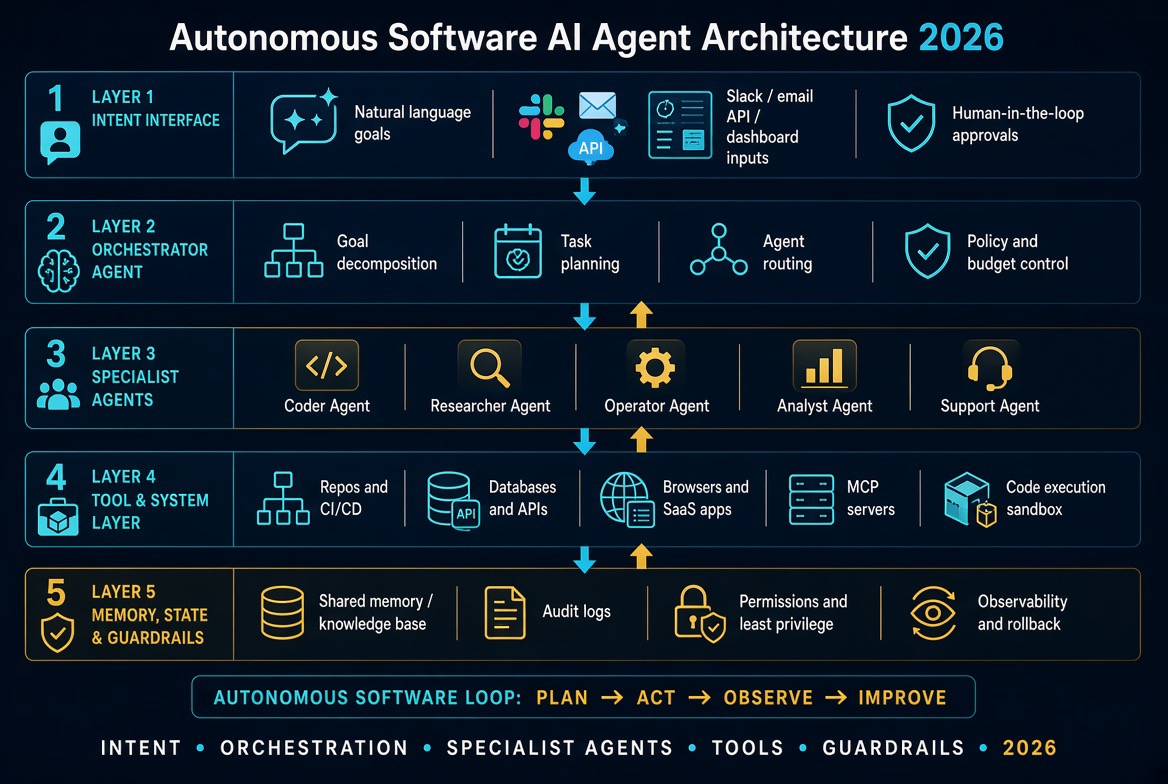
A mature autonomous application will usually contain several layers rather than simply an LLM connected to a prompt.
| Layer | Purpose |
|---|---|
| Foundation model | Language, reasoning, vision, classification, or planning |
| Agent runtime | Manages execution and agent state |
| Tools | Connect the system to APIs, databases, files, and services |
| Memory/state | Maintains relevant context and task progress |
| Orchestration | Coordinates workflows or multiple agents |
| Identity | Determines who or what the agent is acting for |
| Permissions | Controls which resources and actions are allowed |
| Guardrails | Restricts unsafe or invalid behavior |
| Observability | Records what happened during execution |
| Evaluation | Measures whether the system works correctly |
| Human oversight | Handles high-impact or uncertain decisions |
This architecture is important because the model itself should not be treated as the security boundary.
The model can propose an action. Your application should decide whether that action is actually permitted.
Where Autonomous Software Could Have the Biggest Impact
1. Software Development
Software development is already one of the clearest examples of agentic workflows.
AI coding agents can inspect repositories, understand issues, modify files, execute tests, investigate errors, and propose changes.
The next stage is likely to involve more persistent software-development workflows.
An agent might take a task from an issue tracker, inspect the repository, implement a change, run tests, investigate failures, prepare a pull request, and wait for human review.
A developer could supervise several such workflows simultaneously.
That changes the economics of development.
The developer is no longer necessarily the person manually performing every implementation step. Instead, the developer increasingly becomes the person responsible for specifying, supervising, validating, and architecting the system.
That shift makes engineering judgment more valuable, not less.
2. Cybersecurity
Security teams deal with enormous volumes of alerts and telemetry.
Autonomous systems could investigate routine alerts, correlate events, inspect logs, enrich indicators, identify suspicious patterns, and prioritize incidents.
A mature security agent could potentially investigate an alert across several systems before presenting a concise incident summary to a security analyst.
But cybersecurity is also one of the areas where autonomy creates significant risk.
Giving an agent permission to isolate machines, modify firewall rules, disable accounts, or delete suspicious files introduces consequences if the agent makes the wrong decision.
Therefore, security agents need explicit action boundaries and strong audit trails.
Our AI agent security risks guide covers prompt injection, excessive permissions, credential exposure, tool abuse, and related risks.
3. Cloud Infrastructure
Modern cloud environments generate enormous amounts of operational data.
An autonomous infrastructure agent could monitor workloads, investigate performance problems, recommend optimizations, and perform predefined remediation actions.
For example, an agent might detect an unhealthy service and restart it automatically if that action is covered by an approved policy.
More dangerous actions, such as deleting infrastructure or changing production networking, could require approval.
This is where autonomous software becomes particularly interesting for DevOps.
Traditional automation says:
IF condition X occurs
THEN execute action Y
An agentic system can potentially investigate a broader situation before deciding which approved remediation path is relevant.
However, deterministic automation should remain underneath the agent wherever possible. The agent should not replace the reliability of infrastructure automation; it should intelligently coordinate it.
4. Customer Support
Customer service may move from AI answering questions toward AI actually resolving issues.
An agent could potentially:
- Identify a customer.
- Look up an order.
- Check payment status.
- Investigate a delivery problem.
- Check relevant policies.
- Create a support ticket.
- Prepare an authorized refund.
- Notify the customer.
The human support representative can then focus on complicated or sensitive cases.
This is an important distinction: the value of an agent is not necessarily that it produces better prose. The value is that it can potentially complete more of the underlying workflow.
5. Business Operations
Businesses contain countless repetitive workflows.
Procurement, reporting, scheduling, reconciliation, document processing, employee onboarding, inventory monitoring, compliance checks, and internal research all contain tasks that could potentially be partially automated.
The interesting part is that autonomous software does not need to replace the entire process.
Automating 60% of a workflow can already create significant value if the remaining 40% genuinely requires human judgment.
This is one of the more realistic ways to think about enterprise AI.
The objective should not be “remove the human.”
The objective should be “remove unnecessary human effort while preserving necessary human judgment.”
6. Research and Knowledge Work
Research is another natural fit.
An agent can potentially search multiple sources, compare information, extract relevant facts, organize findings, identify contradictions, and prepare a report for human review.
This is particularly useful where the problem involves many small information-retrieval steps rather than one difficult decision.
However, research agents introduce their own reliability challenge: the system needs to distinguish between retrieved evidence, model inference, and unsupported assumptions.
A professional research workflow therefore needs source tracking and human review rather than simply trusting an impressive-looking answer.
The Future of Autonomous Software and Developers
There is a common fear that autonomous software will make developers obsolete.
The reality is more nuanced.
AI can increasingly generate code, but production software involves much more than producing lines of code.
Someone still needs to decide:
- What should the system actually do?
- What data should it access?
- What actions should it be allowed to perform?
- What happens when something goes wrong?
- How should sensitive operations be approved?
- How do we know the agent made the correct decision?
- How do we secure the system?
- How do we control costs?
- How do we recover when an agent gets stuck?
Those are architecture and engineering questions.
In fact, autonomous software may increase the value of good software architecture because poorly designed systems can give AI agents too much freedom without enough safeguards.
Software Engineers Will Become AI System Architects
The role of developers is likely to evolve.
Instead of spending most of their time implementing straightforward application logic, engineers may increasingly spend more time designing systems around AI components.
Important skills will include:
- AI model integration
- Agent architecture
- API design
- Tool calling
- Workflow orchestration
- Database architecture
- Security engineering
- Observability
- Evaluation
- Cloud infrastructure
- Human-in-the-loop design
- Identity and access management
- Cost engineering
Python will remain particularly useful because of its AI ecosystem, while JavaScript, TypeScript, Java, Go, Rust, and other languages will continue to play important roles depending on the application.
If you want to start building these systems today, our guide to building AI agents with Python provides a practical starting point.
Autonomous Software Will Create a New Security Problem
Traditional software generally executes logic that developers explicitly programmed.
Autonomous systems introduce another variable: the system can make decisions based on changing context.
That creates new attack surfaces.
An attacker may attempt to manipulate the information an agent sees rather than directly attacking the underlying application.
For example, malicious instructions hidden inside a document could potentially influence an agent that is authorized to read that document and use external tools.
This is one form of the broader prompt-injection problem.
The risk becomes more serious when the agent has powerful tools.
A model that can only summarize a document has limited ability to cause damage.
A model that can read the document, access a database, send email, modify records, execute code, and interact with external systems presents a much larger security problem.
That leads to an important engineering principle:
The more powerful the tools, the more important the authorization architecture becomes.
The OWASP Top 10 for Agentic Applications 2026 provides a useful security framework for organizations building systems that can plan, act, and make decisions across workflows. OWASP describes the framework as a peer-reviewed resource developed with input from industry experts, researchers, and practitioners.
Organizations should also look at the NIST AI Risk Management Framework, which is designed to help organizations manage AI risks throughout design, development, deployment, use, and evaluation. NIST is currently revising AI RMF 1.0, making it particularly important to treat governance guidance as an evolving discipline rather than a finished checklist.
For adversarial thinking, the MITRE ATLAS knowledge base is another useful reference for understanding tactics and techniques associated with attacks against AI-enabled systems.
Security architecture therefore needs to become part of agent architecture rather than something added at the end.
MCP and the Emerging Agent Connectivity Layer
One of the most important developments around autonomous software is the move toward standardized ways for AI systems to connect to tools and data.
The Model Context Protocol, commonly known as MCP, is an example of this direction.
MCP provides a standardized approach for connecting AI applications with external tools and sources of context.
This matters because autonomous software becomes significantly more useful when it can interact with existing business systems instead of operating inside an isolated chatbot.
Imagine an enterprise agent that needs access to:
- CRM data
- Internal documentation
- Project-management systems
- Databases
- Cloud infrastructure
- Communication systems
- Analytics platforms
Without standardized interfaces, every integration can become a custom engineering project.
Interoperability standards can reduce some of that friction.
However, standardized connectivity should not be confused with automatic security.
Making it easier for an agent to access a tool also makes it more important to control which tools it can discover, which operations are exposed, what credentials it receives, and which actions require approval.
Our MCP explained guide goes deeper into this emerging architecture.
The Importance of Agent-to-Agent Communication
The future will probably not consist of one universal AI agent handling every task.
Specialization often makes more sense.
Consider an e-commerce business:
- A customer-support agent handles customer conversations.
- A sales agent identifies opportunities.
- An inventory agent monitors stock.
- A finance agent handles reconciliation.
- A logistics agent monitors deliveries.
These agents may need to exchange information.
The customer-support agent might ask the logistics agent about a delayed shipment. The logistics agent might ask the inventory agent whether a replacement product is available.
This is where agent-to-agent communication becomes important.
Google’s work around the Agent2Agent ecosystem is one example of the broader push toward interoperability between agents developed using different frameworks and technologies.
The long-term direction is significant: instead of isolated assistants, software could contain networks of specialized systems that coordinate work.
But again, interoperability introduces trust questions.
Before one agent accepts an instruction from another, the receiving system needs to know:
- Who sent the request?
- What authority does that agent have?
- What information is being transferred?
- Can the requested operation be trusted?
- Does the action require user approval?
Agent-to-agent communication will therefore become both an engineering and security problem.
Will Autonomous Software Replace Traditional Applications?
Probably not.
At least, not in the simple sense that traditional applications disappear.
Deterministic software remains extremely valuable.
If you need to calculate a tax amount according to a fixed formula, you probably do not need an AI agent.
If you need to authenticate a user, deterministic security logic is still essential.
If you need to process millions of transactions according to predictable rules, conventional software remains extremely effective.
The future is more likely to be hybrid.
Traditional Software
        +
AI Agents
        +
Automation
        +
Human Oversight
        =
Autonomous Application
Traditional software will provide reliable infrastructure and deterministic operations.
AI agents will handle interpretation, planning, coordination, and ambiguous tasks.
Automation engines will execute repeatable processes.
Humans will retain control over high-impact decisions.
The strength comes from combining the approaches rather than replacing one with another.
The Biggest Challenge: Reliability
Autonomous software has a fundamental problem.
People tolerate occasional mistakes from a chatbot.
They are much less tolerant of mistakes from software that can take action.
If an AI assistant gives you a wrong restaurant recommendation, you can ignore it.
If an autonomous financial agent sends money to the wrong account, that is a completely different category of problem.
Therefore, the future of autonomous software depends heavily on reliability.
Developers will need better methods for:
- Agent evaluation
- Automated testing
- Tool validation
- Permission management
- Human approvals
- Audit logging
- Rollback and recovery
- Continuous monitoring
- Cost monitoring
- Loop detection
- Failure recovery
Evaluation also needs to go beyond checking the final answer.
Suppose an agent eventually produces the correct answer but first accessed a restricted database.
The final output may look correct while the underlying system behaved incorrectly.
That means organizations should evaluate both:
- Outcome: Did the agent accomplish the task correctly?
- Trajectory: Did it use the correct tools, permissions, reasoning path, and stopping conditions?
NIST’s recent work on AI test, evaluation, verification, and validation reflects the growing importance of systematic evaluation for AI systems, including agentic systems.
Our take: the best autonomous systems will not necessarily be the ones that act most independently. They will be the ones that know when they can act, what they are allowed to do, and when they should stop.
Observability Will Become Essential
Traditional applications usually produce logs that tell developers what happened.
Agentic applications need something richer.
Developers may need to understand:
- Which model was used?
- What instructions were supplied?
- Which tools were considered?
- Which tool was selected?
- What arguments were passed?
- What did the tool return?
- How many model calls occurred?
- How much did the task cost?
- How long did it take?
- Why did the agent stop?
- Was a human approval required?
This makes tracing and structured observability fundamental parts of production agent architecture.
Without observability, debugging an autonomous system can become extremely difficult.
A user might simply say, “The agent did something strange.”
The engineering team needs to reconstruct what happened.
That requires an execution trail.
Memory Will Change How Autonomous Software Works
Another major area of development is memory.
Not every piece of information should be stored permanently, and not every conversation needs to become long-term memory.
Autonomous systems may use several forms of state:
Short-Term Context
This is information needed during the current interaction or task.
Persistent Task State
This records where a long-running workflow currently stands.
For example:
{
  "customer_id": "12345",
  "invoice_id": "INV-1001",
  "payment_verified": true,
  "follow_up_prepared": true,
  "human_approval_required": true
}
Long-Term Memory
This can contain information that remains useful across multiple interactions, subject to appropriate privacy and retention policies.
Retrieval Memory
Knowledge can also be stored in searchable systems so that the agent retrieves relevant information when needed rather than placing an entire knowledge base into its context.
This is where retrieval-augmented generation, databases, vector search, and enterprise search become important components of agent architecture.
The key principle is that memory should be intentional.
Storing everything simply because storage is cheap can create privacy, security, and governance problems.
Autonomous Software and Human-in-the-Loop Design
Human approval is sometimes presented as evidence that an AI system is not truly autonomous.
That is the wrong way to look at it.
In serious software systems, human oversight is often a feature rather than a failure.
A financial agent might autonomously research a transaction but require approval before executing it.
A coding agent might autonomously modify a branch but require a developer to approve the pull request.
A security agent might investigate an incident autonomously but require an analyst to authorize account termination.
This produces a practical architecture:
Agent
  ↓
Proposed Action
  ↓
Policy Check
  ↓
Low Risk? ───── Yes → Execute
  |
  No
  ↓
Human Approval
  ↓
Execute or Reject
  ↓
Record Result
This is not a weakness.
It is how organizations can combine machine speed with human accountability.
What Businesses Should Do Now
Businesses do not need to transform their entire organization into an autonomous enterprise overnight.
A better approach is to identify workflows where autonomy can create measurable value without creating unacceptable risk.
Start with tasks that are:
- Repetitive
- Time-consuming
- Data-driven
- Easy to evaluate
- Low or moderate risk
- Currently dependent on manual coordination
Then introduce autonomy gradually.
- Start with AI-generated recommendations.
- Allow the system to prepare actions.
- Add human approval.
- Automate low-risk actions.
- Monitor performance.
- Measure business outcomes.
- Expand permissions only when reliability has been demonstrated.
This approach is much safer than giving an experimental agent unrestricted access to production systems.
It also creates a measurable path from experimentation to production.
How to Identify a Good Autonomous Software Use Case
A useful scoring model is to ask five questions.
| Question | Good Sign | Warning Sign |
|---|---|---|
| Is the workflow repetitive? | Yes | No |
| Can success be measured? | Clearly | Subjectively |
| Are the required tools controllable? | Yes | No |
| Is the downside of failure manageable? | Yes | No |
| Can a human intervene? | Yes | No |
The strongest early use cases tend to score well across these categories.
Businesses should be cautious when an agent is being asked to make irreversible, high-value, safety-critical, or legally significant decisions without a robust approval mechanism.
When You Should Not Use Autonomous AI
This is an important part of the conversation that is often ignored.
You do not need an AI agent simply because you can build one.
Use ordinary software when:
- The process is completely deterministic.
- The rules are stable and clearly defined.
- The workflow has no meaningful ambiguity.
- The operation needs maximum predictability.
- A database query can solve the problem directly.
- A scheduled job is sufficient.
- A conventional API integration is simpler.
Adding an LLM to a deterministic process can introduce latency, cost, variability, and additional security concerns without providing meaningful value.
Good architecture is not about maximizing AI. It is about placing AI where it creates leverage.
The Autonomous Software Stack
As the technology matures, a typical autonomous application may contain several layers:
- Foundation models — provide reasoning, language, vision, or other AI capabilities.
- Agent runtime — manages execution and workflow state.
- Tools — connect the agent to external systems.
- Memory — maintains relevant information.
- Orchestration — coordinates agents and workflows.
- Identity and permissions — control what agents can access.
- Guardrails — restrict unsafe operations.
- Observability — records execution.
- Evaluation — measures performance.
- Human oversight — handles sensitive decisions.
This stack is already emerging, although the tools and standards will continue to evolve rapidly.
Developers who understand the architecture rather than simply learning one AI framework will be better positioned as the ecosystem changes.
What the Next Five Years Could Look Like
Predicting the future of AI with precision is difficult. The technology is moving too quickly, and many current products will evolve or disappear.
However, several architectural trends appear much more durable than individual product names.
1. Software Will Become More Goal-Oriented
Users will increasingly express outcomes rather than individual commands.
Instead of manually navigating several applications, users may increasingly delegate a business objective to an AI-powered interface.
2. Applications Will Become More Agentic
AI capabilities will increasingly be embedded into ordinary business applications rather than existing only as standalone chatbots.
3. Agents Will Gain More Tools
The usefulness of an agent is strongly related to what it can safely access.
Expect more standardized connections to databases, business applications, development environments, cloud systems, files, search, and other services.
4. Multi-Agent Systems Will Grow
Specialized agents may increasingly coordinate around complex workflows, although practical architectures will probably remain more conservative than some of the “agent swarm” demonstrations suggest.
5. Agent Interoperability Will Matter
Organizations will increasingly want agents built with different frameworks and vendors to exchange information and request work.
6. Security Will Move Closer to the Runtime
Instead of relying entirely on prompts to control agents, production systems will increasingly enforce permissions and policies at the application and infrastructure layers.
7. Evaluation Will Become a Core Engineering Discipline
Teams will need repeatable ways to determine whether agents are actually improving business processes rather than merely producing convincing demonstrations.
8. Human Oversight Will Become More Granular
Rather than treating autonomy as simply “on” or “off,” systems will increasingly use risk-based permissions.
Low-risk actions can be automatic.
Medium-risk actions can require confirmation.
High-risk actions can remain fully human-controlled.
The Most Important Shift May Be the Interface
There is another consequence of autonomous software that deserves attention.
For decades, graphical user interfaces have been the primary way humans interact with software.
Autonomous software introduces another possibility: the goal-oriented interface.
Instead of opening five applications and manually moving information between them, a user could potentially describe the desired outcome.
The agent becomes an orchestration layer across existing applications.
This does not mean graphical interfaces disappear.
People will still need dashboards, forms, reports, controls, and visualizations.
But the interface may become increasingly hybrid:
Human Goal
    ↓
AI Interface
    ↓
Agent / Orchestrator
    ↓
Existing Applications
    ↓
Databases + APIs + Services
    ↓
Result
This could become one of the most important changes in enterprise software architecture during the second half of the decade.
Why Software Architecture Matters More in the Autonomous Era
Autonomous software makes architectural weaknesses easier to expose.
If a human has to manually approve every database operation, a poorly designed internal API might remain hidden for years.
Once an agent starts interacting with that API automatically, weaknesses become operational risks.
Poor permissions become dangerous.
Ambiguous APIs become dangerous.
Missing audit logs become dangerous.
Weak authentication becomes dangerous.
Unclear data ownership becomes dangerous.
This means organizations pursuing agentic automation should first improve the underlying software architecture.
Well-defined APIs, service boundaries, authentication, authorization, logging, idempotency, validation, and rollback mechanisms become even more valuable when software agents begin calling those systems automatically.
Autonomous software does not remove the need for good architecture. It makes good architecture more important.
A Practical Roadmap for Developers
Developers who want to prepare for autonomous software do not need to learn every AI framework.
A better path is to understand the underlying building blocks.
- Learn a programming language well.
- Understand APIs and JSON.
- Learn how LLM applications work.
- Build tool-calling applications.
- Learn agent state and memory.
- Understand retrieval and RAG.
- Learn workflow orchestration.
- Understand authentication and authorization.
- Learn AI evaluation and observability.
- Build human-in-the-loop systems.
- Study agent security.
- Learn multi-agent architecture only when a real use case requires it.
If Python is your preferred language, our complete guide to building AI agents with Python is a natural next step.
Developers interested in the wider tooling ecosystem can also explore our AI agent frameworks comparison and AI agent development tools guide.
Our View: Autonomy Is Not the Same as Intelligence
There is a tendency to measure AI progress by asking whether models are getting smarter.
For autonomous software, that is only part of the story.
A highly intelligent model with poor tools and excessive permissions can still produce a dangerous system.
A moderately capable model surrounded by excellent APIs, strong validation, clear state management, robust evaluation, and carefully designed permissions can be much more useful.
In other words:
Autonomous software is a systems-engineering problem, not just a model-intelligence problem.
This is probably one of the most important ideas developers should take away from the current agentic AI wave.
The model is one component.
The product is the entire system around it.
What Will Separate Successful Autonomous Systems From Failed Ones?
Many AI demos look impressive because they demonstrate what is possible.
Production software has a different standard.
A production autonomous system needs to be:
- Reliable enough to trust.
- Observable enough to debug.
- Secure enough to deploy.
- Predictable enough to operate.
- Affordable enough to scale.
- Recoverable when something fails.
- Constrained enough to prevent unacceptable actions.
- Useful enough to justify its complexity.
This creates a very different definition of success.
The most impressive demo may not be the best production architecture.
A boring agent that reliably processes 10,000 support tickets under controlled permissions may create far more business value than a spectacular autonomous system that occasionally makes unpredictable decisions.
Reliability will beat novelty.
What Businesses Should Expect Beyond 2026
Autonomous software is unlikely to arrive as one dramatic replacement event.
The transition will probably happen incrementally.
First, applications will gain AI assistants.
Then those assistants will gain tools.
Then they will gain workflow capabilities.
Then organizations will allow them to perform increasingly useful low-risk actions.
Eventually, several agents may coordinate across applications.
The result will not necessarily look like a science-fiction robot.
It may simply look like software that quietly handles more of the work that humans currently coordinate manually.
That is arguably the more significant transformation.
Final Thoughts: The Future of Autonomous Software
The future of autonomous software is not about removing humans from software systems.
It is about changing where human attention is spent.
For decades, humans have spent enormous amounts of time telling computers exactly what to do.
AI agents are creating the possibility of describing an objective and allowing software to work through some of the details.
That is a profound change.
But autonomy without control is not progress.
The winning systems will combine capable AI with good software engineering, strong security, carefully designed permissions, reliable tools, monitoring, evaluation, and sensible human oversight.
Traditional software will not suddenly disappear. Instead, it will increasingly become the dependable foundation underneath more intelligent and adaptive interfaces.
Developers will not simply disappear either. Their work will increasingly shift toward architecture, system design, evaluation, security, orchestration, and deciding where autonomy should—and should not—be allowed.
The most important question for the next generation of software may therefore not be:
“Can AI do this task?”
It may be:
“How much responsibility should we give AI for doing this task, and what controls should surround that responsibility?”
That is the real engineering challenge behind autonomous software.
And it is what makes autonomous software one of the most important directions in software development for 2026 and the rest of this decade.
Frequently Asked Questions
What is autonomous software?
Autonomous software is software that can perform tasks, make decisions, or progress through workflows with limited direct human intervention. AI agents are an important technology enabling this capability, but autonomous software can also include traditional automation, rules, APIs, and human approval systems.
Will autonomous software replace developers?
Autonomous software is more likely to change the developer role than eliminate it. Developers will increasingly focus on architecture, system design, security, evaluation, agent orchestration, permissions, and reviewing AI-generated work.
Are AI agents the same as autonomous software?
No. AI agents are one way to build autonomous software. Autonomous software is a broader concept that can include AI agents, automation systems, traditional deterministic components, workflow engines, and other technologies.
Is autonomous software safe?
Autonomous software can be made significantly safer through least-privilege access, tool restrictions, human approval, monitoring, auditing, testing, authentication, and carefully designed workflows. High-risk actions should not automatically receive unrestricted autonomy.
What industries will use autonomous software?
Potential applications include software development, cybersecurity, cloud operations, customer support, finance, logistics, healthcare administration, marketing, research, IT operations, and business process automation.
What is the difference between automation and autonomous software?
Traditional automation usually follows predefined rules and workflows. Autonomous software can use AI to interpret goals, evaluate context, select among available actions, and adapt its workflow while operating within defined permissions and constraints.
Will autonomous software replace traditional applications?
Probably not. The most practical future is hybrid. Traditional software will continue handling deterministic operations, authentication, databases, transactions, and infrastructure, while AI agents handle interpretation, planning, coordination, and ambiguous tasks.
What is an AI agent?
An AI agent is a software system that uses an AI model to interpret a goal, select or propose actions, use tools, inspect results, maintain relevant state, and continue through a task until it reaches a stopping condition or requires human intervention.
How can businesses start using autonomous software?
Businesses should begin with repetitive, measurable, low- or moderate-risk workflows. A practical progression is to start with AI recommendations, then allow the system to prepare actions, introduce human approval, automate low-risk actions, monitor results, and expand autonomy only after reliability has been demonstrated.
Is multi-agent software better than a single AI agent?
Not necessarily. Multi-agent systems can be useful when different responsibilities genuinely benefit from specialization, but every additional agent introduces more complexity, communication overhead, and security considerations. A well-designed single agent is often preferable for simpler workflows.

Leave a reply