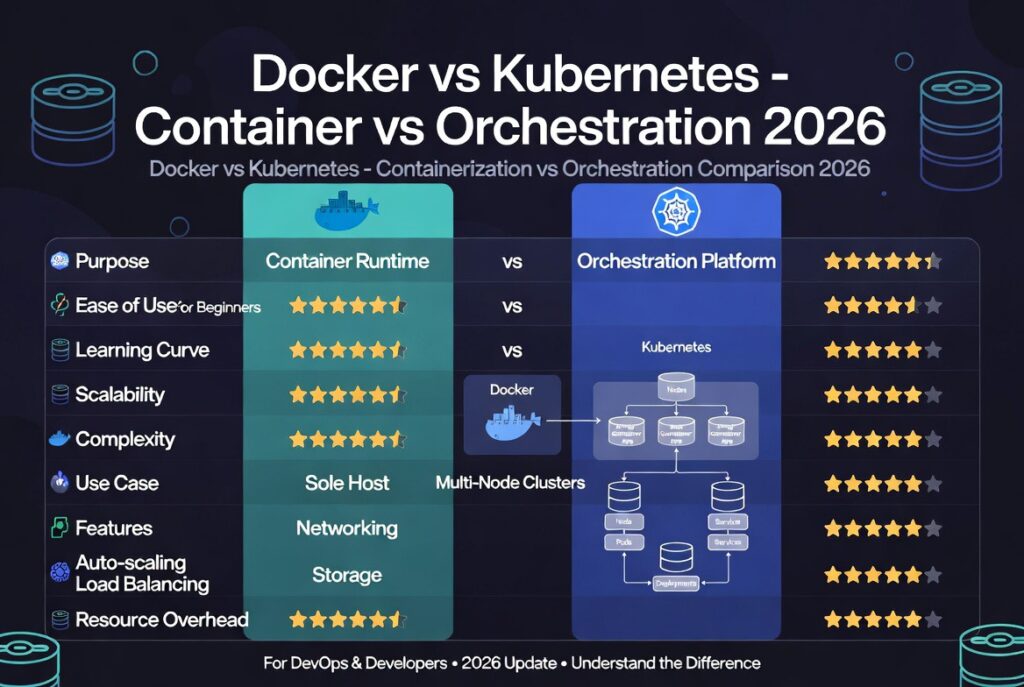
Docker vs Kubernetes Comparison: Key Differences Explained
Docker vs Kubernetes comparison is one of the most common topics in modern DevOps. Many developers confuse these tools, but they serve completely different purposes in the software development lifecycle.
In this guide, we break down Docker vs Kubernetes comparison in simple terms, helping you understand when to use each and how they work together.

If you’re new to DevOps, start with our
devops automation tools pillar guide.
What Is Docker
Docker is a containerization platform that allows developers to package applications and their dependencies into lightweight, portable containers. These containers can run consistently across different environments.
Instead of worrying about system differences, Docker ensures your application behaves the same in development, testing, and production.
- Packages applications into containers
- Ensures environment consistency
- Lightweight and fast deployment
- Widely used for microservices
Learn more:
Docker official guide
What Is Kubernetes
Kubernetes is a container orchestration platform that manages, scales, and deploys containers across clusters of machines. It automates complex container operations and ensures high availability.
While Docker creates containers, Kubernetes manages them at scale.
- Automates container deployment
- Manages clusters of containers
- Provides scaling and load balancing
- Ensures fault tolerance
Explore Kubernetes:
Kubernetes official website
Docker vs Kubernetes Comparison: Core Difference
The most important point in this Docker vs Kubernetes comparison is:
- Docker = Containerization tool
- Kubernetes = Container orchestration tool
They are not competitors — they are complementary technologies often used together in modern DevOps pipelines.
Docker vs Kubernetes Comparison: Key Differences
1. Purpose
Docker focuses on creating and running containers, while Kubernetes focuses on managing containers across multiple systems.
- Docker: Build and run containers
- Kubernetes: Manage and scale containers
2. Ease of Use
Docker is beginner-friendly and easy to set up. Developers can start using Docker with minimal configuration.
Kubernetes has a steeper learning curve due to its complex architecture and configuration.
- Docker: Easy to learn
- Kubernetes: Complex setup
3. Scalability
Docker alone does not provide advanced scaling features. It requires additional tools like Kubernetes or Docker Swarm.
Kubernetes is designed for scalability and can handle thousands of containers across clusters.
- Docker: Limited scaling
- Kubernetes: High scalability
4. Deployment
Docker uses simple commands to run containers, while Kubernetes requires configuration files (YAML) to define deployments, services, and pods.
- Docker: Simple CLI commands
- Kubernetes: Declarative configuration
5. Ecosystem
Docker has a large ecosystem with tools like Docker Hub and Docker Compose.
Kubernetes has an even larger ecosystem with tools like Helm, Istio, and Prometheus.
- Docker: Strong ecosystem
- Kubernetes: Massive ecosystem
6. Use Case
Docker is ideal for building and testing applications, while Kubernetes is used for deploying and managing production workloads.
- Docker: Development and packaging
- Kubernetes: Production and scaling
How Docker and Kubernetes Work Together
In real-world DevOps workflows, Docker and Kubernetes are often used together rather than separately.
Typical workflow:
- Developers build containers using Docker
- Containers are stored in a registry
- Kubernetes deploys and manages containers
This combination enables scalable, reliable, and automated application deployment.
Explore orchestration tools:
container orchestration tools comparison
When to Use Docker
Choose Docker if:
- You want to containerize applications
- You are working in development environments
- You need fast and consistent deployments
- You are building microservices
When to Use Kubernetes
Choose Kubernetes if:
- You are managing multiple containers
- You need automatic scaling
- You require high availability
- You are running production systems
Docker vs Kubernetes Comparison: Pros and Cons
Docker Pros
- Easy to use
- Lightweight containers
- Fast setup
- Great for development
Docker Cons
- Limited orchestration
- Not ideal for large-scale systems
Kubernetes Pros
- Highly scalable
- Automated management
- Self-healing infrastructure
- Enterprise-ready
Kubernetes Cons
- Complex setup
- Steep learning curve
- Higher operational overhead
Cost Considerations
Both Docker and Kubernetes are open-source, but costs depend on infrastructure, cloud usage, and management.
- Docker has lower setup and operational costs
- Kubernetes requires more resources and expertise
Learn more:
devops automation tools pricing
Docker vs Kubernetes Comparison: Which One Should You Choose
This Docker vs Kubernetes comparison shows that the choice depends on your needs:
- Use Docker for development and container creation
- Use Kubernetes for production and orchestration
- Use both together for a complete DevOps workflow
Modern DevOps teams rarely choose one over the other — they combine both for maximum efficiency.
Future Trends in Container Technology
Container technology continues to evolve with trends such as:
- Serverless containers
- Edge computing integration
- AI-driven infrastructure management
- Improved security automation
Kubernetes is expected to dominate enterprise environments, while Docker remains essential for container creation.
Conclusion
Docker vs Kubernetes comparison is not about choosing one over the other. Instead, it is about understanding how they complement each other in modern DevOps workflows.
Docker simplifies application packaging, while Kubernetes ensures those applications run efficiently at scale.
To build scalable systems, developers should learn both tools and understand how they integrate.
FAQ
What is the difference between Docker and Kubernetes?
Docker is used to create containers, while Kubernetes is used to manage and scale containers across multiple systems.
Can Docker run without Kubernetes?
Yes, Docker can run independently for development and small-scale deployments without Kubernetes.
Is Kubernetes replacing Docker?
No, Kubernetes is not replacing Docker. They serve different roles and are often used together.
Which is better for beginners Docker or Kubernetes?
Docker is better for beginners due to its simplicity, while Kubernetes requires more advanced knowledge.

Leave a reply