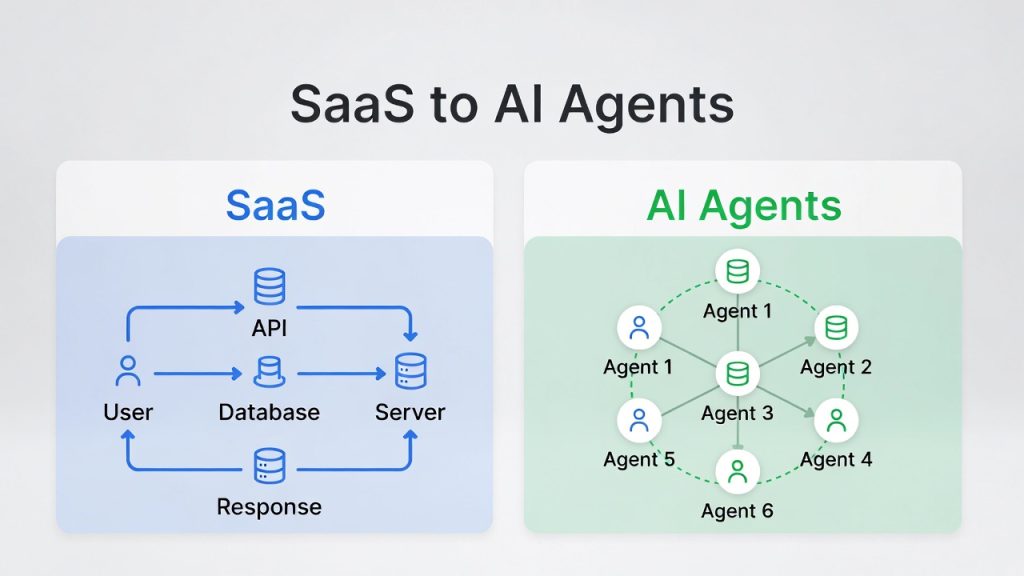
From SaaS to Agents: Why Businesses Are Changing Tools
The SaaS to AI agents transition is becoming one of the most important technological shifts of the decade. After more than fifteen years dominated by Software-as-a-Service platforms, organizations are now moving toward autonomous AI agents capable of executing workflows independently.
Instead of employees operating dashboards, copying data between tools, and manually managing processes, companies increasingly assign objectives to intelligent systems that plan and complete work on their own.
This change does not simply introduce another productivity tool — it fundamentally redefines how software is used inside modern organizations.
As explored in our AI Agents replacing software workflows pillar, businesses are transitioning from software interfaces to goal-driven automation ecosystems.

The SaaS Era: How Software Worked for the Last Decade
Software-as-a-Service revolutionized computing by moving applications to the cloud. Companies no longer installed software locally; instead, they subscribed to online platforms accessible from anywhere.
SaaS enabled massive productivity growth, but it still relied heavily on human operation.
Characteristics of the SaaS Model
- Users log into dashboards
- Humans execute workflows step-by-step
- Data moves manually between applications
- Automation depends on predefined rules
- Productivity scales with workforce size
Common SaaS stacks included:
- CRM platforms
- Project management tools
- Analytics dashboards
- Marketing automation systems
- Customer support software
While powerful, SaaS introduced a new challenge: software complexity increased as companies added more tools.
Many organizations now operate dozens — sometimes hundreds — of SaaS subscriptions simultaneously.
The Problem With Tool Overload
By the early 2020s, enterprises faced a growing issue known as software fragmentation.
Employees spent significant time switching between applications rather than completing meaningful work.
Common Workflow Friction
- Copying data across platforms
- Manually generating reports
- Maintaining integrations
- Monitoring dashboards continuously
- Repetitive administrative tasks
Industry research consistently showed knowledge workers spending large portions of their day coordinating tools rather than producing outcomes.
This inefficiency created demand for a new paradigm — automation that could think, plan, and act.
The Agent Era: Software That Executes Work
AI agents introduce a fundamentally different interaction model.
Instead of operating software manually, businesses define goals and allow agents to execute workflows autonomously.
How Agent-Based Systems Work
- Human defines an objective
- Agent interprets intent
- Agent plans workflow steps
- Tools and APIs are selected automatically
- Execution happens independently
- Results are delivered and optimized
This shift moves software from passive tools to active collaborators.
Examples of Agent Capabilities
- Automated reporting
- Self-running workflows
- Decision assistance
- Continuous monitoring
- Cross-platform orchestration
The result is a workplace where humans supervise outcomes instead of managing processes.
Key Technologies Enabling the Transition
1. Advanced Language Models
Modern AI reasoning systems can interpret natural language goals and translate them into structured actions.
This capability allows software to understand context rather than follow rigid scripts.
2. API Ecosystems
Most enterprise software exposes APIs, allowing agents to interact with multiple platforms simultaneously.
Agents effectively become universal operators across digital systems.
3. Memory and Context Retention
Unlike traditional automation, AI agents maintain context over time, enabling long-running workflows and continuous optimization.
4. Cloud Infrastructure Scalability
Modern cloud environments provide the compute power required for real-time autonomous execution.
Business Advantages Driving Adoption
The SaaS to AI agents transition is accelerating because organizations see measurable operational benefits.
Lower Operational Costs
Agents automate repetitive processes previously handled by large operational teams.
Faster Execution
Workflows run instantly instead of waiting for human availability.
Reduced Manual Processes
Automation eliminates administrative bottlenecks.
Scalable Productivity
Small teams can achieve enterprise-level output.
Continuous Optimization
Agents analyze results and improve workflows automatically.
Enterprise Adoption Examples
Marketing Teams
AI agents generate campaign reports, analyze performance data, and recommend optimization strategies without manual input.
Customer Service
Autonomous agents handle tickets, route issues, and update internal knowledge bases.
Software Development
Coding agents manage testing, debugging, and documentation workflows.
Finance Operations
Agents automate reconciliation, forecasting, and anomaly detection.
These deployments demonstrate that agents are not experimental — they are operational infrastructure.
From Software Licenses to Digital Labor
The economic model of software is also changing.
| SaaS Model | Agent Model |
|---|---|
| Pay per seat | Pay per outcome |
| Human-operated tools | Autonomous execution |
| Manual workflows | Goal-driven automation |
| Productivity tied to headcount | Productivity scales digitally |
This transition introduces the concept of digital labor — software acting as a workforce multiplier.
Challenges Businesses Must Navigate
Governance and Oversight
Organizations must monitor agent decisions to ensure accuracy and compliance.
Security Risks
Agents interacting across systems require strong permission controls.
Change Management
Employees must adapt to supervising AI rather than executing workflows directly.
Trust and Reliability
Companies must establish validation mechanisms before full autonomy.
Workforce Implications
The SaaS to AI agents transition reshapes job roles rather than eliminating work entirely.
Growing Roles
- AI workflow designers
- Automation strategists
- AI operations managers
- Human-AI collaboration specialists
Declining Tasks
- Manual reporting
- Routine administration
- Basic data processing
This transformation aligns closely with trends discussed in:
Industry Predictions (2026–2030)
- Agent orchestration platforms replace integration tools
- Companies deploy specialized AI agents per department
- Agent marketplaces emerge alongside app stores
- Human roles shift toward strategy and oversight
- Autonomous workflows become standard enterprise infrastructure
Technology analysts increasingly describe this transition as comparable to the move from desktop software to cloud computing.
Why Businesses Cannot Ignore the Shift
Organizations that adopt agent-based systems early gain competitive advantages through speed, efficiency, and scalability.
Companies that rely solely on traditional SaaS workflows risk slower execution and higher operational costs.
The future enterprise will likely combine human creativity with autonomous digital execution.
Outbound Sources
Conclusion
The SaaS to AI agents transition represents a shift from software as a tool to software as an autonomous collaborator.
Businesses are not abandoning software — they are redefining how it operates.
As AI agents mature, organizations will increasingly measure productivity not by how many tools employees use, but by how effectively autonomous systems achieve outcomes.
The companies adapting today are building the operational model of the next digital economy.

Leave a reply