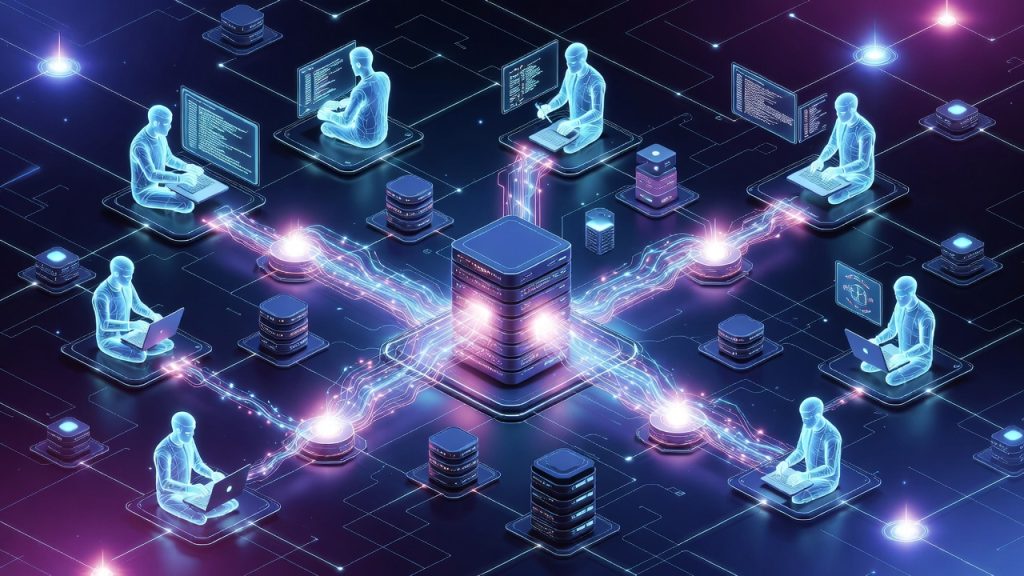
AI Agents Are Quietly Replacing Software Workflows in 2026
AI agents replacing software workflows is no longer a future prediction — it is an active transformation reshaping how digital work happens across industries in 2026.
For decades, productivity depended on humans manually operating software tools. Workers clicked interfaces, transferred data between apps, executed repetitive processes, and coordinated workflows themselves.
Today, a new paradigm is emerging: autonomous AI agents capable of planning tasks, using tools, and completing workflows independently.
Instead of humans using software, software now works for humans.
This shift represents one of the most significant technological transitions since cloud computing and mobile platforms.

Definition: What Are AI Agents?
AI agents are autonomous software systems designed to pursue goals rather than execute isolated commands.
Unlike traditional automation scripts, agents reason through problems, decide actions dynamically, and interact with multiple digital tools.
Core Characteristics
- Goal-oriented reasoning — understands objectives instead of fixed instructions
- Tool usage — interacts with APIs, software, and databases
- Memory — retains context across sessions
- Autonomous execution — performs multi-step workflows independently
- Adaptive learning — improves outcomes over time
In practical terms, an AI agent behaves more like a digital employee than a traditional application.
The Evolution of Software Workflows
To understand why agents matter, it helps to examine how software evolved.
Phase 1: Manual Software (1990–2010)
- Humans controlled every action
- Software acted as passive tools
- Productivity depended on user skill
Phase 2: SaaS Automation (2010–2022)
- Cloud platforms centralized workflows
- Automation rules reduced manual tasks
- Integration tools connected services
Phase 3: Agent-Based Systems (2023–Present)
- Humans define goals
- Agents plan execution
- Software ecosystems self-coordinate
This transition moves computing from tool usage to delegated intelligence.
Why Software Workflows Are Changing Now
1. Breakthroughs in Large Language Models
Modern AI reasoning models can interpret context, generate strategies, and execute structured plans.
These capabilities allow AI systems to manage workflows previously requiring human decision-making.
2. API-First Software Ecosystems
Most modern software platforms expose APIs, enabling agents to interact programmatically across tools:
- CRM systems
- Cloud infrastructure
- Analytics dashboards
- Development environments
This interoperability makes autonomous execution possible.
3. Economic Pressure for Productivity
Organizations increasingly seek productivity growth without proportional hiring increases.
AI agents offer scalable labor amplification — allowing smaller teams to achieve enterprise-scale output.
How AI Agents Replace Traditional Workflows
Traditional workflows require sequential human involvement:
- Collect data
- Analyze information
- Create outputs
- Move results between tools
- Monitor completion
Agent workflows invert this structure:
- Human defines objective
- Agent plans steps
- Agent selects tools
- Execution happens automatically
- Results delivered to user
The human role shifts from operator to supervisor.
Real-World Examples of AI Agents in 2026
Customer Support Automation
Agents handle support tickets, retrieve knowledge base answers, escalate complex cases, and update documentation automatically.
Software Development
AI coding agents now:
- Write features
- Fix bugs
- Run tests
- Create documentation
- Submit pull requests
See deeper analysis:
Marketing Operations
- Campaign creation
- Audience analysis
- Performance optimization
- Report generation
Business Intelligence
Data agents continuously analyze company metrics and generate executive insights automatically.
Industries Adopting AI Agents Fastest
Technology Companies
Software firms deploy agents internally to accelerate development cycles.
Finance
Automated compliance monitoring and forecasting systems reduce operational overhead.
E-commerce
Inventory optimization and pricing adjustments increasingly run autonomously.
Media & Content Creation
AI agents assist with research, editing, publishing, and distribution workflows.
Impact on the Software Industry
The traditional SaaS model is evolving.
Previously, businesses purchased multiple tools and hired employees to operate them.
Now, companies deploy agents capable of orchestrating entire software stacks.
Emerging Shift
| Old Model | New Model |
|---|---|
| Software dashboards | Goal-driven agents |
| Manual workflows | Autonomous execution |
| Tool subscriptions | Agent ecosystems |
Related reading:
Workforce Implications
AI agents do not eliminate work — they redefine it.
Roles Increasing in Demand
- AI workflow designers
- Automation architects
- AI product managers
- Human-AI collaboration specialists
Roles Declining
- Manual data processing
- Routine administrative operations
- Basic repetitive coding tasks
This transformation connects directly with broader workforce changes discussed in:
Benefits Driving Rapid Adoption
1. Productivity Multiplication
One employee can supervise multiple autonomous workflows simultaneously.
2. Continuous Operation
Agents operate 24/7 without fatigue.
3. Reduced Operational Costs
Automation lowers repetitive labor requirements.
4. Faster Innovation Cycles
Teams ship products faster with agent-assisted execution.
Challenges and Risks
Reliability
Autonomous systems require monitoring to prevent incorrect actions.
Security
Agents accessing multiple systems introduce governance challenges.
Human Oversight
Organizations must establish review mechanisms.
Industry analysts emphasize “human-in-the-loop” supervision models.
Predictions: The Agent Economy by 2030
- Most enterprise workflows partially agent-managed
- Agent marketplaces replacing app stores
- Digital employees assigned to departments
- AI orchestration becoming a core IT function
Experts compare this shift to the early internet transformation of business operations.
Why AI Agents Represent a Computing Paradigm Shift
Each major computing era changed interaction models:
- Mainframes → centralized computing
- PCs → personal productivity
- Cloud → scalable infrastructure
- AI Agents → autonomous execution
The defining difference is agency: software now initiates action rather than waiting for input.
Outbound Industry References
Conclusion
AI agents replacing software workflows marks the beginning of an automation era where humans increasingly define outcomes rather than execute processes.
Organizations adopting agent-driven systems early gain significant advantages in productivity, scalability, and innovation speed.
The question is no longer whether agents will reshape software — but how quickly industries will adapt to autonomous digital work.

Leave a reply