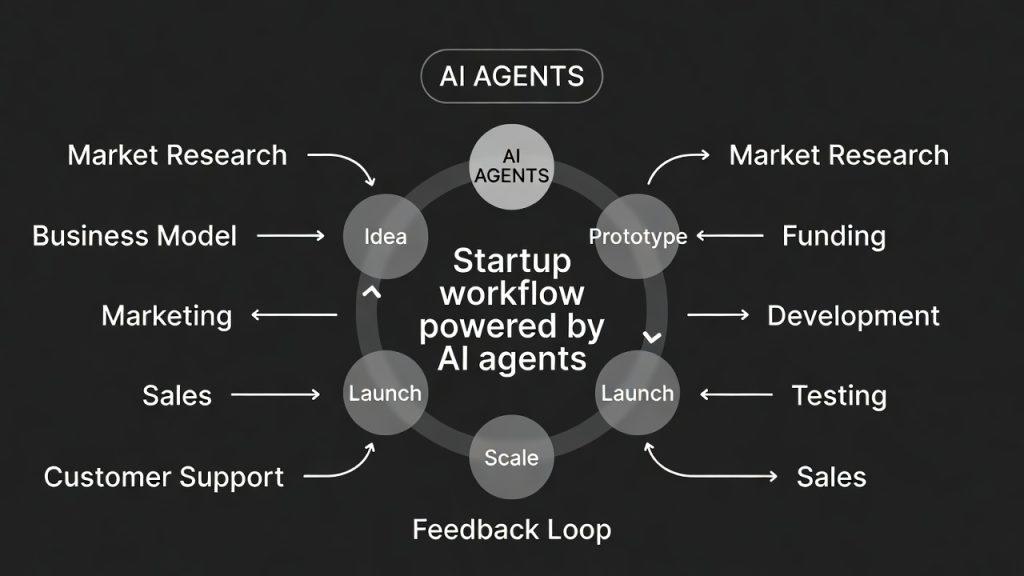
How Startups Are Building Agent-First Companies
A new generation of startups is redesigning how businesses operate by placing artificial intelligence agents at the center of their organizations. Instead of hiring large operational teams or managing complex software stacks manually, these companies deploy autonomous AI systems to execute workflows across marketing, engineering, customer support, analytics, and operations.
This emerging model — known as the agent-first company — represents one of the most important shifts in modern entrepreneurship. Just as cloud computing enabled lean startups in the 2010s, AI agents are enabling hyper-efficient digital organizations in 2026.

What Is an Agent-First Company?
An agent-first company is an organization where autonomous AI agents handle core operational workflows traditionally performed by humans using software tools.
Rather than employees operating dashboards, agents execute tasks independently based on goals defined by founders or operators.
Key characteristics include:
- Goal-driven automation instead of manual task execution
- AI-managed workflows across departments
- Continuous optimization through learning systems
- Human teams focused on strategy and creativity
In traditional startups, software amplifies workers. In agent-first startups, AI becomes the worker.
The Shift From SaaS-First to Agent-First
For over a decade, startups relied on Software-as-a-Service (SaaS) platforms to operate efficiently. Founders assembled stacks including CRM tools, analytics dashboards, marketing automation systems, and project management platforms.
Agent-first companies invert this model.
Traditional SaaS Workflow
- Humans operate tools
- Manual data entry
- Workflow coordination by teams
- Scaling requires hiring
Agent-First Workflow
- Humans define objectives
- AI agents execute tasks
- Systems communicate automatically
- Scaling happens through computation
This transition dramatically reduces operational friction.
Startup Advantages of Agent-First Models
1. Lean Teams
Agent-first startups often operate with extremely small teams. Founders can manage processes previously requiring multiple departments.
Examples include:
- One marketer supervising AI campaign agents
- One engineer managing autonomous coding workflows
- Founders overseeing AI-driven analytics
This creates unusually high revenue-per-employee ratios.
2. Automated Operations
Agents continuously run workflows such as:
- Customer onboarding sequences
- Lead qualification
- Content publishing
- Infrastructure monitoring
- Data reporting
Operations run 24/7 without traditional staffing constraints.
3. Rapid Scalability
Because agents operate digitally, scaling does not require proportional hiring. Companies increase output simply by deploying more agents or expanding compute resources.
Operational Areas Where Startups Use AI Agents
Customer Onboarding
AI agents guide users through onboarding, answer questions, personalize tutorials, and detect churn risks automatically.
Marketing Campaign Automation
Agents now generate campaigns, test variations, analyze performance metrics, and optimize messaging continuously.
Code Deployment and Engineering
Autonomous coding systems build features, run tests, and deploy updates with human approval checkpoints.
Analytics and Reporting
Instead of analysts compiling dashboards manually, AI agents monitor business metrics and generate actionable insights daily.
Customer Support
Advanced conversational agents resolve most support tickets while escalating complex issues to humans.
Why Investors Are Interested in Agent-First Startups
Venture capital firms increasingly view agent-first companies as structurally superior business models.
Lower Operational Costs
Automation reduces payroll expenses while maintaining productivity growth.
Faster Experimentation
Agents allow startups to test product ideas rapidly, shortening innovation cycles.
Scalable Margins
As companies grow, costs increase more slowly compared to traditional organizations.
Data Flywheel Effects
Agents improve through feedback loops, strengthening competitive advantages over time.
Accelerators and early-stage investors report increasing numbers of AI-native startups designed around automation from day one.
How Founders Design Agent-First Organizations
Successful agent-first startups typically follow a structured approach.
Step 1: Define Outcomes, Not Tasks
Founders specify goals such as “increase conversions” rather than assigning individual tasks.
Step 2: Deploy Specialized Agents
Different agents handle marketing, engineering, analytics, and operations.
Step 3: Build Oversight Layers
Humans supervise outputs, ensuring quality and alignment with company strategy.
Step 4: Continuous Optimization
Agents learn from results and improve execution automatically.
Challenges Facing Agent-First Companies
Reliability and Oversight
AI outputs require monitoring to avoid errors or unintended actions.
Security Risks
Autonomous systems interacting with APIs must be carefully permissioned.
Organizational Adaptation
Traditional management practices may not apply when AI performs operational work.
Skill Transition
Founders must learn AI orchestration rather than purely operational management.
The Emerging Role of Human Workers
Agent-first companies do not eliminate humans; instead, they redefine human contribution.
- Strategic decision-making
- Creative direction
- Product vision
- Ethical oversight
- Customer relationship building
Humans increasingly act as supervisors and designers of intelligent systems.
Future Outlook: The Autonomous Startup Era
Industry analysts predict that by the end of the decade, many startups will launch with AI agents embedded into their operational DNA from day one.
Future agent-first companies may:
- Operate globally with micro-teams
- Ship products continuously through autonomous development
- Optimize pricing and marketing automatically
- Adapt business models dynamically using real-time data
The startup itself becomes a semi-autonomous system — guided by humans but executed by AI.
Outbound References

Leave a reply