Container Orchestration Tools Comparison: Kubernetes vs Docker Swarm
Container orchestration tools comparison is essential for developers and DevOps teams managing containerized applications at scale. As modern applications become more distributed, tools like Kubernetes and Docker Swarm play a critical role in automating deployment, scaling, and management.
In this guide, we provide a detailed container orchestration tools comparison to help you choose the best platform based on performance, scalability, and ease of use.

If you’re new to DevOps, start with our
devops automation tools pillar guide.
What Is Container Orchestration
Container orchestration is the process of automating the deployment, management, scaling, and networking of containers. Instead of manually handling containers, orchestration tools ensure applications run efficiently across clusters.
- Automated deployment
- Scaling based on demand
- Load balancing
- Self-healing systems
Learn more about containerization from
Docker official guide.
Top Tools in This Container Orchestration Tools Comparison
This container orchestration tools comparison focuses on two major platforms:
- Kubernetes
- Docker Swarm
Both tools are widely used, but they serve different needs depending on team size, infrastructure, and project complexity.
Kubernetes Overview
Kubernetes is an open-source container orchestration platform originally developed by Google. It is now maintained by the Cloud Native Computing Foundation (CNCF).
Kubernetes is designed for large-scale deployments and complex architectures, making it the industry standard for enterprise applications.
- Highly scalable architecture
- Advanced scheduling capabilities
- Self-healing containers
- Extensive ecosystem and community
Explore Kubernetes here:
Kubernetes official website
Docker Swarm Overview
Docker Swarm is Docker’s native clustering and orchestration tool. It is designed for simplicity and ease of use, making it ideal for beginners and small teams.
Unlike Kubernetes, Docker Swarm integrates directly with Docker, allowing developers to start quickly without complex configuration.
- Simple setup and configuration
- Native Docker integration
- Lightweight orchestration
- Quick deployment
Learn more:
Docker Swarm documentation
Container Orchestration Tools Comparison: Kubernetes vs Docker Swarm
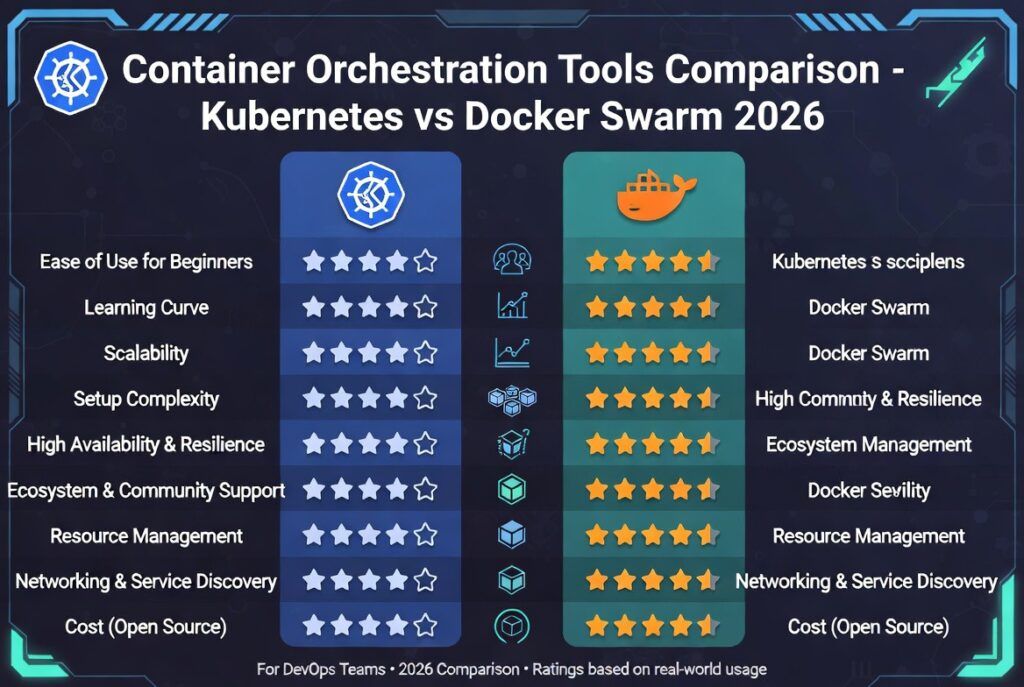
Below is a detailed container orchestration tools comparison across key factors:
1. Scalability
Kubernetes is built for large-scale deployments and can handle thousands of nodes efficiently. It supports auto-scaling and complex distributed systems.
Docker Swarm, on the other hand, is better suited for smaller environments and simpler scaling requirements.
- Kubernetes: Enterprise-level scalability
- Docker Swarm: Small to mid-scale applications
2. Ease of Use
Docker Swarm is significantly easier to learn and deploy. Developers familiar with Docker can get started within minutes.
Kubernetes has a steeper learning curve due to its complex architecture and terminology.
- Kubernetes: Complex setup
- Docker Swarm: Beginner-friendly
3. Deployment and Configuration
Kubernetes requires YAML configuration files and a deeper understanding of clusters, pods, and services.
Docker Swarm uses simpler commands and integrates directly with Docker CLI.
- Kubernetes: Advanced configuration
- Docker Swarm: Simple CLI-based deployment
4. Ecosystem and Community
Kubernetes has a massive ecosystem, including tools like Helm, Istio, and Prometheus.
Docker Swarm has a smaller ecosystem but is easier to maintain.
- Kubernetes: Large ecosystem
- Docker Swarm: Limited ecosystem
5. Performance
Kubernetes offers better performance in large-scale environments due to advanced scheduling and resource management.
Docker Swarm performs well in smaller setups but may struggle with highly complex workloads.
- Kubernetes: Optimized for scale
- Docker Swarm: Lightweight performance
When to Choose Kubernetes
Choose Kubernetes if:
- You are building enterprise-level applications
- You need advanced scaling and automation
- You require high availability and fault tolerance
- You want access to a large ecosystem of tools
When to Choose Docker Swarm
Choose Docker Swarm if:
- You want a simple orchestration solution
- You are working on small to medium projects
- You need quick deployment without complexity
- Your team is new to container orchestration
Best Use Cases for Each Platform
Kubernetes Use Cases
- Microservices architecture
- Large SaaS platforms
- Cloud-native applications
- Enterprise DevOps pipelines
Docker Swarm Use Cases
- Small applications
- Development environments
- Rapid prototyping
- Simple deployment pipelines
Cost Considerations
Both Kubernetes and Docker Swarm are open-source, but costs arise from infrastructure, maintenance, and hosting.
- Kubernetes often requires more resources and expertise
- Docker Swarm has lower operational costs
Compare DevOps costs in our
devops automation tools pricing guide.
Integration with DevOps Pipelines
Both tools integrate well with CI/CD platforms like:
- Jenkins
- GitHub Actions
- GitLab CI/CD
Read:
ci cd tools comparison
Future Trends in Container Orchestration
Container orchestration is evolving rapidly with trends such as:
- AI-driven infrastructure management
- Serverless container platforms
- Edge computing integration
- Improved security automation
Kubernetes is expected to dominate enterprise use, while simpler tools like Docker Swarm will remain relevant for smaller teams.
Conclusion
This container orchestration tools comparison shows that Kubernetes and Docker Swarm serve different purposes. Kubernetes is the best choice for large-scale, complex systems, while Docker Swarm is ideal for simplicity and speed.
Choosing the right tool depends on your project size, team expertise, and long-term scalability needs.
Explore more in:
devops automation tools
FAQ
What is container orchestration?
Container orchestration automates deployment, scaling, and management of containerized applications.
Which is better Kubernetes or Docker Swarm?
Kubernetes is better for large-scale deployments, while Docker Swarm is easier for beginners and smaller projects.
Is Kubernetes harder than Docker Swarm?
Yes, Kubernetes has a steeper learning curve compared to Docker Swarm due to its advanced features and architecture.
Are container orchestration tools free?
Most container orchestration tools are open-source, but infrastructure and management costs still apply.

Leave a reply