Why AI Is Moving Onto Your Device in 2026
Artificial intelligence has traditionally depended on the cloud. When you asked a question, generated an image, or translated text, your request traveled across the internet to massive data centers filled with GPUs.
But in 2026, a structural shift is underway.
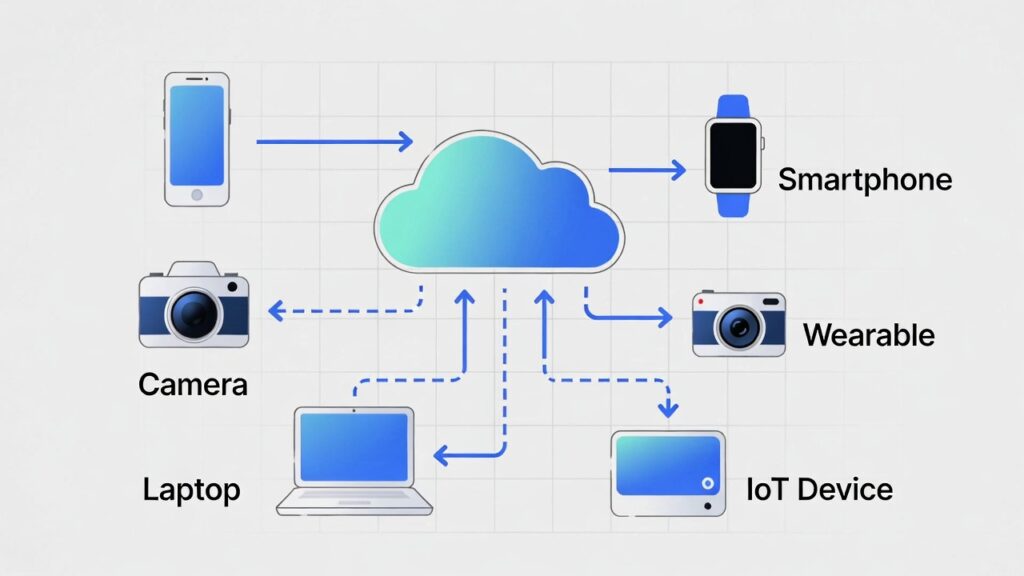
AI is increasingly running directly on your smartphone, laptop, tablet, and even wearable devices. This movement — known as Edge AI — represents one of the most important infrastructure transitions in modern computing.
This shift explains why AI is moving onto your device, transforming smartphones, laptops, and wearable technology into intelligent computing platforms.

The Cloud Era of AI
Over the past decade, artificial intelligence relied heavily on centralized processing. Companies built enormous AI clusters powered by hardware from firms like :contentReference[oaicite:0]{index=0}, enabling large-scale model training and inference.
This architecture made sense because:
- AI models were too large to run on consumer devices.
- Smartphones lacked dedicated AI accelerators.
- Cloud platforms could scale instantly.
- Internet bandwidth improved globally.
However, the cloud-first model created new constraints — particularly around latency, privacy, and cost.
What Changed in 2026?
Four major breakthroughs are accelerating the shift toward on-device AI.
1. AI Hardware Acceleration
Modern devices now include Neural Processing Units (NPUs) and AI accelerators capable of handling billions of operations per second.
Companies like :contentReference[oaicite:1]{index=1} integrate Neural Engines directly into their chips, while :contentReference[oaicite:2]{index=2} builds AI engines into Snapdragon platforms.
These processors dramatically improve performance-per-watt efficiency, making real-time AI feasible on mobile devices.
2. Model Optimization Techniques
Advances in:
- Quantization
- Model pruning
- Distillation
- Efficient transformer architectures
allow powerful AI models to run with fewer parameters and lower memory requirements.
3. Privacy Pressure
Users and regulators increasingly demand that sensitive data stay local. Uploading voice recordings, images, and personal messages to the cloud creates legal and ethical risks.
On-device AI minimizes exposure.
4. Economic Incentives
Cloud inference is expensive. As AI usage scales globally, companies seek to reduce operational costs by distributing computation to devices.
The Latency Advantage
Cloud AI introduces unavoidable delay. Even a few hundred milliseconds can disrupt user experience.
On-device AI eliminates network round trips.
This enables:
- Real-time language translation
- Instant photo enhancement
- Live transcription
- Augmented reality overlays
- Predictive typing improvements
In applications like autonomous systems or medical monitoring, reduced latency is not just convenient — it is essential.
Privacy as a Competitive Feature
Privacy is no longer just a regulatory requirement; it is a product differentiator.
:contentReference[oaicite:3]{index=3} heavily promotes on-device processing to emphasize user privacy. By keeping AI inference local, companies reduce dependency on remote servers.
Benefits include:
- Reduced data transmission risk
- Simplified compliance requirements
- Greater consumer trust
- Lower exposure to data breaches
This strategic shift aligns AI architecture with public expectations.
The Economics of AI Infrastructure
AI services require significant GPU resources. Cloud providers charge per inference request, and high-traffic platforms can accumulate substantial compute costs.
Moving inference to devices:
- Reduces recurring cloud expenses
- Shifts compute load to distributed hardware
- Improves scalability without linear cost growth
For companies deploying AI assistants or consumer-facing tools, this cost model is attractive.
Enterprise Implications
The shift toward edge AI is not limited to consumers. Enterprises are adopting hybrid models:
- Cloud for training large models
- Edge for real-time deployment
Industrial equipment, retail systems, and manufacturing environments increasingly use on-device AI to process data locally.
This reduces bandwidth usage and enhances operational reliability.
Statistical Projections
Market analysts project significant growth:
- Edge AI hardware spending expected to grow at double-digit annual rates through 2030.
- Majority of smartphones now ship with dedicated AI accelerators.
- Enterprise AI deployments increasingly prioritize local inference for privacy-sensitive workflows.
- Global edge computing market projected to exceed $100 billion in the next few years.
These figures reflect structural adoption rather than temporary experimentation.
Hardware Roadmap Trends
NVIDIA’s Hybrid Strategy
:contentReference[oaicite:4]{index=4} continues dominating cloud training infrastructure while expanding edge computing solutions.
The company’s roadmap emphasizes:
- Energy-efficient inference GPUs
- AI software ecosystems
- Integrated edge computing platforms
Apple’s Vertical Control
:contentReference[oaicite:5]{index=5} leverages hardware-software integration to optimize AI performance directly within its ecosystem.
This enables seamless deployment of AI features across devices.
Qualcomm’s Ecosystem Reach
:contentReference[oaicite:6]{index=6} provides AI acceleration to a wide range of Android manufacturers, influencing global device AI capabilities.
Consumer Experience in 2026
For users, AI moving onto devices means:
- Faster responses
- Offline AI capability
- More personalized assistance
- Improved battery optimization through dedicated AI cores
- Enhanced augmented reality performance
Devices are evolving into personal AI companions rather than passive tools.
Challenges and Constraints
Despite its advantages, on-device AI faces limitations:
- Thermal management in compact hardware
- Battery life trade-offs
- Memory constraints
- Model size limitations
- Fragmentation across hardware ecosystems
These constraints drive continued innovation in efficient model design.
The Hybrid Future: Cloud + Edge
Edge AI does not eliminate the cloud. Instead, it rebalances responsibilities:
- Cloud handles large-scale model training and heavy workloads.
- Edge devices execute inference and personalization.
This hybrid architecture is becoming the default AI deployment model.
Why This Shift Matters Long-Term
The move toward on-device AI represents more than performance improvement. It signals:
- A redefinition of computing architecture
- A shift in AI economics
- New competitive dynamics in hardware
- Greater emphasis on privacy-first design
- Decentralization of intelligence
Just as the smartphone transformed internet access, edge AI is transforming artificial intelligence access.
The long-term trend is clear: AI is moving onto your device as hardware, privacy expectations, and infrastructure economics evolve.
References
- NVIDIA Official Site
- Apple Silicon Overview
- Qualcomm Snapdragon AI
- World Economic Forum Technology Reports
Frequently Asked Questions
Why is AI moving onto your device?
AI is moving onto your device because modern smartphones and computers now include dedicated AI accelerators that allow machine learning models to run locally. This improves speed, reduces latency, enhances privacy, and lowers cloud computing costs.
What is on-device AI?
On-device AI refers to artificial intelligence systems that process data directly on a device such as a smartphone, laptop, or wearable instead of sending information to remote cloud servers.
What are the benefits of AI running on devices?
Running AI locally offers several advantages including faster response times, better privacy protection, reduced internet dependency, and improved efficiency through specialized hardware like neural processing units.
Which companies are leading on-device AI development?
Technology companies such as Apple, Qualcomm, and NVIDIA are developing hardware and software platforms that enable AI models to run efficiently on consumer devices and edge computing systems.
Will cloud AI disappear?
Cloud AI will remain important for training large machine learning models. However, many AI applications now use hybrid architectures where models are trained in the cloud and executed on devices.

Leave a reply