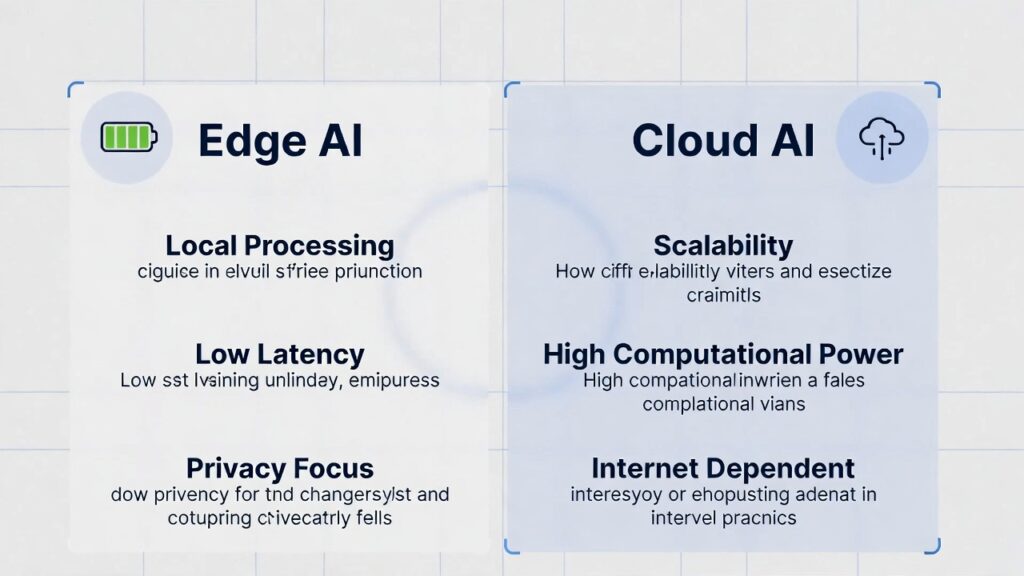
Edge AI vs Cloud AI Explained: Architecture, Cost, and the Future of Deployment
Artificial intelligence systems can run in two primary environments: centralized cloud data centers or directly on local devices. Understanding edge AI vs cloud AI is essential for developers, enterprises, and technology leaders planning AI infrastructure in 2026 and beyond.
This is not simply a technical comparison. It represents a strategic decision that affects performance, cost, privacy, and long-term scalability.

What Is Cloud AI?
Cloud AI refers to artificial intelligence models that run in centralized data centers. When a user makes a request — such as generating an image or analyzing text — the data is transmitted to remote servers where the model processes it and sends back the result.
Cloud AI infrastructure is typically powered by high-performance GPUs and accelerators from companies like :contentReference[oaicite:0]{index=0}.
How Cloud AI Works
- User sends data request.
- Data travels across the internet.
- Cloud servers process request.
- Response is transmitted back.
Advantages of Cloud AI
- Massive compute power
- Centralized management
- Rapid scalability
- Ideal for training large models
- Easy model updates
Limitations of Cloud AI
- Latency from network round trips
- Bandwidth costs
- Privacy concerns
- Ongoing operational expenses
- Dependence on internet connectivity
What Is Edge AI?
Edge AI processes data locally on devices such as smartphones, laptops, IoT sensors, and industrial systems. Instead of sending information to the cloud, computation occurs directly on hardware equipped with AI accelerators.
Modern edge devices rely on chips developed by companies like :contentReference[oaicite:1]{index=1} and :contentReference[oaicite:2]{index=2}, which integrate Neural Processing Units (NPUs) and AI engines into consumer hardware.
How Edge AI Works
- User initiates AI task.
- Device processes request locally.
- Result is generated instantly.
Advantages of Edge AI
- Ultra-low latency
- Offline capability
- Enhanced privacy
- Reduced bandwidth usage
- Lower cloud inference costs
Limitations of Edge AI
- Limited compute compared to cloud clusters
- Hardware constraints
- Thermal and battery limitations
- Fragmented device ecosystem
Edge AI vs Cloud AI: Side-by-Side Comparison
| Feature | Cloud AI | Edge AI |
|---|---|---|
| Compute Power | Extremely High | Moderate |
| Latency | Network Dependent | Minimal |
| Privacy | Lower | Higher |
| Connectivity Required | Yes | No (for inference) |
| Scalability | Centralized Scaling | Distributed Scaling |
| Cost Model | Recurring Cloud Fees | Device-Based Investment |

Latency: The Real-Time Advantage
Latency is one of the biggest differentiators.
Applications such as:
- Augmented reality
- Autonomous systems
- Voice assistants
- Industrial robotics
- Real-time translation
cannot tolerate significant delays. Edge AI eliminates network dependency, enabling near-instant responses.
Privacy and Data Sovereignty
Data privacy regulations worldwide increasingly restrict how personal information can be transmitted and stored.
Cloud AI requires sending data externally. Edge AI keeps processing local, reducing exposure risks.
This privacy advantage is a major reason device manufacturers emphasize on-device AI capabilities.
Cost Considerations
Cloud Cost Model
- Pay per inference
- GPU utilization fees
- Storage charges
- Bandwidth costs
Edge Cost Model
- Upfront hardware investment
- Reduced recurring inference costs
- Lower bandwidth requirements
For high-traffic consumer applications, moving inference to devices can significantly reduce long-term expenses.
Statistical Projections (2026–2030)
- Majority of AI inference expected to shift toward edge environments by late decade.
- Edge AI hardware market projected to exceed $100 billion within a few years.
- Smartphones shipping with dedicated AI accelerators now standard in premium segments.
- Enterprise edge deployments growing at double-digit annual rates.
These projections indicate structural change rather than temporary trend.
Training vs Inference: The Core Divide
Most large AI models are trained in the cloud using high-performance GPU clusters.
Once trained, models can be optimized and deployed to edge devices for inference.
This creates a hybrid model:
- Cloud = Training + Heavy Compute
- Edge = Real-Time Inference + Personalization
Hardware Roadmap Trends
Cloud Infrastructure
:contentReference[oaicite:3]{index=3} continues advancing GPU performance for model training and data center inference.
Data center AI remains critical for:
- Large language model development
- Massive dataset processing
- Enterprise analytics
Edge Device Evolution
:contentReference[oaicite:4]{index=4} and :contentReference[oaicite:5]{index=5} integrate increasingly powerful AI engines into consumer chips.
Future roadmaps emphasize:
- Energy-efficient AI cores
- Smaller, optimized models
- Improved performance per watt
- AI-first operating system design
Enterprise Strategy: When to Use Each
Use Cloud AI When:
- Training large models
- Processing massive centralized datasets
- Scaling globally fast
- Managing enterprise analytics
Use Edge AI When:
- Real-time decisions are required
- Privacy is critical
- Bandwidth is limited
- Offline functionality is needed
Most modern organizations deploy both.
Industry Examples
Healthcare
Medical imaging systems analyze scans locally to reduce delay and protect patient data.
Retail
In-store analytics systems process customer behavior at the edge to reduce bandwidth costs.
Automotive
Autonomous vehicles rely heavily on edge AI because real-time decision-making is essential.
The Future: AI Everywhere
The future of artificial intelligence is not cloud-only or edge-only.
It is distributed intelligence.
As AI models become more efficient and hardware accelerators more powerful, the balance shifts toward localized processing. Cloud remains foundational for training and coordination, but intelligence increasingly lives at the edge.
In 2026 and beyond, successful AI strategies will combine centralized power with distributed responsiveness.
Related Links
- AI Hardware & Edge AI 2026 (Pillar)
- Why AI Is Moving Onto Your Device
- The Next Smartphone War Is AI Chips

Leave a reply