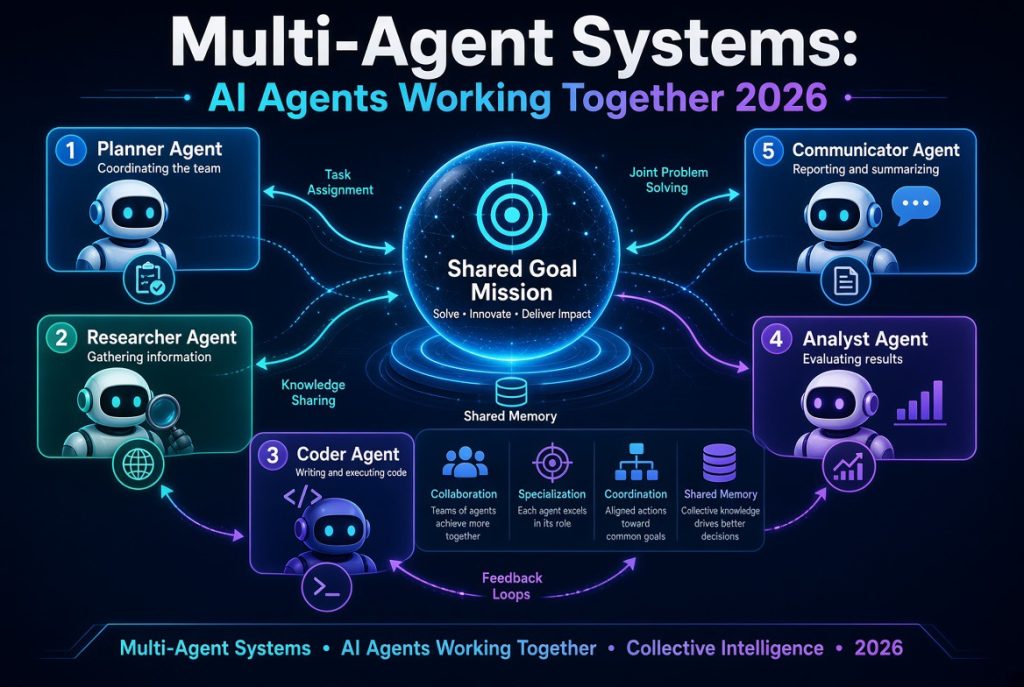
Multi-Agent Systems Explained: How AI Agents Work Together in 2026
Multi-agent systems are AI architectures in which multiple specialized agents collaborate to solve problems, execute workflows, exchange information, and make decisions. Instead of asking one AI agent to handle an entire process, developers can divide the work among several agents with clearly defined responsibilities.
For example, a software development workflow could use one agent for planning, another for coding, another for testing, another for security review, and another for documentation. These agents can communicate through an orchestration layer and combine their results into a single workflow.
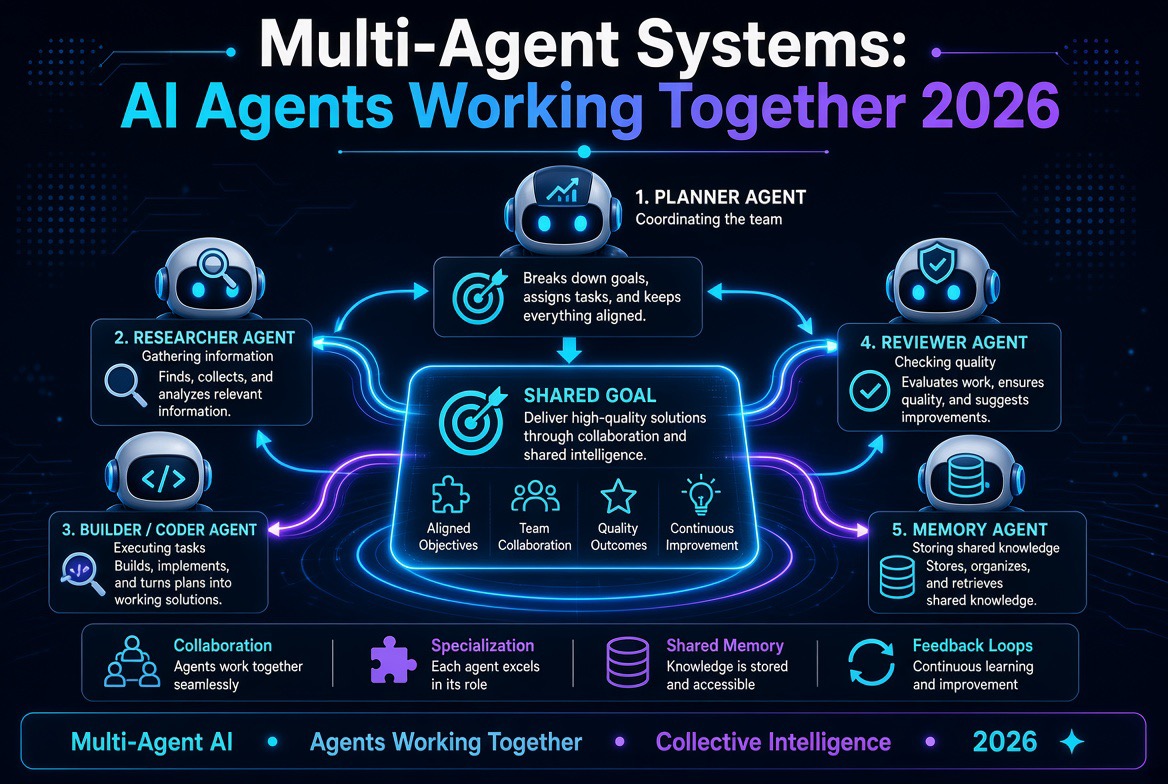
Multi-Agent Systems: Quick Answer
Multi-agent systems are AI systems where two or more specialized agents collaborate to accomplish a shared objective. Each agent can have its own instructions, tools, memory, permissions, and responsibilities. A coordinator or communication layer manages how agents exchange information, delegate tasks, and combine results.
They are most useful when a workflow contains several distinct tasks that require different tools, expertise, or decision-making steps. They are not automatically better than a single AI agent, however. Adding agents also introduces additional latency, cost, security risks, and engineering complexity.
That last point is important. The biggest mistake organizations can make in 2026 is assuming that adding more agents automatically creates a more intelligent system. In practice, a well-designed single agent can outperform an unnecessarily complicated team of agents.
This guide explains how multi-agent architectures work, the major design patterns, real-world applications, frameworks, communication models, security considerations, costs, and when organizations should—or should not—use them.
What Are Multi-Agent Systems?
A multi-agent system is a software architecture made up of multiple autonomous or semi-autonomous agents that interact with one another to accomplish a goal.
Each agent is typically designed around a particular role. Depending on the application, an agent may have access to a language model, tools, APIs, databases, files, memory, external services, or other agents.
Consider a business research task. Instead of giving one AI agent the responsibility of searching the web, analyzing information, checking sources, preparing an executive summary, and formatting a report, a multi-agent architecture could divide those responsibilities.
- Research agent: collects relevant information.
- Verification agent: checks sources and identifies inconsistencies.
- Analysis agent: interprets the information.
- Writing agent: produces the report.
- Review agent: checks the final output.
The result is not simply five chatbots. The important part is the architecture connecting them: task routing, communication, shared or isolated context, permissions, state management, error handling, and final-result synthesis.
Modern frameworks increasingly support these patterns. For example, the official LangChain documentation describes approaches including subagents, handoffs, routers, skills, and custom workflows, while Microsoft’s AutoGen provides abstractions for building conversational and distributed multi-agent applications. LangChain’s multi-agent documentation and Microsoft AutoGen documentation are useful starting points for developers exploring these architectures.
Why Multi-Agent Systems Matter in 2026
AI systems are moving beyond simple question-and-answer interactions. Increasingly, businesses want AI to perform sequences of actions involving multiple applications, data sources, decisions, and people.
A single agent can sometimes manage these workflows, but there are limits to how much context, tooling, responsibility, and decision-making can be placed into one system.
Multi-agent architectures provide another option: divide the workflow into specialized components.
- Break complicated objectives into smaller tasks
- Assign specialized responsibilities to individual agents
- Allow independent tasks to execute in parallel
- Separate sensitive capabilities through permissions
- Reduce the amount of context each agent needs to process
- Make large AI applications more modular
- Allow different models to be used for different tasks
- Support complex business automation
LangChain’s current documentation makes a similar architectural point: multi-agent approaches can be useful when a single agent has too many tools, when specialized knowledge is required, or when tasks can be parallelized. It also emphasizes that not every complicated application needs multiple agents. See the LangChain multi-agent architecture guide.
How Multi-Agent Systems Work
Although implementations differ, most multi-agent applications contain several fundamental components.
1. The User or Business Goal
Everything begins with an objective.
The objective might be:
- Build and test an application
- Research a new market
- Analyze financial information
- Resolve a customer support issue
- Process an insurance claim
- Monitor cloud infrastructure
- Generate and publish a marketing campaign
The system must translate that broad objective into executable tasks.
2. The Orchestrator
An orchestrator determines how the workflow should progress.
It may decide which agent should receive a task, whether several agents should work simultaneously, whether a result needs additional verification, and when the workflow should terminate.
The orchestrator does not necessarily have to be another AI agent. It can also be deterministic software, a workflow engine, a state machine, or a combination of AI and traditional programming.
This distinction matters because deterministic orchestration can make production systems easier to control.
3. Specialized Agents
Each agent is responsible for a particular capability or stage of the workflow.
A coding agent might have access to a repository and development environment. A research agent might have search tools. A database agent might have controlled access to SQL queries. A customer-support agent might have access to CRM information.
Giving agents different responsibilities also makes permissions easier to manage.
4. Communication Layer
Agents need a mechanism for exchanging information.
Messages may contain:
- Task instructions
- Structured data
- Context
- Intermediate results
- Errors
- Status updates
- Approval requests
- Tool results
Communication can be centralized, peer-to-peer, event-driven, sequential, or implemented through a combination of patterns.
5. Shared State and Memory
Complex workflows often need some form of state.
The system may need to remember which tasks have been completed, which agent produced a result, which documents were reviewed, or which actions have already been performed.
Importantly, shared context should not mean that every agent receives every piece of information. Excessive context can increase costs, reduce focus, and expose information unnecessarily.
6. Tools and External Systems
Agents become considerably more useful when they can interact with external systems.
These may include:
- Databases
- CRMs
- Cloud platforms
- Git repositories
- Search engines
- Payment systems
- Enterprise applications
- File storage
- Monitoring platforms
This is where technologies such as the Model Context Protocol can become relevant. MCP addresses standardized interaction between AI applications and external tools or resources, while multi-agent architecture focuses on coordinating agents.
Multi-Agent Systems vs Single AI Agents
| Factor | Single AI Agent | Multi-Agent System |
|---|---|---|
| Architecture | Usually simpler | More distributed and complex |
| Specialization | One agent handles multiple responsibilities | Different agents can specialize |
| Context | Often centralized | Can be isolated or shared selectively |
| Cost | Usually easier to control | Can increase with additional model calls |
| Latency | Potentially lower | Parallelism can help, but coordination adds overhead |
| Monitoring | Relatively straightforward | Requires tracing multiple components |
| Best suited for | Focused workflows | Complex workflows requiring specialization |
Our view: organizations should start with a single capable agent whenever possible and introduce additional agents only when there is a measurable architectural reason to do so.
This is not just a matter of simplicity. Every additional agent creates another potential failure point, model call, permission boundary, state transition, and debugging surface.
Microsoft’s current AutoGen guidance similarly recommends starting with a single agent for simpler tasks and moving to teams when the single-agent approach proves inadequate. Microsoft’s AutoGen team documentation provides examples of this approach.
Major Multi-Agent Architecture Patterns
1. Supervisor Architecture
A supervisor agent coordinates several specialized workers.
For example:
User → Supervisor → Research Agent → Analysis Agent → Writing Agent → Supervisor → User
The supervisor determines which specialist should receive each task.
This architecture is relatively intuitive and can be useful when one component needs to maintain a high-level view of the workflow.
The downside is that the supervisor can become a bottleneck. If every decision has to pass through it, latency and model usage can increase.
2. Router Architecture
A router classifies incoming tasks and directs them to the appropriate specialist.
For example:
- Billing question → billing agent
- Technical problem → technical agent
- Sales question → sales agent
- Account problem → account agent
This pattern works particularly well when requests fall into reasonably distinct categories.
3. Sequential Pipeline
In a sequential architecture, each agent performs one stage before passing the result to the next agent.
For example:
Research → Analysis → Writing → Review → Publishing
This is easier to reason about than a highly dynamic system because the workflow has clearly defined stages.
4. Parallel Agents
Several agents can work simultaneously on independent tasks.
For example, a market research workflow could ask separate agents to analyze:
- Competitors
- Pricing
- Customer reviews
- Industry trends
- Market size
A synthesis agent could then combine the results.
Parallel execution can reduce elapsed time, although it may increase total model usage.
5. Peer-to-Peer Collaboration
In peer-to-peer architectures, agents can communicate directly rather than always going through a central supervisor.
This can create more flexible systems, but it also increases coordination complexity.
6. Handoff-Based Systems
One agent can transfer responsibility to another agent when the second agent is better suited to continue the task.
For example, a general customer-service agent could hand a conversation to a billing specialist after identifying a payment-related issue.
Agent-to-Agent Communication
Communication is the foundation of collaborative AI.
Without reliable communication, multiple agents simply become disconnected AI programs.
In a real multi-agent workflow, agents need to know:
- Who sent the message
- What task is being requested
- What information is relevant
- What permissions apply
- What result is expected
- Whether the task succeeded
- What should happen next
Our detailed guide on agent-to-agent communication explores how AI agents exchange messages, delegate tasks, and coordinate actions.
Multi-Agent Systems and MCP
Multi-agent systems and MCP are related, but they solve different problems.
Multi-agent architecture answers: How should multiple AI agents collaborate?
MCP answers: How can an AI application interact with external tools and resources using a standardized protocol?
An application can therefore use both.
Imagine a software-development system containing a planning agent, coding agent, testing agent, and security agent. Those agents could communicate with one another while using MCP-based integrations to access repositories, documentation, databases, or other tools.
For a deeper explanation, read our MCP (Model Context Protocol) explained guide.
Examples of Multi-Agent Systems
Software Development
Software development is one of the clearest examples of where specialization can make sense.
A development team could contain:
- Product agent: converts requirements into specifications.
- Architecture agent: proposes technical architecture.
- Coding agent: implements features.
- Testing agent: creates and executes tests.
- Security agent: identifies vulnerabilities.
- Documentation agent: creates technical documentation.
However, human review should remain important for production changes, particularly when agents have permission to modify repositories or infrastructure.
Customer Support
A support workflow can use a general intake agent and specialized agents for billing, technical support, account management, and returns.
The system can route the request to the right specialist while maintaining a consistent customer experience.
Business Research
A research system could assign different agents to competitors, customers, market trends, pricing, and industry news.
A synthesis agent then creates the final report.
Marketing Operations
A marketing system could contain separate agents for:
- Keyword research
- Competitor analysis
- Content planning
- Writing
- SEO review
- Social media distribution
- Performance analysis
The important distinction is that each agent should have a clearly defined responsibility. Creating seven agents simply because seven AI prompts are possible does not necessarily create a better system.
IT Operations
Multi-agent architectures can also be applied to IT operations.
One agent could monitor infrastructure, another could investigate incidents, another could analyze logs, and another could prepare remediation recommendations.
For high-risk production changes, however, the workflow should normally require explicit authorization before an agent takes an irreversible action.
Benefits of Multi-Agent Systems
Specialization
The biggest advantage is specialization.
An agent designed specifically for database analysis can have different instructions and tools from an agent responsible for customer communications.
Parallel Processing
Independent tasks can sometimes run concurrently.
This can reduce the time required to complete a workflow even though the total amount of computation may increase.
Modularity
Individual agents can potentially be modified or replaced without rebuilding the entire application.
Better Context Management
Specialized agents can receive only the information relevant to their tasks.
This can reduce unnecessary context and improve the clarity of their instructions.
Flexible Model Selection
Not every task requires the same model.
A workflow could use a more capable model for complex reasoning while using smaller or faster models for classification, formatting, extraction, or routine tasks.
Workflow Automation
Multiple agents can coordinate processes that previously required people to manually transfer information between applications.
The Hidden Costs of Multi-Agent AI
Multi-agent systems are powerful, but their advantages come with costs that are easy to overlook.
More Model Calls
If five agents each make several model calls, token usage can increase rapidly.
A workflow that looks inexpensive at the prototype stage can become expensive at production scale.
Latency
Sequential agent calls add time.
Parallel processing can reduce elapsed time, but synchronization and result aggregation still introduce overhead.
Debugging Complexity
When a final answer is wrong, developers need to determine which agent caused the problem.
Was the research incorrect? Did the analysis agent misunderstand the result? Did the router select the wrong specialist? Did the synthesis agent combine conflicting information incorrectly?
Observability therefore becomes a fundamental requirement rather than an optional feature.
Operational Complexity
Each agent may require:
- Configuration
- Prompts
- Tools
- Permissions
- Monitoring
- Logging
- Version management
- Error handling
Security Risks in Multi-Agent Systems
Security deserves special attention because multi-agent applications can combine autonomous reasoning with access to real systems.
An agent that can read data is one thing. An agent that can read data, modify records, send messages, execute code, and delegate tasks to other agents presents a much larger attack surface.
Organizations should therefore apply least-privilege principles.
- Give each agent only the permissions it needs.
- Separate read and write capabilities.
- Authenticate agent identities.
- Log sensitive actions.
- Require approval for high-risk operations.
- Protect credentials and API keys.
- Validate tool inputs and outputs.
- Monitor unusual agent behavior.
AI governance should also be treated as an engineering concern. The NIST AI Risk Management Framework provides a useful reference for organizations managing AI risks and trustworthiness considerations across the AI lifecycle.
NIST’s framework is voluntary, but its emphasis on governance, mapping, measurement, and management provides a practical way to think about production AI systems rather than treating AI safety as something added after deployment.
Multi-Agent Systems and Human Oversight
Autonomy should not mean removing humans from every decision.
For low-risk activities such as summarizing documents, categorizing information, or preparing drafts, a high degree of automation may be appropriate.
For high-impact activities involving financial transfers, production infrastructure, legal decisions, medical decisions, security changes, or sensitive customer information, organizations should consider human approval gates.
A useful design principle is:
The greater the potential impact of an agent’s action, the stronger the authorization and verification requirements should be.
This approach aligns with the broader risk-management philosophy behind NIST’s AI guidance, which emphasizes trustworthy and responsible AI throughout design, development, deployment, use, and evaluation. Read the NIST AI RMF.
Popular Frameworks for Multi-Agent Systems
Developers do not necessarily need to build every orchestration mechanism from scratch.
LangChain and LangGraph
The LangChain ecosystem provides tools and patterns for building agent applications, including multi-agent architectures. LangGraph can be used for more controlled, stateful workflows where developers need explicit orchestration.
Its documentation describes patterns such as routers, subagents, handoffs, and custom workflows. Explore LangChain’s official multi-agent documentation.
CrewAI
CrewAI focuses on teams of AI agents working together through defined roles, tasks, and workflows. It is particularly appealing to developers who want a relatively intuitive mental model for assigning responsibilities to multiple agents.
Visit the official CrewAI documentation for current implementation details.
Microsoft AutoGen
AutoGen provides programming abstractions for building AI agents and multi-agent applications. Its current architecture includes AgentChat and Core, with support for team patterns, messaging, distributed runtimes, and agent orchestration.
Microsoft’s documentation describes both standalone and distributed agent runtimes, making AutoGen relevant for developers exploring more advanced multi-agent architectures. Explore Microsoft AutoGen.
For a broader comparison, see our AI agent frameworks comparison and our LangChain vs CrewAI comparison.
How to Choose a Multi-Agent Framework
The best framework is not necessarily the one with the most features.
Consider the following factors:
| Requirement | What to Evaluate |
|---|---|
| Workflow control | Can you explicitly control routing and execution? |
| Communication | How do agents exchange messages? |
| State | Can workflow state be persisted and recovered? |
| Observability | Can developers trace agent decisions and tool calls? |
| Tools | Can agents securely access APIs and external systems? |
| Scalability | Can the architecture support distributed execution? |
| Developer experience | How easy is it to test and debug? |
| Security | Can permissions be separated between agents? |
When Should You Use Multi-Agent Systems?
There is no reason to use multiple agents simply because the technology is available.
A single agent is often enough for:
- Simple chatbots
- Document summarization
- Basic content generation
- Simple classification
- Straightforward question answering
- Single-tool workflows
A multi-agent approach becomes more attractive when:
- The workflow contains clearly separable responsibilities.
- Different tasks require different tools.
- Different tasks require different context.
- Independent work can run in parallel.
- Different agents need different permissions.
- The application needs modular specialization.
- A single agent consistently struggles with tool selection or context management.
Our recommendation: build the simplest architecture that solves the problem, measure where it fails, and introduce additional agents to solve specific limitations.
When You Should Not Use a Multi-Agent Architecture
Sometimes the right engineering decision is not to build one.
If a workflow has only two or three predictable steps, traditional application logic may be more reliable and cheaper.
For example, a process such as:
Receive form → Validate fields → Save database record → Send email
does not automatically become better because an AI agent is placed at every step.
Deterministic software is often preferable when the rules are known and predictable.
The real value of AI agents appears when the workflow involves interpretation, ambiguous inputs, planning, reasoning, or dynamic tool selection.
How to Build a Multi-Agent System
Step 1: Define the Business Objective
Do not begin with “How many agents should we create?”
Start with the business problem.
Define what the system needs to accomplish and what success means.
Step 2: Map the Existing Workflow
Document how humans currently perform the task.
Identify:
- Inputs
- Decisions
- Tools
- Approvals
- Outputs
- Failure conditions
Step 3: Identify Natural Responsibilities
Look for places where the workflow naturally separates into specialized functions.
Step 4: Start Small
Begin with two or three agents rather than ten.
Prove that collaboration provides measurable value before adding more complexity.
Step 5: Define Communication Contracts
Decide what information each agent should receive and what output it must return.
Structured data is usually preferable to unrestricted text when reliability matters.
Step 6: Add Observability
Log agent requests, responses, tool calls, errors, latency, token usage, and workflow state.
Without observability, diagnosing failures becomes extremely difficult.
Step 7: Add Security Controls
Define exactly what each agent can read, write, execute, and delegate.
Step 8: Evaluate Before Production
Test normal cases, edge cases, malicious inputs, tool failures, conflicting information, and unexpected agent behavior.
Evaluating Multi-Agent Performance
A multi-agent system should be measured using more than the quality of its final response.
Useful metrics include:
- Task success rate: How often does the workflow achieve its objective?
- Accuracy: How reliable are the results?
- Latency: How long does each workflow take?
- Cost: How many tokens, model calls, and infrastructure resources are consumed?
- Tool success rate: How often do external actions succeed?
- Escalation rate: How often does the system require human intervention?
- Error recovery: Can the system recover from failed steps?
- Safety: Does the system stay within its permissions?
A system that produces excellent answers but costs ten times more than a simpler architecture may not be a successful production system.
Multi-Agent Systems and Cost Optimization
Cost control becomes particularly important as the number of agents increases.
Suppose one workflow uses six agents, each making multiple model calls. The total cost can quickly exceed that of a single-agent implementation.
Several strategies can help:
- Use smaller models for simple tasks.
- Cache repeated information.
- Limit unnecessary agent conversations.
- Run independent tasks concurrently.
- Use deterministic logic for predictable operations.
- Set maximum iteration limits.
- Terminate workflows when the objective is already satisfied.
- Track token and API usage by agent.
Cost should therefore be treated as an architectural metric, not simply an infrastructure bill.
Multi-Agent Systems for Business
Businesses are likely to be among the biggest users of collaborative AI because many business processes naturally contain multiple departments and specialized responsibilities.
A customer onboarding workflow, for example, might involve:
- Customer intake
- Identity verification
- Risk analysis
- Account creation
- Document processing
- Customer communication
AI agents could potentially support different parts of that process while an orchestration layer coordinates execution.
Similarly, an e-commerce company could deploy agents for customer support, inventory, order processing, marketing, analytics, and reporting.
Explore the broader business use cases in our AI agents for business guide.
Multi-Agent Systems and Enterprise Architecture
Enterprise adoption requires thinking beyond prompts and models.
A production architecture may need:
- Identity management
- API gateways
- Secrets management
- Databases
- Message queues
- Workflow orchestration
- Observability
- Audit logging
- Model gateways
- Human approval systems
- Security monitoring
This means multi-agent engineering increasingly overlaps with traditional distributed-systems engineering.
Developers need to understand not only AI models but also APIs, authentication, databases, queues, cloud infrastructure, monitoring, failure recovery, and software architecture.
This is one reason we recommend learning multi-agent systems as an extension of software engineering rather than treating them as a replacement for it.
Multi-Agent AI and Traditional Software Engineering
The strongest production systems will probably combine deterministic software with AI agents rather than choosing one or the other.
For example, an application might use traditional code to enforce authentication, authorization, transaction limits, database constraints, and workflow state while using AI agents for interpretation, classification, planning, or natural-language interaction.
This hybrid approach gives developers more control over the parts of a system where predictability matters most.
E-E-A-T Perspective: Are Multi-Agent Systems Really the Future?
There is a lot of enthusiasm around multi-agent AI, but the technology deserves a more measured assessment.
Our analysis: multi-agent systems are likely to become an important architecture for certain classes of AI applications, but they will not replace every single-agent application.
The strongest use cases are workflows where specialization genuinely matters.
The weakest use cases are simple tasks where multiple agents merely create additional conversation and cost.
The distinction is similar to traditional software architecture. Microservices can provide modularity and independent deployment, but splitting a small application into dozens of services can create unnecessary operational complexity. Multi-agent AI has a similar architectural trade-off.
The winning strategy is therefore not “use more agents.” It is “use the right number of agents for the problem.”
Organizations should judge a multi-agent system based on measurable business outcomes: lower processing time, improved accuracy, reduced manual work, better customer service, increased throughput, or lower operating costs.
Future of Multi-Agent Systems in 2026 and Beyond
The next stage of agentic AI is likely to focus less on isolated agents and more on ecosystems of agents, tools, services, and humans.
Several developments are particularly important.
Agent Discovery
Agents may increasingly discover which other agents or services can provide a required capability.
Dynamic Delegation
Instead of following a fixed workflow, systems may dynamically decide which agent should handle each task.
More Distributed Architectures
Agents may run across different servers, cloud environments, applications, or organizations.
Improved Agent Protocols
Standardized communication mechanisms can make it easier for independently developed agents to interact.
Better Observability
As workflows become more complex, tracing and evaluation will become increasingly important.
Human-Agent Collaboration
The future is unlikely to be completely autonomous. Many high-value workflows will probably combine human judgment with AI execution.
Multi-Agent Systems: Practical Decision Framework
If you are deciding whether to build a multi-agent application, ask these questions:
- Can one agent solve the problem reliably? If yes, start there.
- Are there clearly different responsibilities? If yes, specialization may help.
- Can tasks run independently? If yes, parallel agents may reduce latency.
- Do different tasks require different tools or permissions? If yes, separate agents may improve security and architecture.
- Can you monitor every important action? If not, improve observability before increasing autonomy.
- Can you afford the additional model and infrastructure costs? Measure this before deployment.
- What happens when an agent fails? Build retries, fallbacks, and human escalation.
If you cannot answer these questions clearly, the architecture probably needs more design work before production.
Related AI Agent Resources
If you are building a broader AI agent technology stack, these resources can help you continue your research:
- Agent-to-agent communication
- MCP (Model Context Protocol) explained
- AI agent frameworks comparison
- LangChain vs CrewAI comparison
- AI agent development tools
- AI agents for business
Conclusion
Multi-agent systems provide a powerful way to build AI applications that can divide complex objectives among specialized agents, coordinate tasks, exchange information, and combine results.
The architecture can be particularly useful for software development, research, customer support, business automation, marketing, IT operations, and other workflows that naturally contain multiple specialized responsibilities.
But multi-agent architecture is not a shortcut to better AI. It introduces additional model calls, communication overhead, security boundaries, state-management challenges, and debugging complexity.
The most effective approach is to begin with the simplest architecture that can solve the problem. If a single agent works, there may be no reason to add more. If the workflow contains distinct responsibilities that benefit from specialization, parallelization, or different permissions, a multi-agent architecture can provide significant advantages.
For developers, the important skill is therefore not simply learning how to create multiple AI agents. It is learning how to design reliable systems in which agents, tools, software, data, and humans work together safely.
That architectural thinking will become increasingly valuable as AI moves from standalone assistants toward autonomous, interconnected software systems.
FAQ
What are multi-agent systems?
Multi-agent systems are AI applications in which multiple specialized agents communicate and collaborate to accomplish a shared objective or complete a complex workflow.
What is the difference between a single AI agent and a multi-agent system?
A single AI agent generally handles a workflow independently, while a multi-agent system divides responsibilities between multiple specialized agents that communicate and coordinate with one another.
What are multi-agent systems used for?
Multi-agent systems can support software development, customer service, business research, marketing automation, IT operations, data analysis, workflow automation, and other complex processes requiring multiple specialized capabilities.
Do multi-agent systems always perform better than single AI agents?
No. Multi-agent systems can improve specialization and workflow coordination, but they also introduce additional cost, latency, communication, and engineering complexity. A single agent may be better for simpler tasks.
What frameworks can developers use to build multi-agent systems?
Developers can use frameworks and platforms such as LangChain, LangGraph, CrewAI, Microsoft AutoGen, and other agent orchestration technologies to build collaborative AI applications.
How do AI agents communicate in a multi-agent system?
AI agents can communicate through structured messages, shared state, orchestration layers, event-driven systems, direct handoffs, or other application-specific communication mechanisms.
Are multi-agent systems expensive to operate?
They can be more expensive than single-agent applications because multiple agents may require additional model calls, tokens, infrastructure, monitoring, and communication. Cost optimization should be part of the architecture from the beginning.
Are multi-agent systems secure?
Multi-agent systems can be designed securely, but multiple autonomous components increase the number of permissions, tools, communication channels, and potential failure points that must be protected and monitored.

Leave a reply