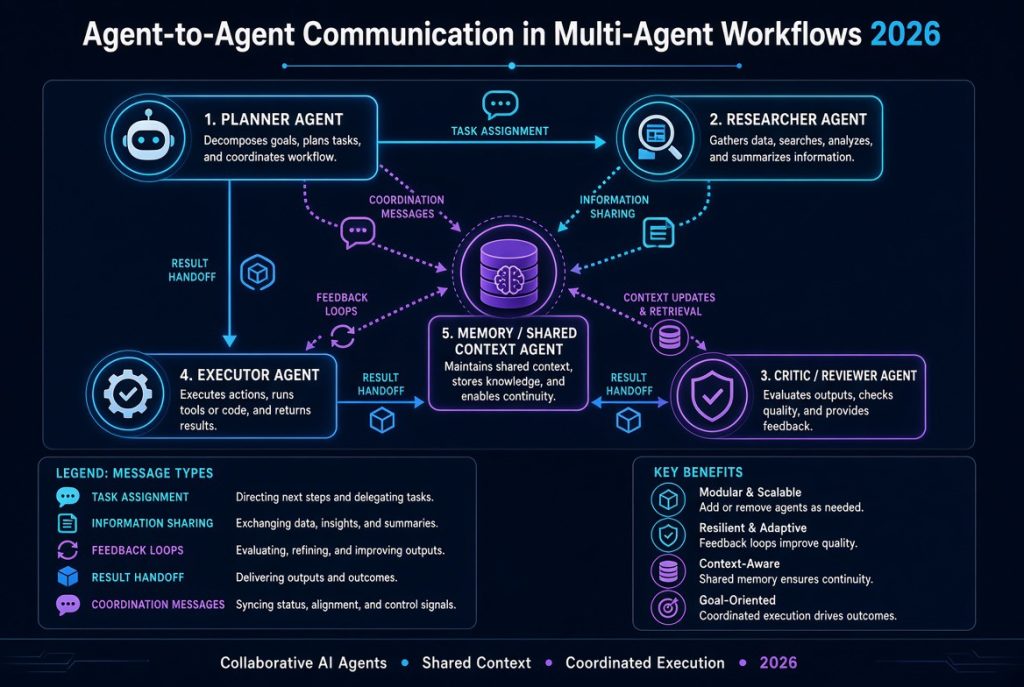
Agent-to-Agent Communication: How AI Agents Work Together in 2026
Agent-to-agent communication is how two or more AI agents exchange tasks, information, context, instructions, and results while working toward a larger objective. Instead of forcing one AI agent to handle an entire workflow, developers can give different agents specialized responsibilities and allow them to coordinate.
This is becoming increasingly important as AI moves beyond chatbots and simple assistants. In a modern business workflow, one agent might research a customer, another could analyze the information, a third might check a database, and another could prepare the final response. The agents do not necessarily need to use the same model, framework, programming language, or infrastructure.
That is where agent-to-agent communication becomes interesting. It turns a collection of independent AI capabilities into something that can behave more like a coordinated software system.
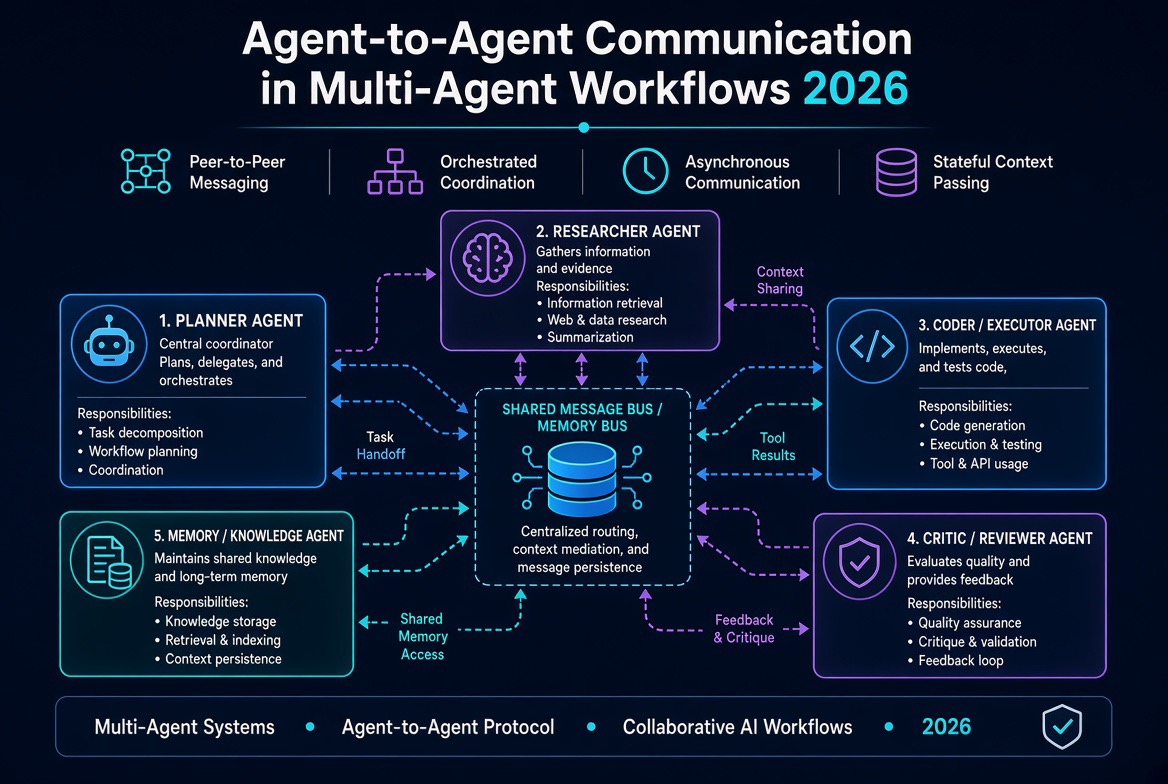
Quick Answer: What Is Agent-to-Agent Communication?
Agent-to-agent communication is the exchange of tasks, information, context, instructions, and results between AI agents that are collaborating on a larger objective.
A simple system might have one agent invoke another agent like a software tool. A more distributed architecture can use an open interoperability protocol such as Agent2Agent (A2A), allowing independently built agents to discover capabilities, exchange messages, manage tasks, and collaborate across application or organizational boundaries.
A2A was originally introduced by Google in 2025 and is now governed as an open project under the Linux Foundation. The A2A specification reached version 1.0.0 in 2026, marking a significant step toward standardized agent interoperability.
For developers, this means agent communication is becoming another important layer of AI application architecture alongside models, tools, memory, authentication, orchestration, observability, and data infrastructure.
If you are new to the broader subject, start with our AI agents for business guide.
What Is Agent-to-Agent Communication?
At its simplest, agent-to-agent communication means that one AI agent can pass work or information to another AI agent and receive something back.
Think of it less like two chatbots having a conversation and more like distributed software components working together.
Imagine a customer contacts a company because a payment was deducted but an order was not completed. Instead of giving one general-purpose agent unrestricted access to every internal system, the workflow could be divided:
- A customer-service agent receives the complaint.
- A billing agent verifies the payment.
- An order agent checks whether the transaction created an order.
- A fraud agent evaluates suspicious activity.
- An resolution agent determines the appropriate next step.
The customer may experience this as one conversation. Behind the scenes, several specialized agents may have contributed to the result.
The important concept is specialization. Each agent can have different instructions, tools, permissions, data sources, and responsibilities.
That can be safer and easier to manage than creating one enormous agent with access to every system in the organization.
Why Agent-to-Agent Communication Matters in 2026
AI agents are increasingly being used for workflows rather than isolated questions. A real business process may involve documents, databases, APIs, approvals, calculations, security policies, human decisions, and several software systems.
A single agent can sometimes handle all of this. But as the workflow becomes more complicated, specialization can become useful.
- Complex workflow automation: Large processes can be divided into smaller responsibilities.
- Specialization: Agents can be designed around specific domains or tasks.
- Interoperability: Independent agents can potentially communicate across frameworks and technology stacks.
- Parallel execution: Independent tasks can sometimes run at the same time.
- Security boundaries: Agents can receive only the permissions required for their specific responsibilities.
- Scalability: New capabilities can be introduced without redesigning the entire application.
The important word here is potentially. Multi-agent architecture does not automatically make an AI system faster, smarter, or cheaper. It introduces another layer of distributed-system complexity.
That trade-off is one of the most important things developers should understand before adopting it.
How Agent-to-Agent Communication Works
A multi-agent system is more than several language models connected together. A production architecture normally needs some combination of agents, orchestration, communication protocols, identity, state management, tools, security controls, and observability.
1. A User or System Creates a Goal
Everything starts with an objective.
The request could be a customer-service problem, a software-development task, a research question, a sales workflow, or an internal business operation.
An orchestrator or primary agent determines what needs to happen and whether another agent should handle part of the work.
2. The Workflow Is Decomposed
The larger objective is divided into smaller tasks.
For example, an AI research workflow might require:
- collecting information
- checking sources
- analyzing the findings
- identifying contradictions
- producing a report
- reviewing the final output
Different tasks can then be assigned to agents with appropriate capabilities.
3. Agents Exchange Structured Messages
The communication layer carries information between agents.
A message might include a task, context identifier, metadata, instructions, status information, requested output format, or a reference to previous work.
Structured messages are generally preferable to passing arbitrary text because they make validation, monitoring, retries, auditing, and integration easier.
4. The Receiving Agent Performs the Work
The receiving agent uses its own model, instructions, tools, and data to complete the task.
It might query a database, call an API, search documents, execute code, analyze an image, or ask another agent to perform a separate task.
5. The Agent Returns a Result
The result could be a simple answer, structured data, a file, a status update, or a request for additional information.
In longer-running workflows, the result may not be available immediately. The system may instead track the task until it reaches a completed, failed, cancelled, or input-required state.
6. The Workflow Continues
The orchestrator evaluates the result and decides what happens next.
It might send the result to another agent, ask the original agent to continue, request human approval, retry the operation, or finish the workflow.
This is why multi-agent systems are closely related to workflow orchestration. Communication moves information; orchestration determines what should happen with it.
Agent-to-Agent Communication Architecture
A useful way to understand the architecture is to view it as several layers:
| Layer | Purpose |
|---|---|
| User or business application | Creates the business objective or request |
| Orchestrator | Plans, delegates, coordinates, and monitors work |
| Communication layer | Transfers messages, tasks, and results between agents |
| Specialized agents | Perform domain-specific reasoning and actions |
| Tools and APIs | Allow agents to interact with external systems |
| Memory and data | Provide context, state, and relevant information |
| Identity and security | Controls authentication, authorization, and trust |
| Observability | Tracks latency, failures, costs, tasks, and agent behavior |
This distinction matters because an agent is only one component of a production system. A sophisticated model cannot compensate for poor identity management, unreliable communication, weak observability, or badly designed workflows.
Single-Agent vs Multi-Agent AI Systems
One of the easiest mistakes in agentic AI development is assuming that more agents automatically means a better architecture.
It does not.
| Single-Agent Architecture | Multi-Agent Architecture |
|---|---|
| One primary agent handles the workflow | Several specialized agents collaborate |
| Usually simpler to build | More distributed and operationally complex |
| Easier debugging and tracing | Requires stronger observability |
| Lower communication overhead | Additional network and coordination overhead |
| Good for focused workflows | Useful when specialization provides measurable value |
| Centralized control | Can distribute capabilities and permissions |
Our analysis: start with the simplest architecture that can reliably solve the problem.
If one agent can perform the workflow using a manageable collection of tools, adding four more agents may simply create more latency, model calls, failure points, and infrastructure to maintain.
Multi-agent architecture becomes more attractive when there is a genuine reason to separate responsibilities—for example, different security permissions, specialized expertise, independent systems, organizational boundaries, or workloads that can run concurrently.
Real-World Examples of Agent-to-Agent Communication
Customer Support
Consider a customer who says:
“My account was charged, but my order failed.”
A support agent could coordinate several specialized agents:
- Billing agent: verifies whether the payment succeeded.
- Order agent: checks the order lifecycle.
- Fraud agent: evaluates unusual activity.
- Resolution agent: determines whether the customer should receive a refund, retry, or escalation.
The advantage is not simply having more AI. The advantage is that each component can have a narrower responsibility and permission boundary.
Software Development
Software development is another promising use case.
A development workflow could contain a requirements agent, coding agent, testing agent, security-review agent, and documentation agent.
The agents should not necessarily be allowed to modify everything. A better design might give each one tightly controlled access to repositories, test environments, issue trackers, or deployment systems.
For more tools and platforms used to build these applications, see our AI agent development tools guide.
Research and Analysis
A research agent could gather information from approved sources. An analysis agent could compare the findings. A verification agent could check important claims, while a reporting agent turns the final dataset into a business report.
This architecture becomes particularly useful when different stages require different tools or expertise.
Sales Automation
A sales workflow might contain agents for lead qualification, company research, CRM updates, personalization, proposal preparation, and approval.
High-impact actions such as changing customer records or sending commercial proposals can remain behind explicit authorization or human approval.
Agent-to-Agent Communication in Enterprise Workflows
Enterprise environments make interoperability considerably more complicated.
A large organization may have a CRM, ERP, ticketing system, databases, document repositories, cloud services, communication platforms, and internal APIs. These systems may be owned by different teams and built using different technologies.
This is where standardized agent communication becomes more interesting.
Rather than building a custom integration for every possible agent pair, organizations can use a common communication contract.
The Linux Foundation’s A2A project was created specifically to address interoperability between independently built agents. In April 2026, the foundation reported more than 150 organizations supporting A2A and adoption across major cloud platforms and enterprise environments.
What Is A2A?
A2A stands for Agent2Agent. Unlike the general concept of agent-to-agent communication, A2A is a specific open protocol designed to standardize communication between independent AI agents.
Google originally introduced A2A in 2025. The project was subsequently contributed to and hosted by the Linux Foundation, where it continues under open governance.
The current A2A specification is version 1.0.0. It defines a common interaction model for agents built by different vendors, frameworks, and technology stacks.
A2A is designed around several important capabilities:
- agent discovery
- capability description
- message exchange
- task management
- different interaction modalities
- long-running work
- interoperability across frameworks and vendors
- communication without requiring access to another agent’s private internal state
For example, an agent can discover another agent’s capabilities through an Agent Card, determine how to communicate with it, submit work, and receive the resulting messages, task updates, or artifacts.
The A2A specification explicitly aims to let agents collaborate without requiring one agent to know the other agent’s internal reasoning, memory, or tools.
Agent-to-Agent Communication vs Agents as Tools
These two patterns are related, but they solve different architectural problems.
With an agent-as-tool design, a parent agent invokes another agent much like it would invoke a function. This can be a very effective pattern when the agents live inside the same application or runtime.
Microsoft’s current Agent Framework documentation describes this as a useful pattern for in-process agent composition. A2A is more appropriate when the communication needs to cross application, service, framework, or organizational boundaries.
| Agents as Tools | A2A |
|---|---|
| Often used inside the same application | Designed for communication across service boundaries |
| Usually tightly integrated | Designed for interoperability |
| Framework manages invocation | Uses a standardized communication protocol |
| Lower architectural overhead | Greater flexibility with distributed-system overhead |
| Good for tightly controlled workflows | Useful for independent or remote agents |
A useful rule is simple: if another agent is effectively a function inside your application, an agent-as-tool pattern may be enough. If it is an independent service that needs to communicate across a boundary, A2A becomes much more interesting.
A2A vs MCP: What Is the Difference?
One of the most common sources of confusion in agentic AI is treating A2A and MCP as competing protocols.
They address different problems.
| Technology | Primary Role |
|---|---|
| MCP | Connect AI applications to tools, resources, and external context |
| A2A | Enable communication and collaboration between AI agents |
| Orchestration | Determine how workflows are planned, executed, and recovered |
| APIs | Connect conventional software services and applications |
In practical terms, an agent could use MCP to access a database or business tool and use A2A to communicate with another agent.
The two technologies can therefore exist in the same architecture rather than replacing one another.
MCP itself has continued to evolve rapidly. Its July 2026 specification introduced changes including a stateless protocol core, multi-round-trip requests, header-based routing, authorization improvements, and a formal extensions framework.
For a deeper explanation, see our MCP Model Context Protocol explained guide.
How A2A Agent Discovery Works
One of the more interesting parts of A2A is that agents can describe their capabilities rather than requiring every client to know everything about them in advance.
An Agent Card can provide information such as:
- agent name
- description
- version
- supported interfaces
- capabilities
- authentication requirements
Microsoft’s current Agent Framework implementation supports discovering remote A2A agents through Agent Cards, including standardized well-known locations and catalog-based discovery.
This is important because large organizations may eventually operate hundreds or thousands of agents. Hard-coding every agent relationship would become difficult to maintain.
How Multi-Agent Systems Handle Long-Running Tasks
Not every agent task can be completed in one request.
A research agent might need several minutes to gather information. A software agent may need to run a test suite. A business workflow could wait for an approval before continuing.
A modern agent communication system therefore needs more than request-and-response messaging.
A2A supports task-oriented interactions where work can continue beyond the initial message. Current Microsoft implementations also expose streaming and background-response patterns for remote A2A agents.
This makes agent communication look increasingly similar to distributed application infrastructure: tasks have identities, states, timeouts, failures, retries, and completion conditions.
Frameworks for Building Multi-Agent Systems
Developers have several options for building multi-agent applications. The best choice depends on the workflow rather than the popularity of the framework.
- LangChain: provides abstractions for building LLM-powered applications, agents, and tool-based workflows.
- CrewAI: focuses heavily on role-based agent collaboration and task-oriented workflows.
- Microsoft Agent Framework: provides agent composition, workflow capabilities, and A2A integration.
- Custom architecture: teams can build multi-agent systems using APIs, queues, event buses, databases, and workflow engines without adopting a single agent framework.
Microsoft’s current documentation demonstrates A2A integration across Python, .NET, and Go, including remote-agent invocation and hosting.
For broader comparisons, see our AI agent frameworks comparison and LangChain vs CrewAI comparison.
Security Challenges in Agent-to-Agent Communication
Adding more autonomous components also means adding more places where something can go wrong.
Authentication
Agents should not automatically trust every other agent they encounter.
Remote agent endpoints need an appropriate identity and authentication mechanism. Depending on the environment, that might involve API credentials, OAuth-based mechanisms, workload identities, or enterprise identity platforms.
Authorization
Authentication answers “Who are you?”
Authorization answers “What are you allowed to do?”
A payment-analysis agent might be allowed to read transaction information but have no permission to issue a refund. A customer-support agent might be able to create a ticket but not delete an account.
These boundaries become increasingly important as agents gain the ability to take real-world actions.
Data Protection
Agent messages can contain sensitive information, including customer records, financial data, documents, internal instructions, and proprietary business information.
Organizations should therefore consider encryption, data minimization, access controls, retention policies, and auditing as part of the architecture rather than afterthoughts.
Prompt Injection
Agent outputs should not automatically be considered trustworthy simply because they came from another AI system.
An agent may have processed an email, web page, uploaded document, or other untrusted content containing malicious instructions. Those instructions could potentially influence subsequent agents.
Every agent should therefore operate within explicit trust boundaries, especially when its output can trigger sensitive actions.
Confused-Deputy and Privilege Risks
A particularly dangerous design is allowing one low-trust agent to indirectly exercise the privileges of a highly privileged agent.
For example, a research agent should not be able to convince a financial agent to execute a payment simply by placing an instruction in its output.
Permission boundaries should survive agent-to-agent delegation.
Reliability and Observability
Multi-agent systems are distributed systems, and distributed systems fail.
Networks disconnect. Agents time out. Models return malformed outputs. Services become unavailable. Tasks get duplicated. Versions change.
That means production systems need visibility into the entire workflow rather than only individual model responses.
Useful telemetry includes:
- agent identity
- task ID
- context ID
- request and response metadata
- latency
- tool calls
- failure reasons
- retry attempts
- model and token usage
- authorization decisions
- workflow state
Microsoft’s current A2A guidance specifically highlights network overhead, timeouts, retries, failures, and versioning as considerations when agents communicate remotely.
Without adequate observability, troubleshooting a workflow involving five agents can quickly become much harder than troubleshooting one conventional application.
Performance and Cost Considerations
More agents do not automatically mean better performance.
Every additional agent can add:
- model inference costs
- network latency
- message-processing overhead
- additional failure points
- more complex monitoring
- more state to manage
A workflow that requires one model call should not become five model calls simply because the architecture is described as “multi-agent.”
Teams should measure the architecture using real operational metrics:
- average workflow latency
- cost per successful task
- number of agent calls
- retry rate
- failure rate
- human intervention rate
- successful task completion rate
The goal is not to maximize agent count. The goal is to maximize reliable business outcomes per unit of complexity and cost.
Best Practices for Building Multi-Agent Systems
Give Every Agent a Clear Responsibility
Every agent should have a reason to exist.
If two agents have almost identical instructions, tools, permissions, and responsibilities, splitting them may add complexity without creating meaningful value.
Use Structured Communication
Define consistent formats for tasks, responses, errors, status updates, identifiers, and artifacts.
Structured interfaces make it easier to validate data and evolve the system over time.
Minimize Unnecessary Agent Calls
Delegation should solve a problem, not become the objective.
If an orchestrator can safely answer a simple question itself, there may be no reason to invoke another agent.
Apply Least Privilege
Agents should have only the access they need to perform their responsibilities.
This becomes particularly important when an agent can invoke another agent that has more powerful tools.
Design for Failure
Assume that remote agents will occasionally fail.
Use timeouts, retries, idempotency where appropriate, fallback strategies, and clear failure states.
Keep Humans in High-Risk Loops
Autonomy should not mean unlimited authority.
Financial transfers, account deletion, legal decisions, security changes, production deployments, and other high-impact operations may require explicit human approval.
Monitor the Complete Workflow
Do not monitor agents in isolation.
Operators need to understand how the original request moved through the system, which agents were called, what decisions were made, where failures occurred, and why the final result was produced.
When Should You Use a Multi-Agent Architecture?
A multi-agent architecture is most useful when the problem naturally contains distinct responsibilities or system boundaries.
| Scenario | Recommended Approach |
|---|---|
| Simple FAQ chatbot | Single agent |
| Agent with several API tools | Single agent + tools or MCP |
| Complex research workflow | Potentially multi-agent |
| Multiple specialized business departments | Multi-agent can be valuable |
| Independent agents across services | Consider A2A |
| Cross-company agent collaboration | Standardized agent communication becomes especially relevant |
| Safety-critical workflow | Strong governance and human oversight are essential |
Our Analysis: Is Agent-to-Agent Communication Overhyped?
There is a real risk of overengineering multi-agent systems.
The term “multi-agent” sounds sophisticated, and that can create pressure to divide workflows that never needed to be divided in the first place.
Our view is that the strongest use cases are not the ones with the largest number of agents. They are the ones where separation creates a genuine architectural advantage.
Consider a payment workflow. Separating a customer-support agent from a payment agent can make sense because they have different responsibilities, data access requirements, and security permissions.
But imagine a simple summarization task being split into three agents simply because the architecture is supposed to be “agentic.” That is probably unnecessary.
The better principle is:
Build the minimum number of specialized components required to produce a reliable outcome.
That principle is likely to matter even more as agentic systems move from prototypes into production.
Building Agent-to-Agent Communication Into an AI Platform
Organizations building their own AI platforms should treat agent communication as infrastructure rather than allowing every agent team to invent its own messaging mechanism.
A larger platform may eventually need:
- agent registry
- agent identity
- capability discovery
- message routing
- task management
- authentication
- authorization
- workflow orchestration
- persistent state
- event processing
- observability
- usage and cost tracking
- policy enforcement
This becomes increasingly important as the number of agents grows.
With ten agents, manually managing relationships may still be possible. With hundreds of agents owned by different teams, centralized discovery, identity, policy, and observability become much more important.
The Future of Agent-to-Agent Communication
The direction of agentic AI is moving from isolated assistants toward interconnected software systems.
That does not necessarily mean a future where millions of autonomous agents freely communicate with one another without controls. A more realistic path is an ecosystem of specialized agents operating behind defined interfaces, identity systems, permissions, policies, and observability infrastructure.
A2A is an important part of that evolution. The protocol’s move under Linux Foundation governance and its 1.0 release represent a significant step toward a more standardized approach to agent interoperability.
The ecosystem is also becoming broader. In April 2026, the Linux Foundation reported that A2A had surpassed 150 supporting organizations and had integrations across major cloud platforms, alongside production deployments in areas including supply chain, financial services, insurance, and IT operations.
Meanwhile, protocols such as MCP are addressing the complementary problem of connecting AI applications to tools and external resources.
The likely result is not one protocol replacing everything else. It is a layered AI infrastructure stack where models, tools, agents, protocols, orchestration, identity, and governance each solve different problems.
Conclusion
Agent-to-agent communication is becoming an important building block for multi-agent AI systems. It allows specialized agents to exchange information, delegate tasks, coordinate work, and contribute to larger workflows.
Its value becomes especially clear when an application involves multiple areas of specialization, different permission boundaries, independent services, or organizational boundaries.
But multi-agent architecture is not automatically better than a single-agent design. Every additional agent introduces communication overhead, cost, security considerations, state management, and potential failure modes.
The strongest implementations will therefore focus less on maximizing the number of agents and more on creating clear responsibilities and reliable boundaries.
For developers and technology leaders, the important concepts to understand are not just agents themselves, but also orchestration, identity, authorization, observability, structured communication, MCP, and A2A.
As these technologies mature, interoperability could become one of the defining infrastructure challenges of agentic software—and learning how the pieces fit together now provides a strong foundation for building AI systems that can actually operate at scale.
Frequently Asked Questions
What is agent-to-agent communication?
Agent-to-agent communication is the exchange of tasks, information, context, instructions, and results between two or more AI agents working toward a shared objective.
Why do AI agents need to communicate with each other?
Agents communicate so they can delegate specialized tasks, exchange information, coordinate actions, and complete workflows that may be too complex or inefficient for one agent to handle alone.
What is the difference between A2A and agent-to-agent communication?
Agent-to-agent communication is the general concept of AI agents communicating with one another. A2A, or Agent2Agent, is a specific open protocol designed to standardize interoperability and task communication between independent agents.
What is the difference between MCP and A2A?
MCP primarily provides a standardized way for AI applications to connect to tools, resources, and external context, while A2A focuses on communication and collaboration between AI agents.
Can multiple AI agents work together?
Yes. Multiple AI agents can collaborate by dividing a larger objective into specialized tasks and exchanging results through direct calls, orchestration frameworks, messaging systems, or standardized protocols such as A2A.
Are multi-agent AI systems better than single-agent systems?
Not always. A single agent is often simpler and more efficient for straightforward workflows. Multi-agent systems become more useful when specialization, distributed capabilities, security boundaries, or cross-system collaboration provides a measurable advantage.
What are the risks of agent-to-agent communication?
Important risks include unauthorized actions, prompt injection, data leakage, incorrect agent outputs, network failures, excessive model costs, poor observability, privilege escalation, and uncontrolled autonomous behavior.
How can businesses secure AI agents?
Businesses should use strong authentication, least-privilege authorization, encryption, audit logging, monitoring, input validation, explicit trust boundaries, and human approval for high-risk operations.
What is an Agent Card in A2A?
An Agent Card is a machine-readable description of an A2A agent that can provide information such as its identity, capabilities, supported interfaces, and authentication requirements. It helps clients discover and understand a remote agent before communicating with it.
Is A2A a replacement for MCP?
No. A2A and MCP solve different problems. A2A focuses on agent-to-agent interoperability, while MCP focuses on connecting AI applications with tools, resources, and external context. They can be used together in the same AI architecture.
Official resources:
A2A Protocol Specification ·
Linux Foundation A2A project update ·
Microsoft A2A documentation ·
Model Context Protocol

Leave a reply