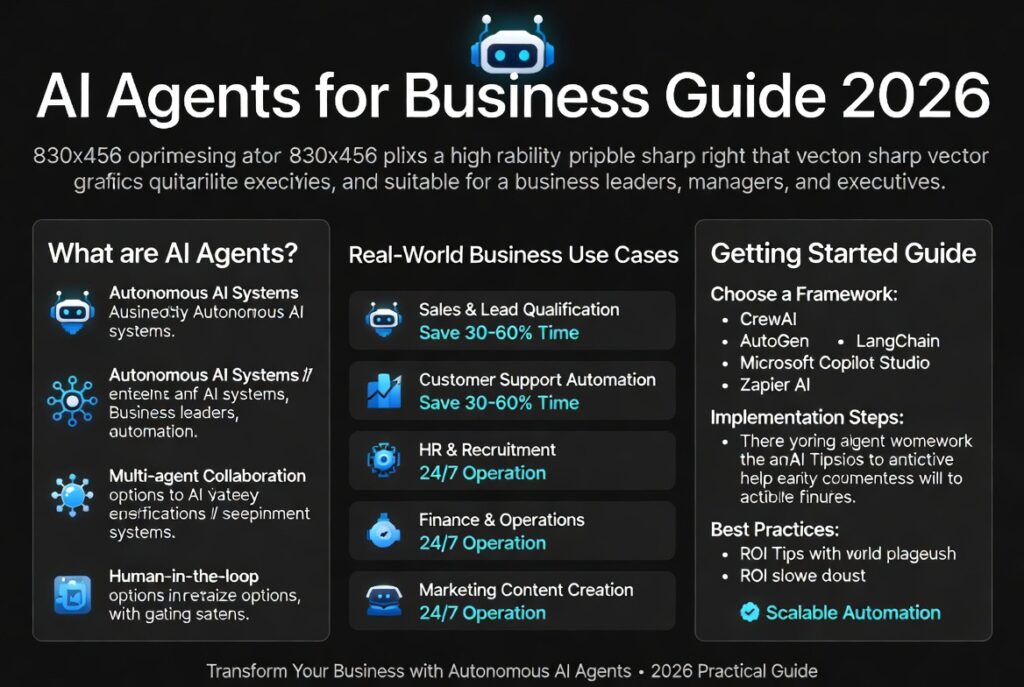
AI Agents for Business: Benefits, Use Cases and Implementation Guide (2026)
AI agents for business are transforming how organizations automate workflows, improve productivity, and scale operations using autonomous artificial intelligence systems. From customer support and sales automation to research, finance, and operations, AI agents are becoming essential tools for modern businesses seeking efficiency and competitive advantage.
Unlike traditional automation software, AI agents can analyze information, make decisions, interact with applications, and execute tasks with minimal human intervention. As agentic AI technology advances, organizations of all sizes are exploring how AI agents can reduce operational costs while increasing productivity and scalability.
What Are AI Agents for Business?
AI agents for business are autonomous software systems that can analyze information, make decisions, execute tasks, and collaborate with humans or other systems to achieve business goals. Organizations use AI agents to automate customer support, sales operations, research, workflow management, and internal business processes while reducing costs and improving productivity.
Why AI Agents for Business Matter in 2026
Businesses are increasingly adopting AI agents to handle repetitive tasks, assist employees, and automate complex workflows across departments.
- Reduce operational costs
- Improve productivity
- Automate business processes
- Scale operations efficiently
What Are AI Agents for Business
AI agents are autonomous software systems that can perceive information, make decisions, and take actions to accomplish specific goals with minimal human intervention.
How AI Agents Work in Business Environments
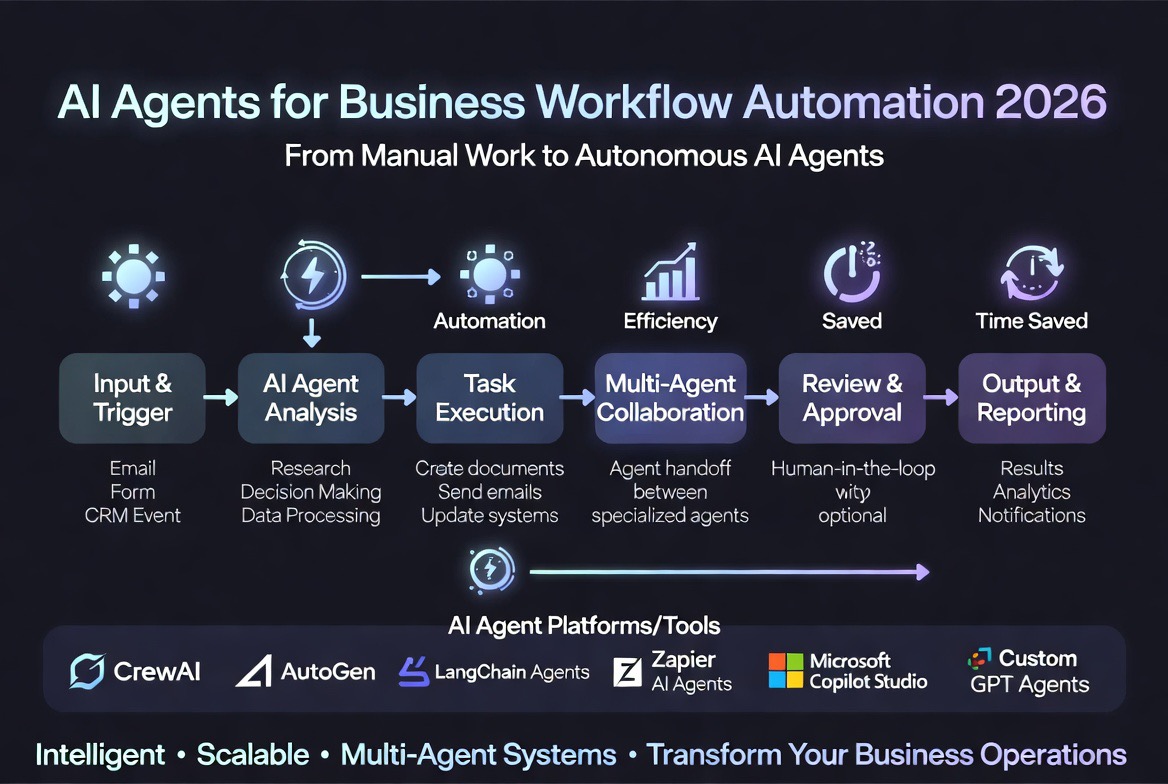
AI agents operate by combining large language models, business data, software integrations, and automation workflows. They can receive instructions, analyze information, make decisions, and perform actions across multiple applications.
- Gather information from databases and APIs
- Analyze business context
- Generate recommendations
- Execute tasks automatically
- Report results to users
Modern AI agents often connect with CRM platforms, help desk software, productivity tools, ERP systems, and internal databases to complete complex workflows autonomously.
Best AI Agent Platforms for Businesses in 2026
| Platform | Best For | Business Size |
|---|---|---|
| OpenAI | General-purpose AI agents | Small to Enterprise |
| Anthropic | Enterprise workflows | Mid-size to Enterprise |
| Google Vertex AI | AI development and analytics | Enterprise |
| Amazon Bedrock | Cloud-native AI applications | Enterprise |
| Microsoft Azure AI | Microsoft ecosystem integration | Enterprise |
How Much Do AI Agents Cost?
AI agent pricing varies based on platform, usage volume, model capabilities, integrations, and deployment requirements.
- Simple AI assistants: low monthly cost
- Workflow automation agents: moderate cost
- Multi-agent systems: higher operational cost
- Enterprise deployments: custom pricing
Organizations should evaluate both implementation costs and long-term productivity gains when calculating ROI.
Key Types of AI Agents for Business
Customer Support Agents
Sales and Marketing Agents
Workflow Automation Agents
Research and Analysis Agents
Best AI Agents for Beginners
Getting started with AI agents? Explore:
OpenAI Operator vs Manus Comparison
Compare leading AI agent platforms:
openai operator vs manus comparison
AI Agent Pricing
Understand costs and pricing models:
AI Agents Review
See our in-depth analysis:
Autonomous Workflow Tools
Discover automation platforms:
AI Agent Frameworks Comparison
Compare popular frameworks:
ai agent frameworks comparison
LangChain vs CrewAI Comparison
Evaluate leading agent development frameworks:
langchain vs crewai comparison
AI Agent Development Tools
Explore tools for building AI agents:
AI Automation Agents Pricing
Review automation costs:
Best Practices for Implementing AI Agents
- Start with clearly defined workflows
- Measure business outcomes
- Maintain human oversight
- Ensure data security and compliance
AI Agents for Business Comparison Table
| Agent Type | Primary Function | Business Benefit | Best Use Case |
|---|---|---|---|
| Customer Support Agent | Handle customer inquiries | Reduce support costs | Help desks and chat support |
| Sales Agent | Lead qualification and outreach | Increase conversions | B2B and SaaS sales |
| Marketing Agent | Content and campaign automation | Scale marketing operations | Digital marketing teams |
| Research Agent | Data collection and analysis | Faster decision-making | Market research and intelligence |
| Workflow Agent | Business process automation | Operational efficiency | HR, finance, and operations |
AI Agents vs Traditional Automation Tools
| Feature | AI Agents | Traditional Automation |
|---|---|---|
| Decision Making | Dynamic | Rule-based |
| Adaptability | High | Limited |
| Natural Language | Yes | No |
| Workflow Complexity | Advanced | Moderate |
| Human Interaction | Conversational | Limited |
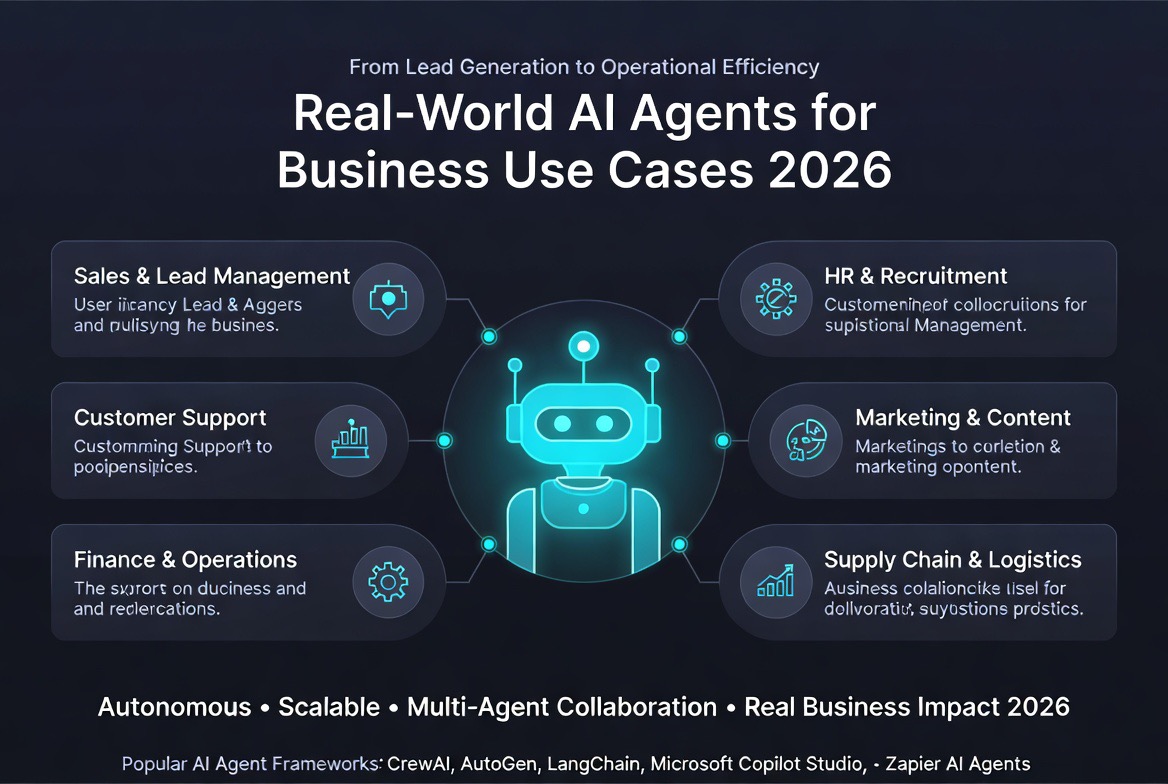
Real-World AI Agents for Business Use Cases
The adoption of AI agents for business is accelerating because organizations are seeing measurable results in productivity and operational efficiency.
Customer Service Automation
AI agents can answer customer questions, resolve common issues, route support tickets, and provide 24/7 assistance. This reduces support workloads while improving response times.
Sales Prospecting
Sales teams use AI agents to identify prospects, enrich lead data, draft personalized outreach messages, and prioritize opportunities based on buying intent.
Human Resources
HR departments deploy AI agents to screen resumes, schedule interviews, answer employee questions, and automate onboarding workflows.
Financial Operations
Finance teams use AI agents to process invoices, monitor spending, generate reports, and identify anomalies in transactions.
Market Research
Research agents gather competitive intelligence, monitor industry trends, summarize reports, and generate actionable insights for decision-makers.
Benefits of AI Agents for Business
Organizations implementing AI agents often experience improvements across multiple operational areas.
- Lower operational costs
- Increased employee productivity
- Faster response times
- Scalable business processes
- Improved customer experience
- Better data-driven decision making
- Reduced manual workloads
- 24/7 operational availability
Unlike traditional automation tools, modern AI agents can adapt to changing situations, analyze context, and make intelligent decisions based on business objectives.
Challenges of Implementing AI Agents for Business
While AI agents provide significant benefits, organizations should understand potential challenges before implementation.
- Data privacy concerns
- Regulatory compliance requirements
- Integration complexity
- Model accuracy limitations
- Security risks
- Need for human oversight
Successful deployments typically combine AI automation with governance policies, monitoring systems, and human review processes.
Expert Analysis: Are AI Agents for Business Worth the Investment?
From a business perspective, AI agents represent one of the highest-impact technology investments available in 2026. Organizations that focus on workflow automation often achieve measurable productivity gains within months rather than years.
However, the biggest mistake companies make is deploying AI agents without clear business objectives. Successful implementations start with specific use cases such as customer support automation, lead qualification, or operational workflow management.
In practice, AI agents deliver the strongest ROI when they augment employees rather than replace them. Human expertise combined with intelligent automation creates better outcomes than either approach alone.
Businesses should view AI agents as digital team members that handle repetitive work, allowing employees to focus on strategic, creative, and customer-facing activities.
Official Resources and Platforms
Future of AI Agents for Business Beyond 2026
The future of AI agents for business extends far beyond simple task automation. Emerging agentic AI systems will collaborate with other agents, manage complex workflows independently, and operate across multiple business platforms simultaneously.
Industry analysts expect multi-agent ecosystems to become common in customer service, supply chain management, software development, healthcare operations, and financial services.
Organizations that begin experimenting with AI agents today will be better positioned to leverage fully autonomous business systems as the technology matures.
Our Analysis
Based on current enterprise adoption trends, AI agents represent one of the most significant productivity technologies introduced since cloud computing and software-as-a-service platforms. Organizations that begin with targeted use cases such as customer support, sales operations, or workflow automation typically achieve faster returns than those attempting large-scale deployments immediately.
The most successful implementations combine AI agents with human oversight, governance frameworks, and clearly defined business objectives. Businesses that focus on measurable outcomes rather than technology experimentation are more likely to achieve sustainable ROI.
Conclusion
AI agents for business are becoming a competitive advantage for organizations seeking greater efficiency, automation, and scalability in 2026 and beyond.

Leave a reply