Vibe Coding vs Traditional Coding: Key Differences, Benefits, and Future Trends (2026 Guide)
Vibe coding vs traditional coding is one of the most important comparisons in modern software development. As artificial intelligence becomes deeply integrated into developer workflows, the way code is written, tested, and deployed is rapidly evolving.
Traditional coding has been the foundation of software engineering for decades, requiring developers to manually write every line of logic. In contrast, vibe coding introduces a new approach where developers describe what they want, and AI tools generate the code automatically.
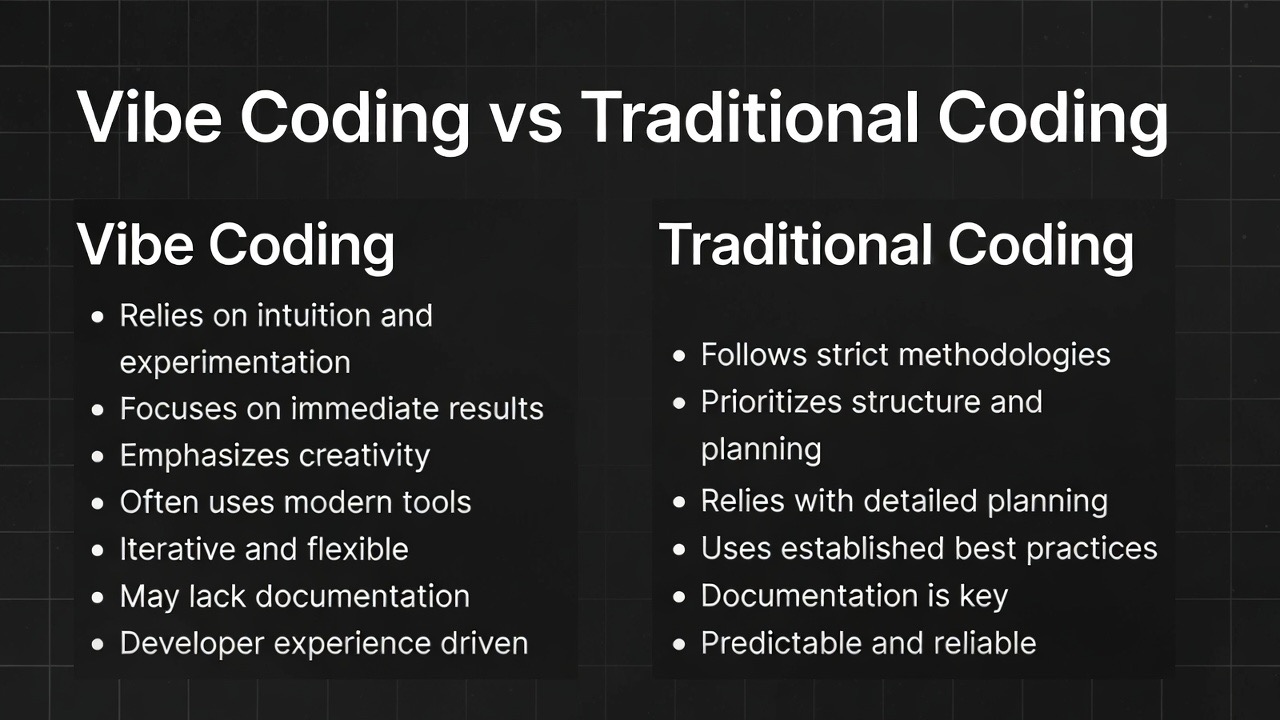
vibe coding vs traditional coding comparison chart 2026
If you’re new to AI-assisted development, start with our
how to start vibe coding guide.
Vibe Coding vs Traditional Coding: What Is Traditional Coding
Traditional coding is the standard method of software development where developers write code manually using programming languages such as Python, JavaScript, or Java. Every function, loop, and condition must be written explicitly.
This approach requires a deep understanding of syntax, algorithms, and system design. Developers must also handle debugging, optimization, and architecture decisions manually.
- full control over code structure and logic
- strong understanding of programming concepts required
- greater flexibility and customization
- slower development compared to AI-assisted methods
Traditional coding remains essential for complex systems, performance optimization, and critical applications.
Vibe Coding vs Traditional Coding: What Is Vibe Coding
Vibe coding is a modern development approach where developers use natural language prompts to instruct AI tools to generate code. Instead of writing everything manually, developers describe the desired functionality, and the AI produces the implementation.
This approach shifts the developer’s role from writing code to guiding, reviewing, and refining AI-generated outputs.
- faster development and prototyping
- reduced manual coding effort
- accessible to beginners and non-developers
- requires careful review and testing
Popular tools enabling this workflow include:
You can also explore official resources:
Vibe Coding vs Traditional Coding: Key Differences
Understanding the differences between these two approaches helps developers choose the right workflow for their needs.
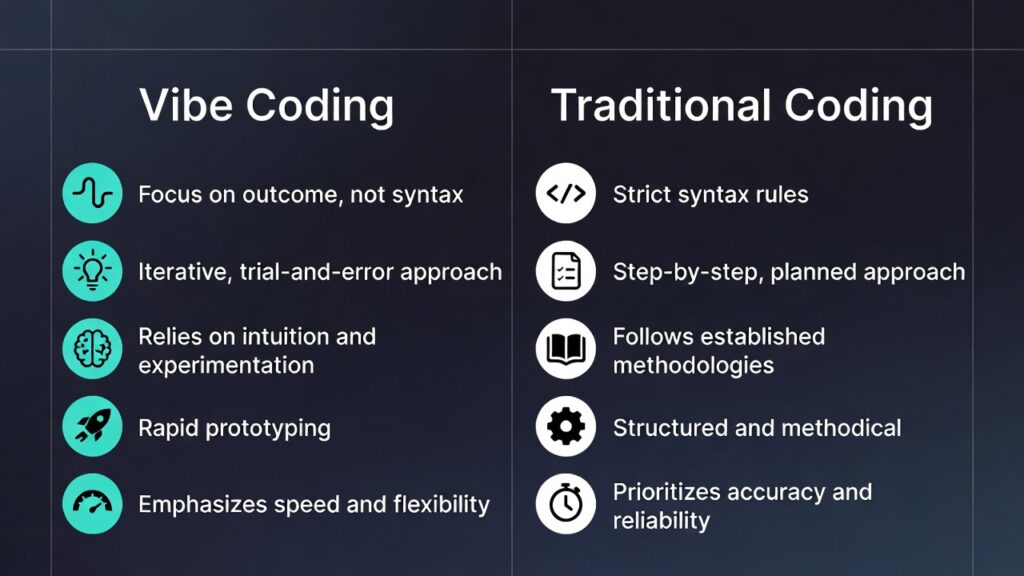
- manual coding vs AI-assisted development
- syntax-based vs intent-based programming
- slower development vs rapid prototyping
- deep technical focus vs high-level problem solving
Traditional coding emphasizes precision and control, while vibe coding focuses on speed and efficiency.
Vibe Coding vs Traditional Coding: Benefits of Each Approach
Both approaches have unique advantages depending on the use case.
Benefits of Traditional Coding
- greater control over code quality and performance
- better for complex systems and large-scale applications
- stronger understanding of programming fundamentals
Benefits of Vibe Coding
- significantly faster development cycles
- reduced effort for repetitive tasks
- ideal for prototyping and experimentation
Developers who combine both approaches often achieve the best results.
Vibe Coding vs Traditional Coding: When to Use Each
Choosing between vibe coding and traditional coding depends on the project type and requirements.
Use traditional coding when:
- building performance-critical systems
- working on complex architectures
- ensuring strict security requirements
Use vibe coding when:
- building prototypes quickly
- automating repetitive tasks
- learning new technologies
Most modern workflows combine both approaches for maximum efficiency.
Vibe Coding vs Traditional Coding: Challenges and Limitations
Despite its advantages, vibe coding comes with challenges:
- AI-generated code may contain errors
- requires strong review and debugging skills
- can lead to over-reliance on automation
Traditional coding also has limitations:
- time-consuming for repetitive tasks
- steeper learning curve for beginners
- slower iteration cycles
Understanding these limitations helps developers use each approach effectively.
Vibe Coding vs Traditional Coding: The Future of Development
The future of software development lies in a hybrid model that combines both vibe coding and traditional coding. Developers will increasingly rely on AI tools for speed while maintaining control through manual coding.
AI systems are expected to improve significantly, enabling more advanced features such as automated debugging, performance optimization, and full application generation.
To stay ahead, developers should focus on building both technical and AI-related skills. Explore our
AI developer skills 2026 guide.
You can also explore more tools in our
best AI developer tools 2026 guide.
Conclusion
Vibe coding vs traditional coding is not about choosing one over the other. Instead, it is about understanding how both approaches work and using them together effectively.
Developers who adapt to this hybrid model will be more productive, efficient, and prepared for the future of AI-driven software development.
FAQ
What is the difference between vibe coding and traditional coding?
Traditional coding involves writing code manually, while vibe coding uses AI tools to generate code based on natural language prompts.
Is vibe coding better than traditional coding?
Vibe coding is faster for prototyping and automation, while traditional coding is better for complex systems and full control.
Can beginners use vibe coding?
Yes, beginners can use vibe coding, but they should still learn programming fundamentals to understand and debug code.
Will vibe coding replace traditional coding?
No, vibe coding will not replace traditional coding but will complement it by improving development speed and efficiency.

Leave a reply