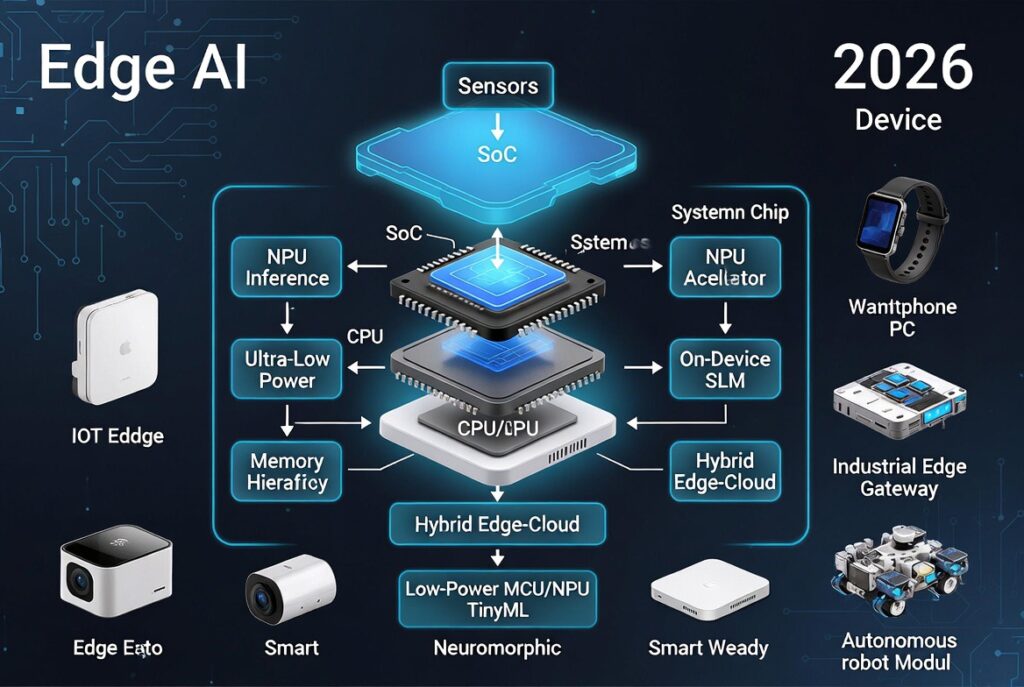
The Complete Edge AI Hardware 2026 Guide for Developers and Businesses
Edge AI hardware 2026 is transforming how artificial intelligence applications are deployed by enabling real-time processing directly on devices without relying on cloud infrastructure.
Instead of sending data to centralized servers, edge AI devices process information locally, making systems faster, more efficient, and more secure. This shift is redefining industries such as healthcare, manufacturing, retail, and autonomous systems.

If you’re building AI systems, you should also understand the software side in our guide to
AI developer skills 2026.
Why Edge AI Hardware 2026 Matters More Than Ever
The importance of edge ai hardware 2026 continues to grow as organizations demand faster, more reliable AI systems. Traditional cloud-based AI introduces latency and dependency on internet connectivity, which can limit real-time applications.
Edge computing solves this problem by bringing AI closer to where data is generated.
- Faster decision-making in milliseconds
- Reduced cloud infrastructure costs
- Improved data privacy and security
- Offline AI capabilities for remote environments
- Lower bandwidth usage
For example, autonomous vehicles cannot rely on cloud servers for split-second decisions. Edge AI hardware ensures immediate processing, which is critical for safety.
What Is Edge AI Hardware
Edge AI hardware refers to physical devices that can run artificial intelligence models locally. These devices include embedded systems, AI accelerators, GPUs, and specialized processors designed for machine learning workloads.
Unlike traditional computing systems, edge AI hardware is optimized for:
- low power consumption
- real-time inference
- compact form factors
- high efficiency
These devices are commonly used in IoT systems, robotics, smart cities, and industrial automation.
Types of Edge AI Hardware
AI Development Boards
AI development boards are among the most popular entry points into edge AI hardware 2026. These compact devices allow developers to prototype and deploy AI models efficiently.
Popular examples include:
- NVIDIA Jetson series
- Google Coral Dev Board
- Raspberry Pi with AI accelerators
These boards support frameworks like TensorFlow, PyTorch, and ONNX, making them ideal for experimentation and production deployments.
Edge AI Cameras
Edge AI cameras combine imaging sensors with onboard AI processors to enable real-time computer vision applications.
Use cases include:
- facial recognition systems
- traffic monitoring
- retail analytics
- security surveillance
These devices eliminate the need to send video data to the cloud, significantly reducing latency and bandwidth usage.
Industrial Edge Devices
Industrial edge devices are rugged systems designed for harsh environments such as factories and warehouses.
They are commonly used for:
- predictive maintenance
- quality inspection
- robotics automation
- smart manufacturing
These systems often integrate with IoT sensors and enterprise platforms to enable intelligent automation.
Best Edge AI Devices for Beginners
If you’re new to edge ai hardware 2026, starting with beginner-friendly devices is essential.
Check out our detailed guide:
edge ai devices for beginners
Beginner devices typically offer:
- easy setup
- strong documentation
- active developer communities
- affordable pricing
These factors make it easier to learn and build your first AI-powered applications.
Edge AI Hardware Comparison
Choosing the right edge AI platform depends on performance, ecosystem, and budget. Two of the most popular platforms are NVIDIA Jetson and Google Coral.
Each has its strengths:
- NVIDIA Jetson: powerful GPU-based processing
- Google Coral: optimized for TensorFlow Lite models
See full comparison:
nvidia jetson vs coral comparison
When comparing devices, consider:
- compute performance (TOPS)
- power consumption
- software ecosystem
- price-to-performance ratio
Edge AI Hardware Pricing Overview
The cost of edge ai hardware 2026 varies widely depending on capabilities and use cases.
- Entry-level devices: $50–$150
- Mid-range boards: $150–$500
- Industrial systems: $500–$5000+
Pricing factors include:
- processing power
- memory and storage
- AI acceleration capabilities
- build quality and durability
Explore detailed pricing:
edge ai hardware pricing
Real-World Use Cases of Edge AI Hardware 2026
Edge AI hardware 2026 is already transforming multiple industries with real-world applications.
Autonomous Vehicles
Self-driving systems rely on edge AI hardware to process sensor data instantly and make real-time decisions.
Smart Surveillance
Edge AI cameras analyze video feeds locally to detect anomalies, reducing reliance on cloud processing.
Healthcare Diagnostics
Medical devices use AI to analyze patient data in real time, improving diagnosis and treatment speed.
Retail Analytics
Retailers use edge AI to track customer behavior, optimize store layouts, and improve sales strategies.
Industrial Automation
Factories use edge AI hardware to monitor equipment, predict failures, and automate production processes.
How Businesses Are Adopting Edge AI Hardware 2026
Businesses across industries are rapidly adopting edge ai hardware 2026 to improve efficiency, reduce operational costs, and enable real-time intelligence.
Unlike traditional cloud-based AI systems, edge deployments allow companies to process data locally, which significantly improves response times and reduces dependency on internet connectivity.
Manufacturing
Manufacturers use edge AI hardware for predictive maintenance and quality control. Sensors collect machine data, and AI models analyze it in real time to detect anomalies before failures occur.
Retail
Retailers deploy edge AI cameras to analyze customer behavior, track foot traffic, and optimize store layouts without sending sensitive data to the cloud.
Healthcare
Medical devices powered by edge AI hardware can analyze patient data instantly, helping doctors make faster and more accurate decisions.
Smart Cities
Edge AI hardware supports traffic monitoring, energy optimization, and public safety systems by processing data locally across distributed networks.
These real-world applications highlight why edge ai hardware 2026 is becoming essential for modern businesses.
Future Trends in Edge AI Hardware 2026
The future of edge ai hardware 2026 is driven by innovation in AI chips and low-power computing.
- more powerful AI accelerators
- lower energy consumption
- integration with 5G networks
- improved on-device training
- edge-cloud hybrid architectures
These trends will enable more advanced applications, from smart cities to autonomous robotics.
Developers should also explore tools in our
best AI developer tools 2026 guide.
How to Choose the Right Edge AI Hardware
Selecting the right hardware depends on your project requirements.
- Define your use case (vision, NLP, robotics)
- Evaluate performance requirements
- Consider power constraints
- Check software compatibility
- Plan for scalability
Making the right choice early can save significant time and cost in development.
Edge AI Hardware 2026 Benefits Summary
Here are the key benefits of edge ai hardware 2026:
- real-time data processing
- reduced latency
- improved privacy and security
- lower cloud costs
- offline functionality
Official Edge AI Hardware Resources
To explore real edge AI hardware platforms and documentation, visit these official resources:
These platforms provide SDKs, documentation, and tools for building and deploying edge AI applications.
Conclusion
Edge ai hardware 2026 is a critical component of modern AI systems. It enables real-time intelligence, reduces reliance on cloud infrastructure, and unlocks new possibilities across industries.
As AI continues to evolve, edge computing will play an increasingly important role in delivering faster, smarter, and more efficient solutions.
FAQ
What is edge AI hardware?
Edge AI hardware refers to devices that process AI workloads locally without relying on cloud computing.
What are examples of edge AI hardware?
Examples include NVIDIA Jetson, Google Coral, and edge AI cameras.
Why is edge AI important?
Edge AI reduces latency, improves privacy, and enables real-time decision-making.

Leave a reply