Critical Cloud Computing Layers Explained 2026 Guide: IaaS vs PaaS vs SaaS
Cloud computing layers explained 2026 provides a clear understanding of how modern applications are delivered through structured services: infrastructure, platforms, and software. As businesses increasingly rely on cloud solutions, understanding these layers is essential for IT professionals, developers, and decision-makers.
As introduced in our technology explained simply 2026 guide, cloud architecture forms the backbone of almost all modern software, from enterprise SaaS platforms to AI-powered edge solutions.

Definition: Cloud Computing Layers Explained 2026
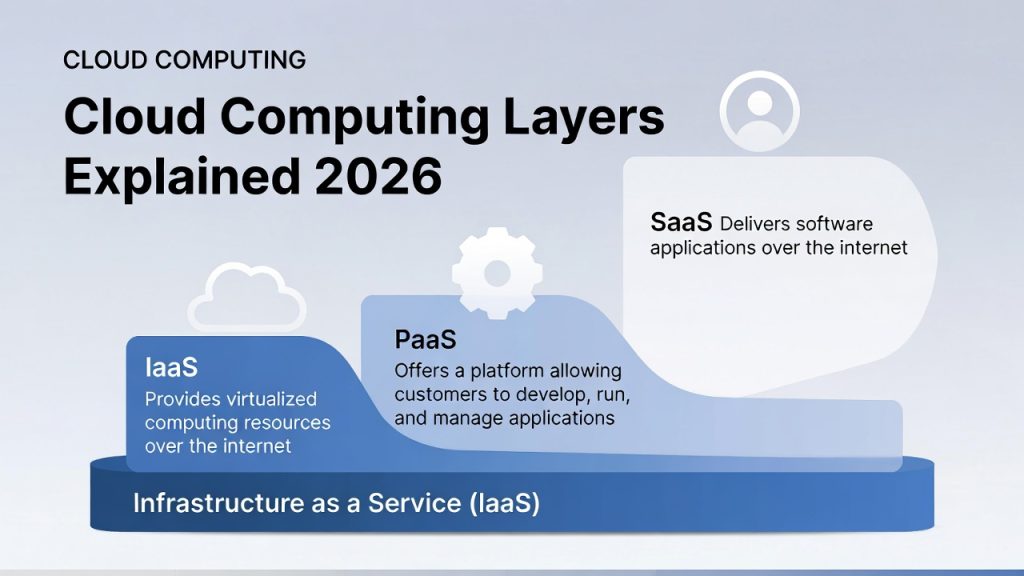
The concept of cloud computing layers explained 2026 refers to the organization of cloud services into distinct models. These layers allow businesses and developers to consume computing resources without managing physical hardware directly. The three primary layers are:
- Infrastructure as a Service (IaaS): Virtualized computing resources such as servers, storage, and networking.
- Platform as a Service (PaaS): Development frameworks and platforms for building applications without managing underlying infrastructure.
- Software as a Service (SaaS): Fully hosted, ready-to-use applications accessible via browsers or apps.
This layered approach simplifies cloud adoption, increases flexibility, and enables cost-efficient scaling for businesses of all sizes.
How Cloud Computing Layers Work
IaaS: Infrastructure as a Service
IaaS provides virtualized computing resources on-demand. Users can provision servers, storage, and networking using APIs or dashboards. It offers the most control but requires users to manage operating systems, security patches, and runtime environments.
- Use Case: Hosting virtual machines, data storage, or testing development environments.
- Example Providers: AWS EC2, Microsoft Azure Virtual Machines, Google Compute Engine.
PaaS: Platform as a Service
PaaS provides a managed environment for developers to build, test, and deploy applications without worrying about underlying servers or infrastructure. PaaS platforms handle scaling, operating systems, and runtime updates automatically.
- Use Case: Web and mobile application development, microservices deployment.
- Example Providers: Google App Engine, Heroku, Microsoft Azure App Services.
SaaS: Software as a Service
SaaS delivers fully functional applications over the internet. End users access the software via web browsers or mobile apps without managing any backend infrastructure.
- Use Case: Email services, productivity suites, CRM platforms, collaboration tools.
- Example Providers: Microsoft 365, Google Workspace, Salesforce.
For more official definitions and terminology, see the Microsoft Azure Cloud Guide.
Real-World Applications
Understanding cloud computing layers explained 2026 helps organizations optimize IT operations and innovate faster. Real-world examples include:
- IaaS: Hosting scalable e-commerce websites on AWS EC2 instances during peak shopping seasons.
- PaaS: Building AI-enabled applications using Google App Engine without managing servers.
- SaaS: Using collaboration tools like Slack or Trello to manage global teams remotely.
- Hybrid Deployments: Combining IaaS, PaaS, and SaaS for complex enterprise workflows, including machine learning pipelines and edge device management.
Benefits of Cloud Computing Layers
- Scalability: Quickly scale resources up or down based on demand.
- Cost Efficiency: Pay-as-you-go pricing reduces upfront infrastructure costs.
- Security: Leading providers offer built-in encryption, compliance certifications, and monitoring.
- Global Accessibility: Cloud apps can be accessed from anywhere with an internet connection.
- Innovation Enablement: Developers can experiment and deploy applications faster using PaaS and SaaS tools.
Future Impact of Cloud Computing Layers Explained 2026
By 2026, cloud computing layers will continue enabling next-gen technologies:
- Supporting scalable AI and machine learning workloads
- Enabling hybrid edge-cloud architectures for IoT and Edge AI
- Reducing carbon footprint through energy-efficient, optimized infrastructure
- Facilitating global software deployment and microservices architecture
- Driving digital transformation across industries from finance to healthcare
Understanding cloud layers empowers organizations to architect resilient systems that combine IaaS, PaaS, and SaaS for efficiency and innovation.
Who Should Understand Cloud Computing Layers?
Learning cloud computing layers explained 2026 is essential for:
- Developers designing scalable apps
- IT architects planning infrastructure
- Business decision-makers evaluating cloud strategies
- Students entering cloud computing and AI fields
- Cloud engineers managing multi-layered environments
Related Links
FAQs
Which cloud layer do users interact with most?
SaaS, because end users access ready-to-use applications without managing infrastructure or platforms.
Is cloud computing cheaper than managing physical servers?
Usually yes, as pay-as-you-go models and scalable resources reduce upfront investment and maintenance costs.
Why are cloud layers important?
They separate infrastructure, development, and application responsibilities, enabling specialized management and faster deployment.
What is the difference between IaaS, PaaS, and SaaS?
IaaS provides raw infrastructure, PaaS offers development platforms, and SaaS delivers fully managed software applications.
Can hybrid cloud architectures combine layers?
Yes, businesses often integrate IaaS, PaaS, and SaaS across private and public clouds for optimal performance.

Leave a reply