
OpenAI Operator vs Manus Comparison (2026): Features, Pricing, Use Cases & Which AI Agent Is Better?
Quick AnswerOpenAI Operator vs Manus comparison comes down to your automation goals. OpenAI Operator is designed for AI-assisted task execution within the OpenAI ecosystem, making it suitable for users who want an intuitive interface and broad integrations. Manus focuses on autonomous planning and multi-step workflow execution, making it attractive for users seeking more independent AI agents. The better choice depends on your workflows, integration needs, security requirements, and budget.
At a glance comparison
| Category | Winner |
| Ease of Use | OpenAI Operator |
| Autonomous Planning | Manus |
| Business Productivity | Tie |
| Enterprise Integrations | OpenAI Operator |
| Complex Multi-Agent Workflows | Manus |
| Best for Beginners | OpenAI Operator |
| Best for Developers | Manus |
Openai operator vs manus comparison helps businesses and developers evaluate two emerging AI agent platforms for automation, task execution, and workflow management.
Why OpenAI Operator vs Manus Comparison Matters
AI agents are becoming essential business tools. Choosing the right platform depends on your automation needs, integrations, and deployment requirements.
- Compare automation capabilities
- Evaluate ease of use
- Understand pricing models
- Select the right AI agent platform
What Is OpenAI Operator?
OpenAI Operator is an AI agent designed to complete multi-step tasks, interact with software, and assist users by automating digital workflows.
What Is Manus?
Manus is an autonomous AI agent platform focused on planning, executing complex workflows, and completing tasks with minimal human intervention.
OpenAI Operator vs Manus Comparison at a Glance
| Feature | OpenAI Operator | Manus |
|---|---|---|
| Primary Focus | AI-assisted task execution | Autonomous workflow execution |
| Ease of Use | Excellent | Moderate |
| Business Automation | Strong | Very Strong |
| Developer Customization | High | High |
| Learning Curve | Low | Medium |
| Best For | General productivity | Complex autonomous workflows |
OpenAI Operator vs Manus Comparison for Different Users
The ideal platform depends less on which tool is “better” and more on how you plan to use AI agents. Individual professionals may value simplicity and ease of use, while engineering teams often prioritize flexibility, integrations, and automation depth.
For Small Businesses
Businesses looking to automate repetitive administrative work, customer support, scheduling, and document processing may appreciate OpenAI Operator’s familiar ecosystem and straightforward experience.
For Developers
Developers typically evaluate API availability, customization options, orchestration capabilities, and compatibility with existing software stacks. Both platforms support advanced workflows, but their implementation approaches differ.
For Enterprise Teams
Larger organizations should consider governance, security, scalability, audit logging, compliance, and integration with existing business systems before selecting either platform.
Who should choose which?
Choose OpenAI Operator if:
- you already use ChatGPT
- you want browser-based automation
- you prefer a polished UI
- you don’t want to configure agent workflows
Choose Manus if:
- you need autonomous planning
- you want agents that execute complex tasks
- you’re experimenting with advanced AI automation
- you’re comfortable with a steeper learning curve
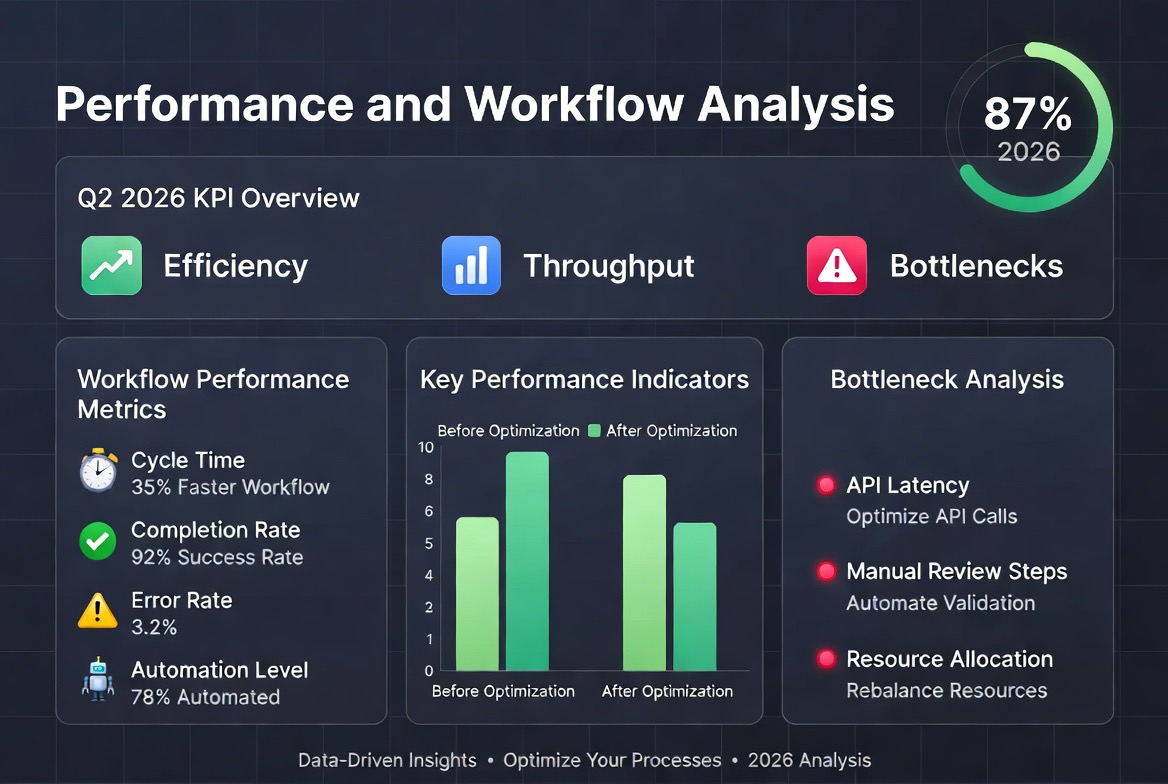
Performance and Workflow Analysis
Both platforms are designed to automate digital tasks, but they emphasize different strengths.
- Task planning accuracy
- Multi-step reasoning
- Browser automation
- API integrations
- Knowledge retrieval
- Workflow orchestration
- Response quality
- Reliability
For straightforward productivity tasks, both platforms can save significant time. For more complex workflows involving multiple applications and long-running processes, users should carefully evaluate how each platform manages context, memory, and execution.
OpenAI Operator vs Manus Comparison
Ease of Use
OpenAI Operator is designed with a user-friendly experience, while Manus focuses on advanced autonomous workflow execution.
Automation Features
Both platforms automate repetitive work, but their workflow capabilities and supported tasks differ.
Business Integrations
Consider available integrations with productivity software, business applications, and APIs before choosing a platform.
Developer Experience
Developers should compare API access, customization options, and support for agent development.
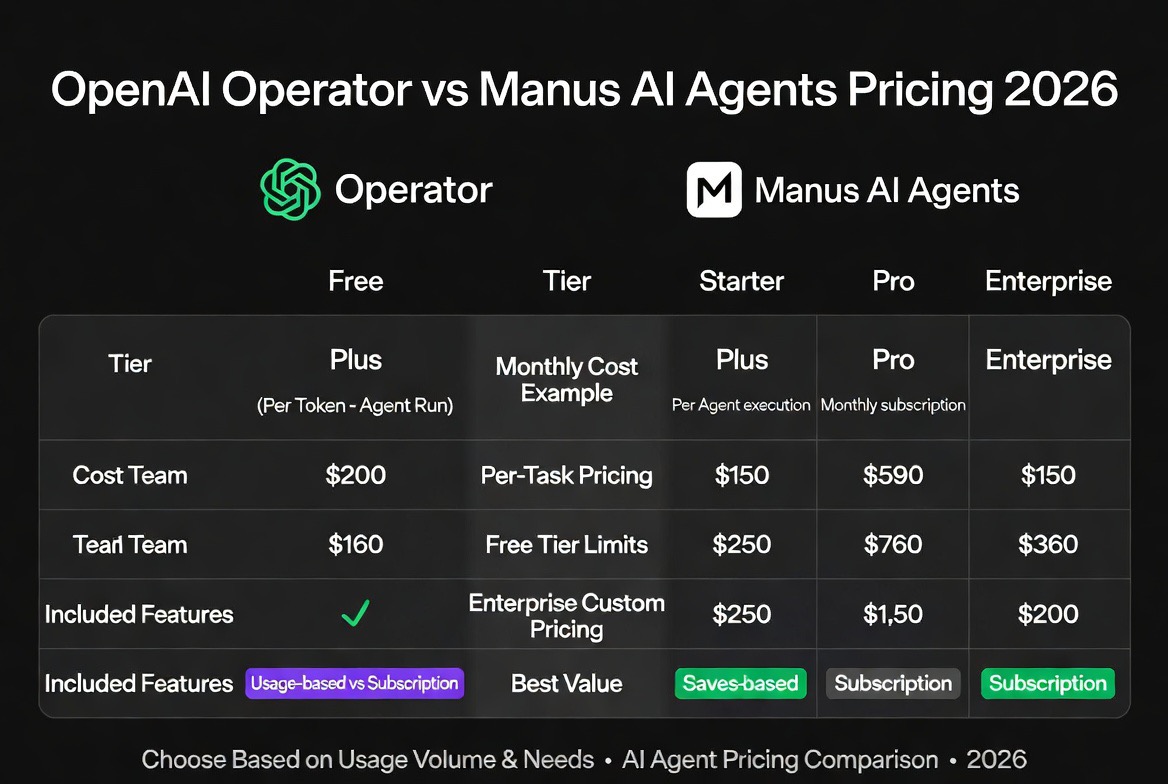
OpenAI Operator vs Manus Pricing
| Pricing Factor | OpenAI Operator | Manus |
| Free plan | Limited/depends on availability | Limited/varies |
| Paid subscription | Yes | Yes |
| Enterprise plans | Available | Contact sales/varies |
| API costs | Usage-based where applicable | Depends on deployment |
Feature Comparison
- Autonomous task execution
- Workflow automation
- API integrations
- Business productivity
- Multi-step reasoning
Which AI Agent Is Better?
If you need general workflow automation with a familiar ecosystem, OpenAI Operator may be the better option. If your priority is autonomous task planning and execution, Manus may be worth evaluating depending on your business requirements.
AI Agent Pricing
Compare subscription plans and costs:
ai agent pricing
Best AI Agents for Beginners
New to AI agents? Start here:
best ai agents for beginners
AI Agents for Business
Read our complete guide:
ai agents for business
MCP (Model Context Protocol) explained
Our Analysis: Which Platform Offers Better Long-Term Value?
After reviewing publicly available product information, documentation, demonstrations, and current AI agent capabilities, neither platform is objectively “better.” Instead, they target different stages of AI adoption.
OpenAI Operator prioritizes accessibility, usability, and integration with the broader OpenAI ecosystem, making it a strong choice for professionals and teams seeking practical automation without extensive configuration.
Manus emphasizes autonomous task planning and multi-step execution, which may appeal to organizations exploring more advanced agentic workflows. However, because autonomous AI platforms continue to evolve rapidly, businesses should validate performance with real-world pilot projects before committing to a large deployment.
In our view, the greatest determinant of long-term ROI is not the choice of platform itself, but how well the chosen agent integrates with existing workflows, governance policies, and business objectives.
Which AI Agent Should You Choose?
| If you need… | Recommended Platform |
|---|---|
| Simple workflow automation | OpenAI Operator |
| Advanced autonomous planning | Manus |
| Developer flexibility | Both deserve evaluation |
| Enterprise experimentation | Compare both with pilot projects |
| Fast onboarding | OpenAI Operator |
Official Resources
Common Mistakes When Choosing an AI Agent
Many organizations focus on impressive demonstrations rather than practical business outcomes. Avoiding these common mistakes can improve implementation success and long-term return on investment.
- Comparing only pricing. The cheapest platform may not deliver the greatest productivity gains or operational value.
- Ignoring integrations. AI agents should work seamlessly with your existing software, APIs, and business systems.
- Skipping pilot testing. Testing real workflows provides more reliable insights than feature comparisons alone.
- Overlooking security. Evaluate authentication, permissions, compliance, audit logging, and data governance before deployment.
- Underestimating employee training. Successful AI adoption requires onboarding, documentation, and change management.
- Expecting full autonomy immediately. Most organizations achieve the best results by gradually expanding AI automation while maintaining appropriate human oversight.
OpenAI Operator vs Manus Security
Security is one of the most important considerations when evaluating AI agents, especially for organizations handling sensitive customer, financial, or proprietary business data. While both OpenAI Operator and Manus aim to automate complex workflows, businesses should assess how each platform aligns with their internal security and compliance requirements before deployment.
Data Privacy
Review each platform’s data handling policies, retention practices, and options for controlling how prompts and outputs are processed. Organizations working with confidential information should understand whether conversations are stored, how long they are retained, and what administrative controls are available.
Enterprise Security
Enterprise deployments typically require strong security controls such as encrypted communications, role-based access controls, secure identity management, and centralized administration. Larger organizations should also evaluate vendor security documentation and operational practices.
Authentication
Support for enterprise authentication methods, including single sign-on (SSO), multi-factor authentication (MFA), and identity provider integrations, can simplify user management while improving security across teams.
Compliance
Businesses operating in regulated industries should determine whether the platform supports relevant compliance frameworks, contractual requirements, and organizational governance policies before integrating AI agents into production workflows.
API Permissions
Because AI agents often connect with third-party applications, administrators should carefully control API permissions and grant only the minimum access required for each workflow. Limiting permissions reduces security risks if credentials are compromised.
Audit Logs
Comprehensive audit logging allows organizations to review user activity, monitor automated actions, investigate incidents, and maintain accountability across AI-assisted workflows. This capability becomes increasingly important as AI agents perform higher-value business operations.

OpenAI Operator vs Manus Performance
Performance extends beyond response speed. Businesses should evaluate how each platform plans tasks, maintains context, integrates with external applications, and completes complex workflows under real-world conditions.
| Capability | OpenAI Operator | Manus |
|---|---|---|
| Task Planning | Strong for guided workflows | Designed for autonomous planning |
| Reasoning | Excellent contextual reasoning | Strong multi-step reasoning |
| Reliability | High for structured tasks | Depends on workflow complexity |
| Browser Automation | Built for interactive web tasks | Supports complex autonomous execution |
| Long-Running Tasks | Suitable for many productivity workflows | Optimized for extended autonomous processes |
| Context Handling | Strong conversational context | Designed to manage multi-stage objectives |
| Integrations | Broad ecosystem integration | Growing integration capabilities |
Rather than focusing on benchmark comparisons alone, organizations should test each platform using real business workflows. Pilot deployments often provide more meaningful insights than feature checklists because performance depends heavily on the complexity of your automation requirements.
OpenAI Operator vs Manus for Different Industries
The ideal AI agent varies by industry, business processes, and operational requirements. Organizations should evaluate which platform aligns best with their existing workflows and long-term automation goals.
| Industry | Common AI Agent Use Cases |
|---|---|
| Marketing | Content creation, campaign planning, SEO research, and competitor analysis. |
| Customer Support | Automated responses, ticket routing, knowledge retrieval, and customer assistance. |
| Software Development | Documentation, code assistance, testing workflows, debugging support, and technical research. |
| Finance | Report generation, expense analysis, forecasting support, and operational automation. |
| Human Resources | Resume screening, interview scheduling, employee onboarding, and internal knowledge management. |
| Research | Literature reviews, competitive intelligence, market analysis, and document summarization. |
| Legal | Contract reviews, policy research, document organization, and compliance assistance under human supervision. |
| Healthcare | Administrative workflow support, documentation assistance, scheduling, and operational efficiency while maintaining regulatory compliance. |
Regardless of industry, organizations should maintain appropriate human oversight for important business decisions, especially where regulatory, legal, or financial risks are involved.
Alternatives to OpenAI Operator and Manus
OpenAI Operator and Manus are not the only AI agent platforms available. Depending on your technical expertise and business requirements, several alternatives may be worth evaluating.
| Platform | Best For |
|---|---|
| ChatGPT Agent | General productivity and AI-assisted task execution. |
| Microsoft Copilot | Organizations using Microsoft 365 and enterprise productivity tools. |
| Anthropic Claude | Research, document analysis, writing, and enterprise AI assistance. |
| Google Gemini | Google Workspace users, multimodal AI, and enterprise collaboration. |
| CrewAI | Building collaborative multi-agent workflows. |
| AutoGen | Developers creating customized AI agent systems. |
| LangGraph | Stateful, production-ready agent orchestration and complex workflow automation. |
Choosing between these platforms depends on your organization’s workflow complexity, technical expertise, integration requirements, and long-term AI strategy.
Free AI Agents Implementation Checklist
Planning to deploy AI agents in your business? Download our free implementation checklist covering workflow selection, security, integrations, governance, and ROI measurement.
Prefer direct download?
Download instantly here
.
Related articles:
Tech News
Conclusion
OpenAI Operator and Manus represent two different approaches to AI agents rather than direct replacements for one another. OpenAI Operator is generally a stronger fit for users who value simplicity, ecosystem integration, and everyday productivity, while Manus is better suited to organizations exploring autonomous planning and more sophisticated workflow automation.
Before making a decision, define the business problem you want to solve, test each platform with a representative workflow, evaluate integration requirements, and measure productivity improvements. The most successful AI deployments are driven by clear business objectives rather than feature lists alone.
Continue Learning About AI Agents
- Complete AI Agents for Business Guide
- AI Agent Frameworks Comparison
- LangChain vs CrewAI Comparison
- AI Agent Development Tools
- AI Agent Pricing Guide
- Best AI Agents for Beginners
FAQ
What is the difference between OpenAI Operator and Manus?
OpenAI Operator focuses on AI-assisted workflow execution, while Manus emphasizes autonomous planning and task completion with minimal human input.
Which AI agent is better for businesses?
The best choice depends on business requirements, including automation complexity, integration support, scalability, and pricing.
Can developers build custom workflows with AI agents?
Yes. Many AI agent platforms provide APIs, workflow automation features, and development tools that allow developers to build customized AI-powered solutions.
Is Manus open source?
Manus is not generally positioned as a traditional open-source AI framework. Review the official documentation for current licensing, deployment options, and availability.
Can OpenAI Operator browse the web?
Yes. OpenAI Operator is designed to perform browser-based tasks and interact with supported websites to help users complete multi-step workflows.
Which AI agent is best for small businesses?
Small businesses often prioritize ease of use and quick deployment. OpenAI Operator may be a strong choice for everyday productivity, while Manus may suit businesses seeking more autonomous workflow automation.
Can I integrate these agents with CRM software?
Many AI agent platforms support integrations through APIs, automation tools, or third-party connectors. Compatibility depends on the CRM platform and available integration options.
Are AI agents secure for enterprise use?
Enterprise security depends on factors such as authentication, encryption, administrative controls, audit logging, compliance support, and organizational governance policies.
Do I need coding skills to use OpenAI Operator?
No. Many everyday workflows can be completed without programming knowledge, although developers may benefit from APIs and advanced integrations.
Can OpenAI Operator replace RPA tools?
Not entirely. AI agents and robotic process automation (RPA) often complement each other. Many organizations combine both technologies to automate structured and unstructured business processes.
Which platform is better for developers?
Both platforms provide value for developers. The better choice depends on your preferred ecosystem, customization requirements, workflow complexity, and integration needs.

Leave a reply