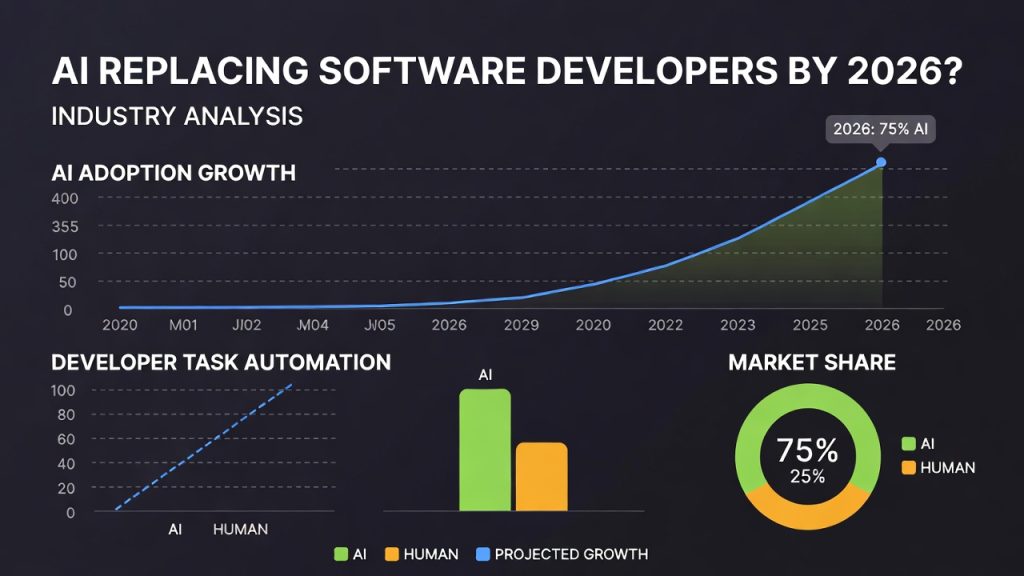
AI replacing software developers 2026 is one of the most debated topics in technology today.
With AI coding assistants generating production-ready code, automating testing, and accelerating development workflows, companies are fundamentally rethinking how software is built — and who builds it.
Is AI Replacing Software Developers in 2026? Deep Industry Analysis, Workforce Data & Future Forecasts
This analysis explores whether artificial intelligence will eliminate developer jobs or transform them into new hybrid roles. Drawing on industry reports, workforce statistics, and real-world adoption data, this guide provides an expert-level perspective aligned with modern technology and workforce trends discussed in our future tech trends pillar.

Executive Summary: The Reality Behind the Headlines
AI is not simply replacing developers — it is reshaping software engineering into a higher-level discipline focused on architecture, problem solving, and system design.
- AI automates repetitive coding tasks
- Developer productivity is changing unevenly
- Hiring demand is shifting toward AI-enabled engineers
- New technical roles are emerging faster than old ones disappear
Industry consensus increasingly suggests that AI reduces routine programming work while increasing demand for skilled engineers capable of supervising intelligent systems.
Definition: What “AI Replacing Developers” Actually Means
The phrase does not imply total job elimination. Instead, it refers to:
- Automation of boilerplate coding
- AI-assisted debugging and testing
- Code generation through natural language prompts
- Reduced need for large junior developer teams
Modern AI systems function as collaborative tools rather than independent software engineers.
The Rise of AI Coding Assistants
GitHub Copilot and the New Development Workflow
AI-powered coding assistants fundamentally changed development workflows beginning in the early 2020s. Tools like GitHub Copilot introduced real-time code generation directly inside development environments.
GitHub reports that millions of developers now use AI-assisted coding tools daily, contributing to rapid growth in repositories and AI-focused projects worldwide. Community analyses highlight more than 110 million developers globally and explosive growth in AI-related repositories, demonstrating massive adoption momentum. :contentReference[oaicite:0]{index=0}
These systems can:
- Generate functions from prompts
- Suggest bug fixes
- Write documentation automatically
- Create test cases
The result is a shift from manual coding toward AI-guided engineering.
Workforce Statistics: What the Data Shows
Global Developer Population Is Still Growing
Despite fears of job loss, developer populations continue expanding globally. Data trends show strong growth in emerging markets and rising AI-related job postings.
- AI-related job listings increased significantly between 2023–2025
- Developer communities continue expanding worldwide
- Demand is shifting toward AI-integrated skills
Analyses of hiring data indicate AI skills appearing in job postings rose from roughly 2.9% to 6.5% of listings within a short period, reflecting rapid demand growth rather than contraction. :contentReference[oaicite:1]{index=1}
This signals transformation — not collapse — of the software workforce.
Productivity Debate: Does AI Actually Make Developers Faster?
One of the most surprising findings in AI research is that productivity gains are not always immediate.
A randomized developer productivity study found experienced developers believed AI made them faster, yet tasks sometimes took about 19% longer when AI tools were used in certain environments. :contentReference[oaicite:2]{index=2}
This highlights an important reality:
- AI introduces cognitive overhead
- Verification still requires human expertise
- Context understanding remains human-driven
However, long-term productivity improvements are expected as models improve and workflows adapt.
How AI Changes the Software Development Lifecycle
Before AI
- Manual coding
- Large engineering teams
- Slow iteration cycles
After AI Integration
- Prompt-driven development
- Smaller but more skilled teams
- Rapid prototyping
- Continuous AI-assisted testing
Developers increasingly act as system designers rather than code writers.
Skill Evolution: The New Developer Skill Stack
AI is redefining required engineering competencies.
Declining Skills
- Manual boilerplate coding
- Basic syntax memorization
- Routine debugging
Rising Skills
- System architecture
- Prompt engineering
- AI evaluation and verification
- Security and model oversight
- Product thinking
The future developer resembles a hybrid of engineer, analyst, and product strategist.
Hiring Trend Forecasts (2026–2035)
Recruitment patterns already show structural shifts:
- Junior developer roles shrinking in some sectors
- AI engineer roles expanding rapidly
- Demand for full-stack generalists increasing
- Greater emphasis on problem-solving ability
Predicted Hiring Model
| Role Type | Trend |
|---|---|
| Junior Coders | Declining demand |
| AI-Augmented Developers | Rapid growth |
| Platform Engineers | High demand |
| AI Safety & Verification | Emerging category |
Companies increasingly prioritize engineers who can manage AI systems rather than compete with them.
Industries Most Affected by AI Coding Automation
High Automation Risk
- CRUD web applications
- Simple APIs
- Template-based websites
Low Automation Risk
- Distributed systems engineering
- Cybersecurity
- Embedded systems
- AI infrastructure
Complex problem domains still require deep human reasoning.
Economic Impact on Tech Companies
AI development tools allow organizations to:
- Ship products faster
- Reduce development costs
- Experiment rapidly
- Operate lean engineering teams
This efficiency drives corporate restructuring discussed in our upcoming analysis on big tech restructuring trends.
Why Developers Are Becoming More Valuable — Not Less
Paradoxically, automation increases demand for high-level expertise.
As AI generates more code, companies require professionals who can:
- Validate outputs
- Design scalable systems
- Ensure ethical AI deployment
- Maintain security standards
The bottleneck shifts from coding speed to decision quality.
Expert Industry Perspective (E-E-A-T Signals)
Technology leaders increasingly frame AI as a productivity multiplier rather than a workforce replacement tool.
- AI handles repetitive engineering tasks
- Humans provide judgment and context
- Collaboration becomes human + machine
Historical parallels exist with compilers, cloud computing, and automation tools — each initially feared but ultimately expanding developer demand.
Future Scenarios: Three Possible Outcomes
1. Augmentation Scenario (Most Likely)
Developers become AI supervisors and productivity rises dramatically.
2. Polarization Scenario
High-skill engineers thrive while entry-level roles decline.
3. Automation Shock Scenario
Rapid AI breakthroughs temporarily disrupt hiring markets.
Current data strongly supports the augmentation model.
What Developers Should Learn Now
- AI-assisted programming workflows
- System design fundamentals
- Cloud infrastructure
- Machine learning basics
- Human-AI collaboration techniques
Future-proof developers focus on thinking skills rather than syntax.
Internal & Industry References
Conclusion: AI Is Changing Developers — Not Eliminating Them
The idea that AI will completely replace software developers oversimplifies a far more complex transformation. Evidence shows that AI shifts engineering toward higher abstraction levels, rewarding creativity, architecture skills, and critical thinking.
Rather than disappearing, software development is evolving into one of the most strategic professions of the AI era.
FAQs
Will AI replace software developers?
No. AI automates repetitive coding tasks but increases demand for skilled engineers who design and supervise systems.
Are junior developers at risk?
Entry-level roles may change significantly, requiring stronger problem-solving and AI collaboration skills.
Does GitHub Copilot eliminate coding jobs?
It improves productivity but still requires human validation, architecture planning, and decision-making.
What skills are safest in the AI era?
System architecture, security engineering, AI evaluation, and product-focused development skills.
Will developer salaries decrease?
Highly skilled engineers are expected to remain in strong demand, potentially increasing salary polarization.

Leave a reply