Essential Future of Work With AI 2026 Guide: Jobs, Skills & Industry Transformation
Future of work with AI 2026 describes how artificial intelligence is reshaping employment, productivity, and workplace collaboration across nearly every industry. From software development and finance to healthcare and marketing, intelligent systems are transforming how work is performed rather than simply replacing workers.
This analysis expands insights from our future tech trends guide, where artificial intelligence emerges as the defining force behind modern economic transformation and organizational restructuring.

Definition: Future of Work With AI 2026
The future of work refers to the evolving relationship between humans and intelligent machines. AI systems now assist with reasoning, automation, content creation, analytics, and decision-making, fundamentally changing professional responsibilities.
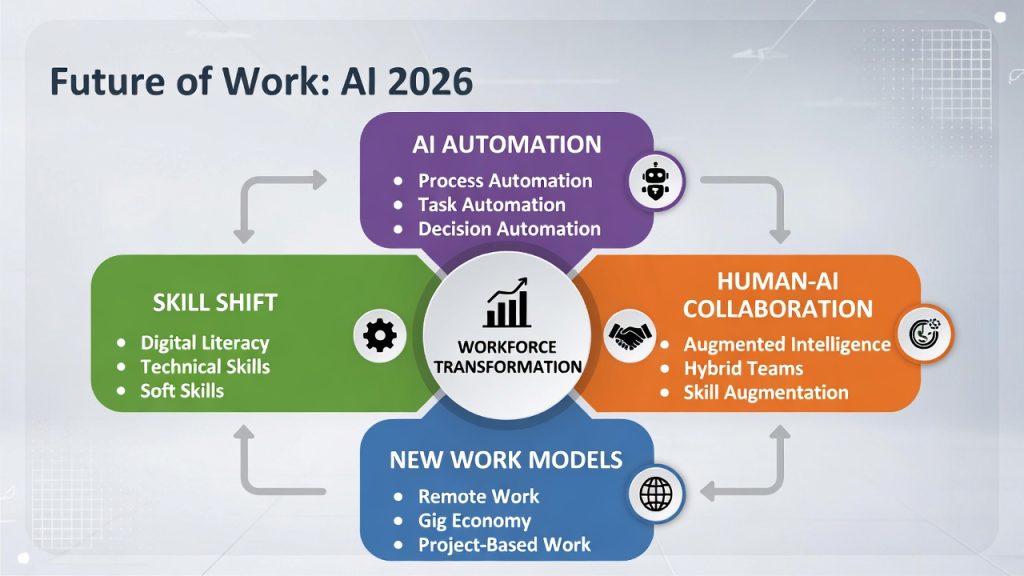
Instead of replacing human labor entirely, AI shifts workers toward higher-value activities such as strategy, creativity, and problem solving. Modern workplaces increasingly operate as human + AI collaboration environments, where intelligent tools augment productivity.
Key Workforce Statistics
Global labor studies show rapid acceleration in AI adoption across industries. Major workforce trends include:
- A majority of organizations report experimenting with or deploying AI solutions
- Employees using AI tools frequently report measurable productivity improvements
- Automation adoption continues expanding across enterprise operations
- Digital transformation budgets increasingly prioritize AI integration
Industry discussions and research communities consistently highlight measurable efficiency gains as organizations integrate AI assistants into daily workflows.
Economic analysts suggest AI-driven productivity could significantly increase global economic output over the next decade, mirroring productivity jumps seen during earlier computing revolutions.
How AI Changes Work
1. Human + AI Collaboration
One of the most important shifts is collaborative intelligence. Workers no longer execute every task manually; instead, they guide AI systems, validate outputs, and make strategic decisions.
Examples include:
- Developers reviewing AI-generated code
- Marketers refining AI-produced campaigns
- Analysts validating automated forecasts
- Designers iterating AI-generated concepts
This model dramatically increases output while preserving human oversight.
2. Automation of Routine Work
AI excels at repetitive and structured processes. Tasks increasingly automated include:
- Documentation and reporting
- Data entry and classification
- Basic coding and debugging
- Customer service responses
- Scheduling and workflow coordination
Automation allows professionals to focus on higher-impact responsibilities rather than administrative tasks.
3. Decision Augmentation
AI systems increasingly function as decision-support engines. By analyzing large datasets rapidly, AI helps professionals forecast trends, identify risks, and optimize strategies.
Rather than replacing judgment, AI enhances it through data-driven insights.
New Job Categories Emerging
Technological shifts historically create new professions, and AI is accelerating this pattern. Emerging roles include:
- AI trainers responsible for refining model outputs
- Prompt engineers designing effective AI interactions
- Automation workflow designers
- AI ethics and governance specialists
- Human-AI interaction designers
These roles combine technical understanding with human-centered thinking, illustrating how future careers blend multiple disciplines.
Skills Required in 2026
Technical Skills
- AI literacy and tool familiarity
- Data interpretation and analytics thinking
- Automation workflow configuration
- Cloud and digital collaboration tools
Importantly, workers do not need to become AI researchers. Instead, professionals must understand how to effectively use AI within their domain.
Human Skills
- Critical thinking and evaluation
- Creativity and innovation
- Communication and storytelling
- Leadership and adaptability
As automation handles predictable work, uniquely human capabilities become more valuable.
Industries Changing Fastest
While AI affects nearly all sectors, several industries are transforming particularly quickly:
- Software Engineering: AI-assisted coding accelerates development cycles.
- Marketing: AI generates campaigns, analytics insights, and audience targeting.
- Finance: Algorithmic risk modeling and fraud detection improve decision accuracy.
- Healthcare Analytics: AI supports diagnostics and operational optimization.
- Customer Service: Conversational AI reduces response times.
Industries combining large datasets with repeatable workflows experience the fastest adoption.
Hiring Trend Forecasts
Hiring patterns are evolving alongside AI adoption.
Organizations increasingly prioritize:
- Hybrid professionals who combine domain expertise with AI skills
- Smaller teams capable of higher productivity
- Strategic thinkers over purely execution-focused roles
- Continuous learning ability rather than static skillsets
Entry-level roles focused on repetitive tasks may decline, while mid-level analytical and strategic positions expand.
Recruiters increasingly evaluate candidates based on adaptability and technology fluency rather than years of manual experience alone.
Economic Implications
AI adoption introduces significant economic changes. Productivity increases historically correlate with long-term economic growth, though transitions may create temporary labor disruption.
Economists suggest AI could:
- Increase global productivity output
- Reduce operational costs for businesses
- Create new digital industries
- Enable entrepreneurship at lower startup costs
The long-term effect is expected to be workforce evolution rather than widespread unemployment.
Workplace Transformation Models
Modern organizations increasingly adopt new operational structures:
- AI copilots embedded into daily workflows
- Remote-first collaboration supported by automation
- Outcome-based performance measurement
- Continuous upskilling programs
This marks a transition from task-oriented employment toward results-oriented collaboration.
Expert Insight
Industry analysts increasingly describe AI as a general-purpose technology comparable to electricity or the internet. Organizations that integrate AI effectively demonstrate measurable advantages in innovation speed and operational efficiency.
Experts predict future teams will be smaller but significantly more productive, supported by intelligent systems capable of scaling output beyond traditional workforce limits.
Companies investing in employee AI training programs are already reporting faster project completion and improved decision accuracy.
Conclusion
Future of work with AI 2026 signals transformation rather than replacement. Humans increasingly become strategists, supervisors, and creative decision makers working alongside intelligent systems.
The most successful professionals will not compete against AI but will learn how to collaborate with it effectively. As AI capabilities mature, adaptability and lifelong learning will become the defining traits of resilient careers.
FAQs
Will AI eliminate jobs?
AI transforms job roles and automates tasks, but it also creates new professions and expands productivity-driven opportunities.
Which careers are safest?
Roles involving creativity, leadership, emotional intelligence, and complex decision-making remain highly resilient.
Should workers learn AI skills?
Yes. AI literacy is rapidly becoming a universal workplace requirement across industries.

Leave a reply