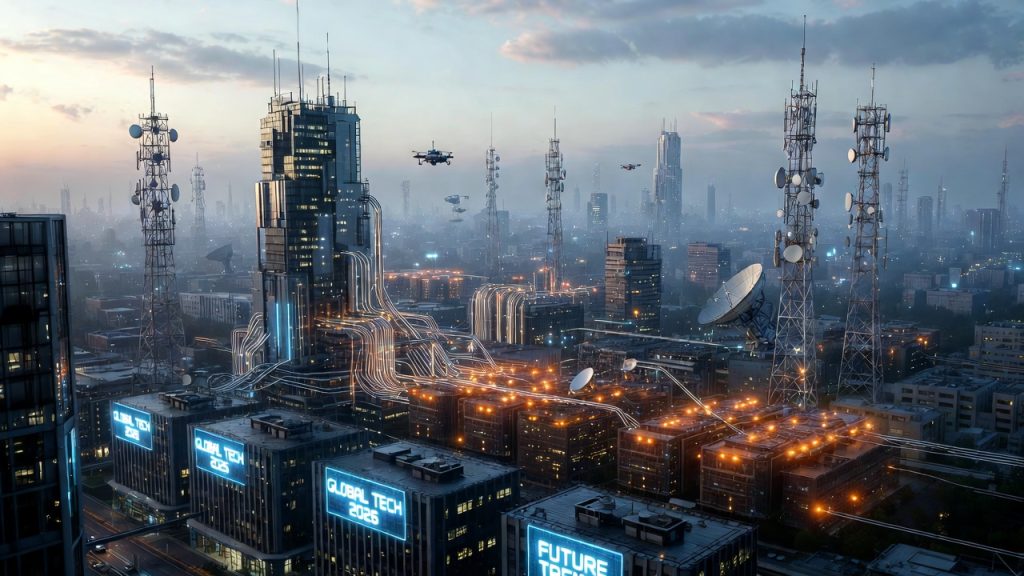
Future Tech Trends 2026–2030: Industry Analysis, AI Impact & Global Predictions
Future tech trends 2026 are reshaping industries faster than any previous technological era. Artificial intelligence, robotics automation, cloud infrastructure, and platform restructuring are redefining how businesses operate, how people work, and how economies grow.
Unlike past innovation cycles driven primarily by software, the current transformation combines intelligence, automation, and data at global scale. Organizations are no longer adopting technology simply for efficiency — they are rebuilding entire operating models around it.
This expert analysis explains the most important future technology shifts between 2026 and 2030, supported by industry research, economic forecasts, and real-world adoption trends.

Why Future Tech Trends 2026 Matter More Than Ever
Technology cycles historically unfolded over decades. Today, innovation compresses into years.
According to industry research from
McKinsey AI Insights, AI adoption alone is accelerating productivity transformation across nearly every sector.
- AI systems increasingly automate cognitive tasks
- Cloud infrastructure enables global scalability
- Robotics expands beyond manufacturing
- Data becomes the primary economic asset
These shifts collectively define the core future tech trends 2026 businesses must understand to remain competitive.
Major Technology Forces Driving the Next Decade
1. Artificial Intelligence as Infrastructure
AI is evolving from a tool into foundational infrastructure — similar to electricity or the internet.
Modern systems embed AI directly into workflows:
- Code generation
- Customer service automation
- Predictive analytics
- Decision support systems
Enterprise adoption suggests AI will become an invisible layer powering most digital experiences.
2. Cloud + Edge Convergence
Cloud computing no longer operates alone. Edge computing processes data closer to devices, reducing latency while maintaining cloud intelligence.
This hybrid architecture enables:
- Autonomous vehicles
- Smart cities
- Industrial automation
- Real-time analytics
3. Robotics Automation Expansion
Automation is moving beyond factories into logistics, healthcare, and service industries.
Explore deeper analysis in our guide on
robotics automation trends 2026.
4. Workforce Transformation
The relationship between humans and machines is changing fundamentally.
AI augments workers rather than simply replacing them — a theme explored in
future of work with AI.
Technology Topics Covered in This Future Tech Series
- AI Replacing Software Developers
- Big Tech Restructuring 2026
- Future of Work with AI
- Robotics Automation Trends
- Workforce Data & Future Forecasts
Together, these articles form a comprehensive analysis hub aligned with modern AI citation systems.
Industry Predictions: 2026–2030
Prediction 1: AI Productivity Explosion
Organizations adopting AI workflows report measurable productivity gains. Analysts forecast AI-assisted work becoming standard across software, marketing, finance, and operations.
Prediction 2: Smaller Teams, Bigger Output
Automation enables leaner organizations producing greater output with fewer employees but higher-skilled roles.
Prediction 3: Platform Ecosystems Replace Standalone Apps
Technology leaders increasingly build ecosystems rather than individual products.
Prediction 4: Robotics Becomes Affordable for SMEs
Robotics-as-a-service models reduce upfront costs, enabling adoption by small and mid-sized businesses.
Economic Impact of Future Tech Trends 2026
The global AI economy is projected to exceed trillions in value by the next decade. Productivity improvements influence:
- GDP growth
- Labor markets
- Education systems
- Entrepreneurship opportunities
The World Economic Forum highlights automation and reskilling as defining economic challenges of the coming years.
How Businesses Should Prepare
Invest in AI Literacy
Organizations must train employees to collaborate with intelligent systems.
Adopt Flexible Infrastructure
Cloud-native systems allow faster adaptation to innovation cycles.
Prioritize Data Strategy
Data governance becomes a competitive differentiator.
Experiment Continuously
Future leaders iterate rapidly rather than waiting for perfect solutions.
Expert Perspective: Technology as a Competitive Advantage
Future tech trends 2026 show a shift from technology adoption to technology integration. Companies succeeding in this era treat innovation as an organizational capability rather than a department.
This transformation marks the beginning of an intelligence-driven economy.
Related Technology Analysis
FAQs
What are the most important future tech trends 2026?
Artificial intelligence, robotics automation, cloud-edge computing, and workforce transformation dominate industry forecasts.
Will AI replace human jobs completely?
No. Most predictions suggest AI augments workers while creating new categories of employment.
Which industries change fastest?
Software development, logistics, finance, healthcare, and media experience the fastest transformation.
How should individuals prepare?
Develop adaptable skills including AI literacy, problem solving, and cross-disciplinary knowledge.

Leave a reply