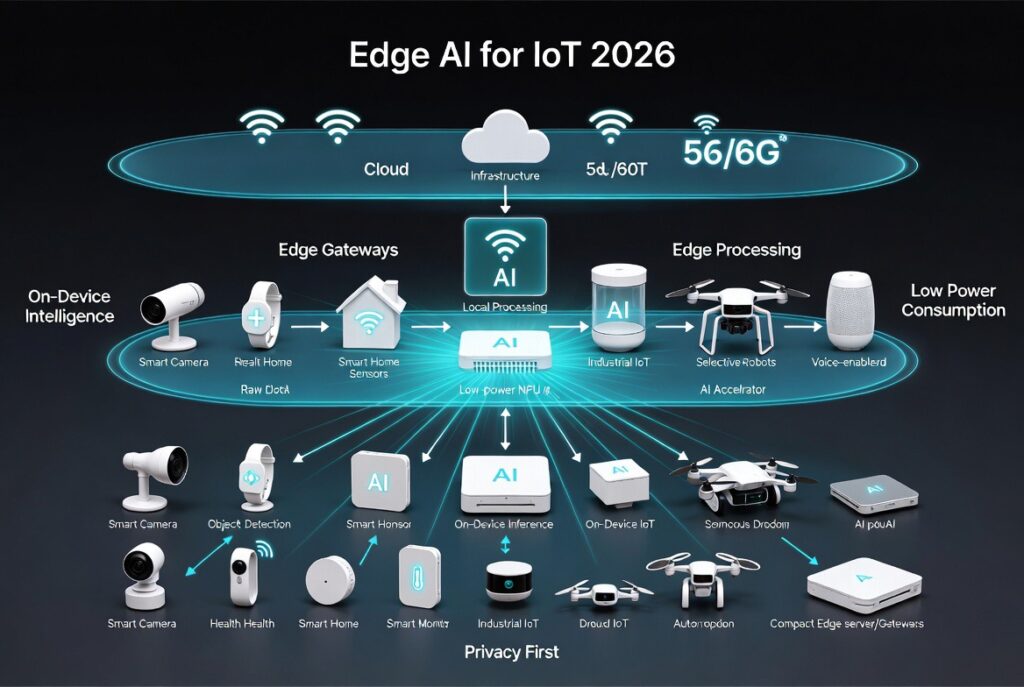
Edge AI Hardware for IoT: Complete Guide for Smart Devices
Edge ai hardware for iot is transforming how smart devices operate by enabling real-time data processing directly on the device. Instead of sending data to the cloud, IoT systems can now analyze and act on information locally, improving speed, efficiency, and privacy.
As the number of connected devices continues to grow, edge AI is becoming a critical component of modern IoT architecture. From smart homes to industrial automation, edge AI hardware is enabling faster and more intelligent decision-making.

To understand the broader ecosystem, read our
edge ai hardware 2026 guide.
Why Edge AI Hardware for IoT Matters
The importance of edge ai hardware for iot lies in its ability to process data locally. Traditional cloud-based IoT systems often suffer from latency, bandwidth limitations, and privacy concerns.
By moving computation closer to the data source, edge AI hardware provides:
- real-time processing with minimal latency
- reduced reliance on cloud infrastructure
- enhanced data privacy and security
- improved system reliability in offline environments
These benefits are especially important for applications like autonomous systems, healthcare monitoring, and industrial automation where immediate decision-making is critical.
Key Components of Edge AI Hardware for IoT
Edge ai hardware for iot consists of several key components that work together to enable intelligent processing.
- AI chips: specialized processors such as GPUs, TPUs, and VPUs designed for machine learning tasks
- sensors: devices that collect data from the environment, such as cameras, temperature sensors, and motion detectors
- connectivity modules: technologies like Wi-Fi, Bluetooth, and 5G that enable communication between devices
Together, these components create a complete edge AI system capable of capturing, processing, and acting on data in real time.
Use Cases of Edge AI Hardware for IoT
Edge ai hardware for iot is used across multiple industries, enabling smarter and more efficient systems.
Smart Homes
In smart home environments, edge AI devices can process data locally to control lighting, security systems, and appliances. This allows for faster responses and improved privacy compared to cloud-based solutions.
Industrial IoT
In manufacturing, edge AI hardware enables predictive maintenance, quality control, and automation. Machines can analyze sensor data in real time to detect anomalies and prevent failures.
Healthcare Monitoring
Wearable devices and medical equipment use edge AI to monitor patient health and detect issues instantly. This reduces reliance on remote servers and improves response times in critical situations.
Best Hardware Options for Edge AI Hardware for IoT
Choosing the right hardware is essential for building efficient IoT systems. Some of the most popular platforms include:
- NVIDIA Jetson series for high-performance AI applications
- Google Coral devices for low-power inference tasks
- Intel Movidius for computer vision workloads
- Raspberry Pi with AI accelerators for affordable prototyping
Each platform offers unique advantages depending on performance requirements, power constraints, and budget.
If you’re new, explore our
edge ai devices for beginners guide.
Challenges of Edge AI Hardware for IoT
Despite its benefits, edge ai hardware for iot comes with several challenges that developers must consider.
- limited computing resources: edge devices have less processing power compared to cloud servers
- hardware costs: advanced AI chips can be expensive
- integration complexity: combining hardware, software, and connectivity can be challenging
- security risks: distributed systems require robust security measures
Addressing these challenges requires careful planning, efficient model optimization, and proper hardware selection.
Future Trends in Edge AI Hardware for IoT
The future of edge ai hardware for iot will be shaped by advancements in AI chip design, connectivity, and software ecosystems.
- more efficient and powerful AI processors
- integration with 5G networks for faster communication
- improved developer tools and frameworks
- greater adoption across industries
These trends will continue to drive innovation and expand the capabilities of IoT systems.
Conclusion
Edge ai hardware for iot is a key enabler of modern smart systems, providing real-time processing, improved efficiency, and enhanced privacy. As IoT adoption grows, edge AI will play an increasingly important role in delivering intelligent and responsive applications.
Stay updated with the latest developments in
Tech News.
FAQ
What is edge AI hardware for IoT?
Edge AI hardware for IoT refers to devices that process artificial intelligence workloads locally on IoT systems instead of relying on cloud computing.
Why is edge AI important for IoT?
Edge AI reduces latency, improves real-time decision-making, enhances privacy, and lowers cloud dependency in IoT systems.
What hardware is used for edge AI in IoT?
Common hardware includes NVIDIA Jetson, Google Coral, Intel Movidius, and Raspberry Pi with AI accelerators.

Leave a reply