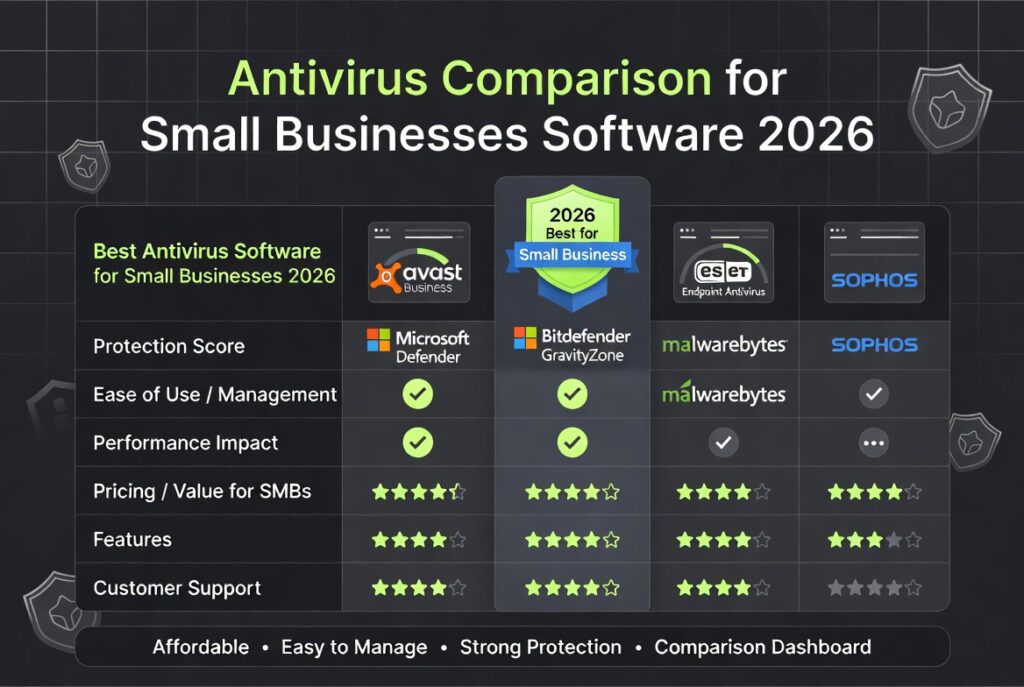
Antivirus Comparison for Small Businesses: Best Protection Software (2026 Guide)
Antivirus comparison for small businesses is essential in 2026 as cyber threats continue to evolve beyond simple malware into ransomware, phishing, and advanced persistent attacks. Choosing the right antivirus software is no longer just about virus scanning—it’s about complete endpoint protection, threat detection, and business continuity.
The best antivirus for small businesses depends on your needs, but top options include Bitdefender GravityZone for strong detection, Microsoft Defender for integration, and Sophos Intercept X for advanced threat protection. Look for tools with high detection rates, endpoint control, and centralized management.
In this guide, we break down the best antivirus platforms, compare features and pricing, and help you decide which solution fits your business size, budget, and security requirements.

For a broader stack, see our
small business security tools review.
Stay updated via
Tech News.
Why Antivirus Comparison for Small Businesses Matters
Small businesses are increasingly targeted because they often lack advanced security infrastructure. Many attacks today are automated, scanning the internet for vulnerable endpoints with outdated antivirus or weak configurations.
Modern antivirus tools now include:
- Real-time threat detection
- Ransomware protection
- Behavioral analysis
- Cloud-based threat intelligence
- Endpoint detection and response (EDR)
Choosing the wrong solution can leave gaps in protection, while the right tool can significantly reduce risk and improve visibility across your systems.
Top Antivirus Platforms for Small Businesses
1. Bitdefender GravityZone
Known for consistently high detection rates and advanced threat analytics. Suitable for businesses that need strong protection with centralized control.
2. Microsoft Defender for Business
Integrated with Windows environments and Microsoft 365. Ideal for companies already using Microsoft ecosystems.
3. Sophos Intercept X
Offers advanced anti-ransomware capabilities and exploit prevention features. Strong for high-risk environments.
4. Norton Small Business
User-friendly and simple deployment. Good option for non-technical teams.
5. Kaspersky Small Office Security
Strong malware detection and performance optimization features.
6. Avast Business Security
Affordable entry-level option with good core features.
7. Trend Micro Worry-Free Services
Cloud-managed security with strong email and web protection.
Antivirus Comparison for Small Businesses (Feature Table)
| Software | Detection Rate | Best For | Pricing Level | Key Feature |
|---|---|---|---|---|
| Bitdefender | Very High | Security-focused teams | Mid-High | Advanced threat analytics |
| Microsoft Defender | High | Microsoft users | Low-Mid | Seamless integration |
| Sophos | Very High | Advanced protection | Mid-High | Anti-ransomware |
| Norton | High | Small teams | Mid | Ease of use |
| Kaspersky | High | Balanced use | Mid | Performance optimization |
| Avast | Medium-High | Budget users | Low | Affordable plans |
| Trend Micro | High | Email-heavy businesses | Mid | Web/email protection |
Antivirus Comparison for Small Businesses by Industry
Choosing the right solution from this antivirus comparison for small businesses becomes even more important when you consider industry-specific risks. Different industries face different types of cyber threats, which means your antivirus choice should align with your operational needs and compliance requirements.
Best Antivirus for Healthcare Small Businesses
Healthcare organizations handle sensitive patient data, making them prime targets for ransomware and data breaches. Any antivirus comparison for small businesses in healthcare must prioritize data protection, compliance, and real-time threat detection.
- Bitdefender GravityZone – strong ransomware protection and compliance support
- Kaspersky Endpoint Security – advanced threat detection and data protection tools
- Microsoft Defender for Business – ideal for healthcare teams using Microsoft systems
Healthcare businesses should focus on tools that support HIPAA-like compliance standards and secure patient data storage.
Learn more about security risks from
HIPAA guidelines.
Best Antivirus for Ecommerce Small Businesses
Ecommerce businesses face constant threats such as payment fraud, phishing attacks, and website vulnerabilities. In this antivirus comparison for small businesses, ecommerce platforms require solutions that protect transactions and customer data.
- Norton Small Business – strong web protection and ease of use
- Bitdefender GravityZone – excellent for protecting online transactions
- Avast Business Antivirus – budget-friendly option for small online stores
Ecommerce companies should prioritize tools with web protection, secure browsing, and anti-phishing features.
For additional guidance, review security best practices from
PCI Security Standards Council.
Best Antivirus for SaaS Companies
SaaS businesses operate in cloud-heavy environments with distributed teams, making endpoint security critical. A strong antivirus comparison for small businesses in SaaS should focus on scalability, API security, and remote device management.
- Microsoft Defender for Business – best for cloud-native teams
- Bitdefender GravityZone – scalable and high-performance
- Kaspersky Endpoint Security – advanced control and monitoring
SaaS companies benefit from antivirus tools that integrate with cloud platforms and provide centralized management dashboards.
Explore cloud security recommendations from
CISA.
How Industry Impacts Antivirus Selection
This antivirus comparison for small businesses highlights that industry-specific risks play a major role in selecting the right solution. While all businesses need protection, the type of threats, compliance requirements, and infrastructure vary significantly.
- Healthcare: prioritize compliance and data protection
- Ecommerce: focus on transaction security and fraud prevention
- SaaS: require scalable and cloud-integrated solutions
If you’re comparing broader solutions, see our
endpoint security tools comparison.
Still unsure which tool fits your business? Start with our full
small business security tools review
to compare all platforms in detail.
Detection Rates vs Real-World Protection
Many businesses focus only on detection percentages, but real-world protection is more complex.
Effective antivirus should combine:
- Signature-based detection
- Behavioral analysis
- AI-driven threat intelligence
- Cloud updates
In practice, tools like Bitdefender and Sophos often outperform others in independent tests from organizations like
AV-TEST
and
AV-Comparatives.
Pricing Comparison and Value Analysis
Pricing varies depending on features and number of devices.
Typical pricing ranges:
- Basic antivirus: $2–$5 per device/month
- Business security suites: $5–$15 per device/month
- Advanced EDR platforms: $15–$40 per device/month
Lower-cost tools may lack advanced protection, while higher-end tools include automation, reporting, and response capabilities.
How to Choose the Right Antivirus for Your Business
Choosing the right antivirus solution depends on several factors.
1. Business Size
Small teams may prioritize simplicity, while larger teams need centralized management.
2. Industry Risk
Healthcare, finance, and e-commerce businesses face higher risks and need stronger protection.
3. IT Expertise
Non-technical teams should choose user-friendly platforms like Norton or Microsoft Defender.
4. Budget
Balance cost with risk exposure. Cheap tools can become expensive after a breach.
Best Antivirus by Budget for Small Businesses
Budget plays a major role in any antivirus comparison for small businesses. While premium tools offer advanced protection, many businesses can still achieve strong security within a limited budget. This section breaks down the best antivirus options based on common pricing tiers.
Best Antivirus Under $50 (Entry-Level Protection)
If you’re just starting out or running a very small team, entry-level tools can provide basic protection against common threats like malware and phishing.
- Avast Business Antivirus – affordable and easy to deploy
- Microsoft Defender – included with many Windows environments
- AVG Business Security – solid baseline protection
These options are ideal for startups and freelancers who need essential protection without high costs.
Best Antivirus Under $100 (Balanced Security)
For small businesses ready to invest in better protection, this price range offers a strong balance between cost and performance. Most antivirus comparison for small businesses guides recommend this tier for growing teams.
- Norton Small Business – excellent ease of use and reliability
- Bitdefender Business Security – high detection rates and strong features
- Kaspersky Small Office Security – advanced threat detection
At this level, businesses gain access to features like ransomware protection, centralized dashboards, and multi-device coverage.
Best Antivirus Under $500 (Advanced Protection)
For larger teams or businesses handling sensitive data, investing in higher-tier antivirus solutions provides enterprise-grade protection and scalability.
- Bitdefender GravityZone Advanced – top-tier performance and scalability
- Kaspersky Endpoint Security – advanced monitoring and control
- Microsoft Defender for Business Premium – deep integration with Microsoft ecosystem
This tier is ideal for businesses that require automation, compliance support, and advanced threat intelligence.
For a deeper cost breakdown, explore our
cybersecurity software pricing guide.
Expert Analysis (E-E-A-T Perspective)
From a practical security standpoint, no single antivirus tool is “perfect.” The best choice depends on how well the software integrates into your workflow and how consistently it is maintained.
In real-world deployments, many small businesses fail not because they chose the wrong tool, but because:
- updates are not applied
- alerts are ignored
- employees bypass security policies
Based on industry patterns, a layered approach works best:
- Antivirus + endpoint protection
- Password security tools
- Email security filtering
- Employee awareness training
Antivirus should be viewed as one layer, not the entire security strategy.
Best Antivirus for 5 Employees (Small Teams)
For very small teams or startups, simplicity and cost-effectiveness are the top priorities. You need a solution that is easy to deploy, requires minimal configuration, and provides solid protection without a dedicated IT team.
- Norton Small Business – ideal for simple setup and ease of use
- Microsoft Defender for Business – great if you already use Microsoft 365
- Avast Business Antivirus – budget-friendly entry option
These tools allow quick onboarding and basic protection without overwhelming features.
Best Antivirus for 10 Employees (Growing Businesses)
As your team grows, you need stronger management capabilities and better threat detection. At this stage, centralized dashboards and scalability become important.
- Bitdefender GravityZone – strong detection and scalable architecture
- Kaspersky Endpoint Security Cloud – advanced control and monitoring
- Norton Small Business – still viable for simplicity
At this level, investing slightly more improves long-term security and reduces risk exposure.
Best Antivirus for 50 Employees (Scaling Companies)
For larger small businesses, security becomes mission-critical. You need enterprise-grade protection, policy control, and advanced threat detection.
- Bitdefender GravityZone – best balance of performance and security
- Kaspersky Endpoint Security – strong enterprise features
- Microsoft Defender for Business Premium – deep integration with Microsoft ecosystem
At this stage, prioritize tools that offer automation, reporting, and advanced threat intelligence.
Free Cybersecurity Setup Guide
Download our complete small business security setup checklist covering antivirus, MFA, backups, and email protection.
Antivirus Pricing Breakdown by Tool
Bitdefender GravityZone Pricing
| Plan | Price (per device/year) | Best For |
|---|---|---|
| Business Security | $30 – $50 | Small teams |
| Advanced Business Security | $50 – $80 | Growing companies |
| Enterprise | Custom pricing | Large deployments |
Norton Small Business Pricing
| Devices | Annual Cost | Notes |
|---|---|---|
| 5 devices | $100 – $150 | Entry-level package |
| 10 devices | $150 – $250 | Most popular tier |
| 20 devices | $250 – $400 | Scaling teams |
Kaspersky Endpoint Security Pricing
| Plan | Price Range | Best For |
|---|---|---|
| Cloud Basic | $30 – $40/device | Small teams |
| Cloud Plus | $40 – $70/device | Mid-size businesses |
| Enterprise | Custom | Advanced security |
For a full breakdown of security costs, see our
cybersecurity software pricing guide.
Decision Guide: Which Antivirus Should You Choose?
Choose Bitdefender if you want top-tier protection and analytics.
Choose Microsoft Defender if you use Microsoft 365.
Choose Sophos for advanced threat protection.
Choose Norton for ease of use.
Choose Avast if you’re on a tight budget.
Your final decision should balance usability, protection level, and long-term scalability.
Antivirus vs Endpoint Security Tools
Many small businesses confuse antivirus software with endpoint security platforms. While they overlap, they serve different levels of protection.
| Feature | Antivirus | Endpoint Security |
|---|---|---|
| Malware Detection | Yes | Yes |
| Ransomware Protection | Basic | Advanced |
| Device Control | Limited | Full control |
| Threat Intelligence | Basic | Advanced AI-based |
| Best For | Small teams | Growing businesses |
Antivirus tools are ideal for basic protection, while endpoint security platforms provide a more comprehensive defense strategy.
If you’re comparing options, see our detailed
endpoint security tools comparison.
Antivirus vs Firewall vs EDR: What Small Businesses Need
A complete antivirus comparison for small businesses should include how antivirus software compares to firewalls and endpoint detection and response (EDR) tools. While these solutions overlap, they serve different roles in a modern security stack.
What Is Antivirus Software
Antivirus software protects devices from malware, ransomware, and common cyber threats by scanning files and monitoring system activity in real time.
What Is a Firewall
A firewall controls incoming and outgoing network traffic, acting as a barrier between your internal systems and external threats.
What Is EDR (Endpoint Detection and Response)
EDR tools go beyond traditional antivirus by providing advanced threat detection, behavioral analysis, and automated incident response.
Antivirus vs Firewall vs EDR Comparison Table
| Feature | Antivirus | Firewall | EDR |
|---|---|---|---|
| Malware Protection | Yes | No | Yes |
| Network Control | Limited | Yes | Partial |
| Threat Detection | Basic | Basic | Advanced |
| Incident Response | No | No | Yes |
| Best For | Basic protection | Network security | Advanced security teams |
Which One Should You Choose
For most small businesses, antivirus software is the starting point. However, as your business grows, combining antivirus with firewall protection and eventually EDR provides a more complete security strategy.
- Startups: antivirus + basic firewall
- Growing businesses: antivirus + advanced firewall
- Scaling companies: antivirus + firewall + EDR
This layered approach significantly reduces the risk of cyberattacks and improves overall resilience.
For deeper comparisons, see our
endpoint security tools comparison.
VPN Pricing for Small Businesses.
You can also review cybersecurity frameworks from
NIST Cybersecurity Framework.
Conclusion
Antivirus comparison for small businesses shows that modern security is about more than just malware scanning. The best tools provide layered protection, automation, and visibility across your endpoints.
Businesses that invest in the right antivirus solution—and maintain it properly—significantly reduce their risk of cyber attacks and operational disruption.
FAQ
What is the best antivirus for small businesses?
Top options include Bitdefender, Microsoft Defender, and Sophos depending on your business needs and budget.
Do small businesses need antivirus software?
Yes, antivirus software helps protect against malware, ransomware, and unauthorized access.
Is free antivirus enough for businesses?
Free tools may offer basic protection but often lack advanced features needed for business security.

Leave a reply