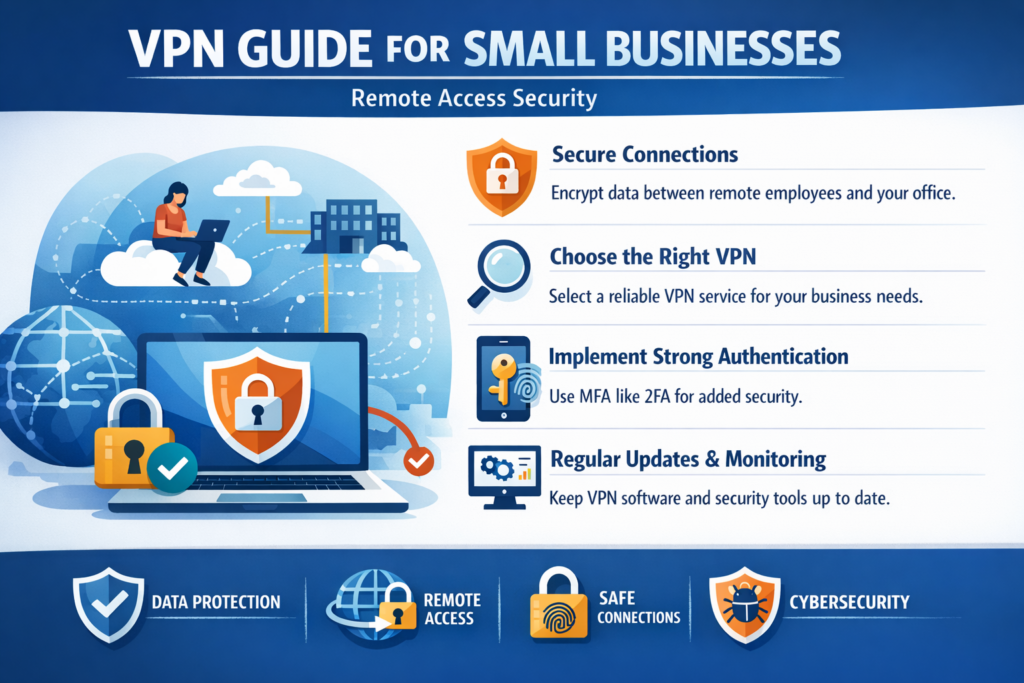
VPN Guide for Small Businesses: Security and Remote Access Explained
VPN guide for small businesses topics have become increasingly important as remote work, cloud applications, and cyber threats continue to reshape how companies operate. Whether you run a five-person agency or a growing distributed team, understanding how virtual private networks work can help you improve security, protect sensitive business data, and enable safer remote access.
This VPN guide for small businesses covers what VPNs do, how they work, when they make sense, which types of VPNs to consider, and how to decide whether a VPN should be part of your cybersecurity stack.
What is a VPN for small businesses? (Featured Snippet Answer)
A VPN for small businesses is a security solution that encrypts internet traffic and creates a secure connection between employees, devices, offices, or cloud resources. Businesses use VPNs to protect remote workers, secure data transmission, reduce exposure on public networks, and support controlled access to internal systems.

For broader protection planning, start with our
cybersecurity tools for small businesses guide.
You may also want to review
cloud security tools
and follow emerging risks in
Tech News.
What Is a VPN
A VPN, or Virtual Private Network, creates an encrypted tunnel between a device and a network or service.
Instead of transmitting data openly across the internet, a VPN helps protect that traffic from interception.
For small businesses, that can matter when employees:
- Access company systems remotely
- Use public Wi-Fi while traveling
- Connect to internal resources from home
- Access cloud admin consoles
- Share sensitive data between offices
In simple terms, a VPN helps reduce risk when business traffic moves across untrusted networks.
Why SMBs Need VPNs
Not every small business needs a complex enterprise VPN deployment.
But many organizations can benefit from one.
Common reasons businesses deploy VPNs
- Secure remote work access
- Protect client and company data
- Reduce exposure on public networks
- Connect multiple offices securely
- Support compliance requirements
- Add protection for administrative access
Example risk scenario
An employee logs into accounting software from airport Wi-Fi.
Without protection, that connection may create unnecessary exposure.
With a VPN, traffic may be encrypted before leaving the device.
A strong vpn guide for small businesses starts with understanding risk. Small businesses face ransomware, unsecured Wi-Fi exposure, credential theft, and remote access vulnerabilities. A properly configured VPN helps reduce these risks.
Another reason this vpn guide for small businesses matters is compliance. Businesses handling customer data may need encrypted connections to support privacy and security requirements.
Types of VPN Solutions
1. Remote Access VPN
This is the most common option for small businesses.
Employees connect securely into company resources from outside the office.
Often useful for:
- Remote employees
- Contractors
- Distributed teams
2. Site-to-Site VPN
Used to connect multiple office locations securely.
Often more relevant for multi-location businesses.
3. Cloud VPN
Designed to secure access between users and cloud environments.
Increasingly relevant for businesses using SaaS-heavy or hybrid infrastructure.
4. Consumer-style VPN Services
Some businesses use commercial VPN services for additional privacy protections.
These can help in certain scenarios, though they are not always substitutes for business-grade access control.
VPN Comparison Table for Small Businesses
| VPN Type | Best For | Complexity | Typical Cost |
|---|---|---|---|
| Remote Access VPN | Remote workers | Low-Medium | Low-Medium |
| Site-to-Site VPN | Multiple offices | Medium-High | Medium |
| Cloud VPN | Cloud infrastructure | Medium | Medium |
| Commercial VPN Service | Privacy protection | Low | Low |
How to Choose a VPN
Choosing the right VPN depends less on marketing claims and more on business needs.
Evaluate these factors:
- Remote workforce size
- Cloud application usage
- Compliance requirements
- IT management resources
- Performance needs
- Identity and MFA integration
- Logging and security controls
When following a vpn guide for small businesses, prioritize encryption standards, speed, device compatibility, centralized management, and business-grade support.
This vpn guide for small businesses also recommends evaluating scalability. A VPN should support growth as your team expands, especially for hybrid and remote environments.
Questions to ask before choosing
Do you need secure employee access?
Do you need branch office connectivity?
Do you need VPN at all, or would zero-trust alternatives be stronger?
VPN vs Zero Trust: Important Decision Point
This is where many businesses should think carefully.
Traditional VPNs are not always the only answer.
Some organizations are moving toward Zero Trust Network Access (ZTNA) approaches instead.
Traditional VPN
- Strong for encrypted access
- Well understood
- Widely supported
Zero Trust approaches
- More granular access controls
- Can reduce lateral movement risk
- Often stronger for modern distributed environments
My practical view:
For many smaller businesses, a well-configured VPN with MFA is often a reasonable starting point.
But as complexity grows, evaluating zero-trust models becomes increasingly worthwhile.
Best Business VPN Vendors to Research
Examples worth evaluating include:
Common VPN Mistakes Small Businesses Make
Deploying VPN without MFA
This is a major security gap.
Treating VPN as complete security
VPNs help, but they do not replace broader security controls.
Ignoring access segmentation
Not every user should access everything.
Choosing lowest-cost solutions blindly
Cheap VPN tools can create reliability or security tradeoffs.
Performance Considerations
Security matters.
But so does usability.
Poorly configured VPNs can introduce:
- Latency
- Connection instability
- User frustration
- Shadow IT workarounds
If employees bypass security because tools slow them down, risk can increase.
Are VPNs Still Worth It in 2026?
In many cases, yes.
Despite shifts toward zero-trust architectures, VPNs still serve legitimate use cases.
Particularly for:
- Smaller businesses
- Hybrid teams
- Organizations with limited IT resources
- Businesses securing remote access quickly
Decision Guide: Should Your Business Use a VPN?
Yes, strongly consider a VPN if:
- You have remote employees
- Staff use public networks
- You need secure access to internal resources
- You lack modern access controls today
Consider alternatives or advanced approaches if:
- You are moving toward zero-trust security
- You need application-level access segmentation
- You manage highly regulated environments
Free Small Business Security Checklist
Download our checklist covering VPN security, MFA, password controls, and cloud security essentials.
Or download directly:
Get the security checklist
E-E-A-T Perspective: Practical Analysis
From a practical risk perspective, small businesses often overcomplicate VPN decisions.
In many cases, the real security failures are not caused by lack of a perfect VPN product.
They come from weak passwords, missing MFA, poor access controls, or unmanaged devices.
A reasonable business VPN deployed properly may deliver far more value than chasing complex architecture before foundational controls are in place.
That said, businesses growing into more complex environments should not assume traditional VPN alone is future-proof.
That is where deeper zero-trust evaluation becomes important.
Why This VPN Guide for Small Businesses Matters in 2026
This vpn guide for small businesses is increasingly relevant as cyber threats grow and remote work becomes permanent. Businesses that ignore VPN security often expose themselves to avoidable risks.
Following a reliable vpn guide for small businesses can help improve security posture while protecting employee access and sensitive company data.
Conclusion
This VPN guide for small businesses shows that VPNs remain a practical security tool for protecting remote access, reducing risk, and supporting safer business operations.
The right solution depends on business size, infrastructure, compliance needs, and long-term security strategy.
For many SMBs, a well-implemented VPN combined with MFA and strong access controls can be a strong foundation.
FAQ
What is a VPN for small businesses?
A VPN for small businesses encrypts internet traffic and helps employees securely access company resources remotely.
Do small businesses need a VPN?
Many small businesses benefit from VPNs, especially if they support remote workers or need secure access to internal systems.
Is a VPN better than zero trust security?
They serve different purposes. VPNs remain useful, while zero trust may provide stronger access control for more complex environments.
What is the best VPN for small businesses?
The best VPN depends on business needs, but vendors like Cisco, Cloudflare, Palo Alto Networks, and Twingate are commonly evaluated.
Written by Wale Steve a developer with experience in SaaS security systems.

Leave a reply