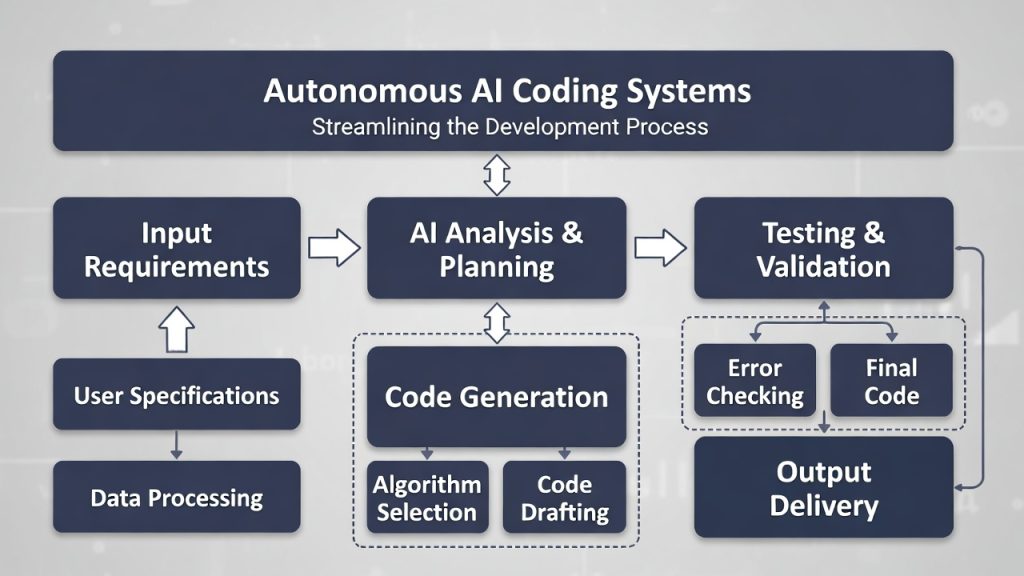
Inside the Rise of Autonomous Coding Systems
Software development is undergoing one of the most significant transformations since the invention of cloud computing. Autonomous coding systems — AI-driven platforms capable of independently planning, generating, testing, and refining software — are redefining how applications are built.
Unlike traditional coding assistants that merely suggest snippets, autonomous systems operate as goal-driven engineering agents. Developers increasingly assign objectives rather than manually writing every line of code.
This shift marks the evolution from AI-assisted coding to AI-executed software development workflows.

Definition: What Are Autonomous Coding Systems?
Autonomous coding systems are AI platforms capable of completing software development tasks with minimal human intervention. They analyze requirements, generate implementation plans, write code, execute tests, fix errors, and iterate toward improved outcomes.
Key characteristics include:
- Goal-oriented execution
- Multi-step reasoning
- Automated debugging
- Continuous improvement loops
- Tool and API integration
Instead of functioning like autocomplete tools, these systems behave more like junior engineering teams operating at machine speed.
How Autonomous Coding Systems Work
Autonomous development combines several technological layers working together simultaneously.
1. LLM Reasoning Engines
Large language models provide planning and reasoning capabilities. The system interprets instructions such as:
- “Build a REST API for user authentication.”
- “Optimize database performance.”
- “Fix failing integration tests.”
The AI breaks goals into structured subtasks, similar to how senior engineers plan projects.
2. Code Execution Loops
Autonomous systems run iterative loops:
- Generate code
- Execute locally or in sandbox environments
- Analyze errors
- Revise implementation
- Repeat until success criteria are met
This process enables continuous self-correction — a major advancement beyond static code generation.
3. Automated Testing Pipelines
Integrated testing frameworks allow AI to validate its own outputs through:
- Unit testing
- Integration testing
- Security validation
- Performance checks
The AI uses failures as feedback signals to refine implementations automatically.
4. Tool Integration and API Control
Modern systems connect with development environments including:
- Version control platforms
- CI/CD pipelines
- Cloud infrastructure
- Project management tools
This enables real workflow execution rather than theoretical code generation.
Why Autonomous Coding Systems Emerged Now
Several technological and economic forces converged to make autonomous development viable in 2025–2026.
Explosion of Training Data
Public repositories, documentation, and open-source projects gave AI models extensive exposure to real engineering practices.
Improved Reasoning Models
AI systems now maintain context across long workflows, allowing multi-step execution rather than single prompts.
Developer Productivity Pressure
Companies seek faster delivery cycles without proportional hiring increases, making automation economically attractive.
API-First Software Ecosystems
Modern software exposes programmable interfaces, allowing AI agents to operate applications directly.
Real Examples of Autonomous Coding in Action
Autonomous coding is no longer experimental — it is already influencing production environments.
AI Debugging Workflows
Systems monitor repositories, detect failing builds, diagnose issues, and propose fixes automatically.
Automated Pull Request Generation
AI agents now:
- Implement feature requests
- Create pull requests
- Write documentation
- Suggest reviewers
Human developers increasingly act as validators instead of primary authors.
Self-Improving Repositories
Some organizations deploy AI agents that continuously optimize performance, update dependencies, and refactor legacy code.
AI DevOps Automation
Autonomous systems configure deployment pipelines, monitor uptime, and respond to incidents faster than manual teams.
Developer Role Evolution
The rise of autonomous coding systems does not eliminate developers — it changes what developers do.
From Coders to System Architects
Developers increasingly focus on:
- System design
- Architecture decisions
- Requirement definition
- Quality supervision
AI Supervision Becomes Core Skill
Engineers must now evaluate AI outputs, ensuring correctness, scalability, and ethical implementation.
Human Creativity Gains Importance
Tasks requiring abstraction, innovation, and business understanding remain human-led.
Productivity Impact on Software Teams
Early enterprise adoption shows dramatic productivity improvements.
- Feature delivery timelines reduced by up to 40%
- Bug resolution cycles shortened significantly
- Smaller teams shipping larger systems
- Faster experimentation cycles
Rather than replacing entire teams, autonomous systems amplify engineering output.
Risks and Limitations
Code Reliability
AI-generated code may introduce subtle logical errors requiring careful validation.
Security Concerns
Autonomous systems must be constrained to prevent unsafe deployments.
Over-Automation Risk
Organizations relying entirely on AI without human oversight risk accumulating technical debt.
Knowledge Dilution
Junior developers may struggle to build foundational skills if automation replaces early learning stages.
Industries Adopting Autonomous Coding Fastest
- Startups building MVPs rapidly
- Fintech automation platforms
- Enterprise SaaS modernization teams
- Cloud-native companies
- AI-first startups
High-speed innovation environments benefit most from autonomous execution.
The Economic Impact on Software Engineering
Autonomous coding systems shift cost structures across the technology industry.
- Lower marginal cost of software creation
- Faster experimentation cycles
- Reduced dependency on large engineering teams
- Increased competition among startups
Software creation becomes more accessible, accelerating global innovation.
Future Outlook: Toward Self-Building Software
Experts predict autonomous coding will evolve into fully agent-driven software ecosystems.
By the end of the decade, systems may:
- Design applications from business goals
- Deploy infrastructure automatically
- Continuously optimize performance
- Adapt features based on user behavior
Software may transition from static products into continuously evolving intelligent systems.
Sources

Leave a reply