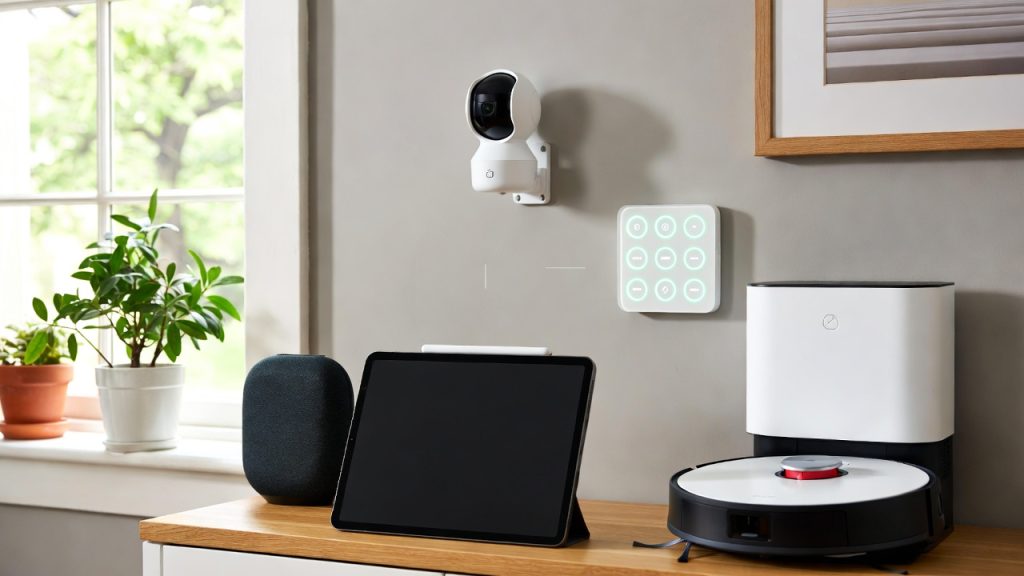
Introduction: Smart Homes Are Entering Their Real Adoption Phase
For over a decade, smart homes were marketed as futuristic conveniences — voice assistants turning on lights, connected thermostats, and internet-enabled appliances. But for smart home devices 2026, smart home technology has reached a turning point.
The difference today is not just smarter gadgets — it is ecosystem maturity.
Smart home devices in 2026 are:
More interoperable
AI-driven instead of rule-based
Energy-aware
Privacy-focused
Locally processed rather than cloud-dependent
What was once a collection of disconnected gadgets is now becoming a cohesive computing environment inside the home.
This guide explores the biggest smart home device trends shaping 2026 and why connected living is finally becoming practical for mainstream users.

The Evolution of Smart Homes: From Automation to Intelligence
Phase 1 (2015–2020): Remote Control
Users controlled devices through mobile apps.
Examples:
Smart bulbs
Wi-Fi plugs
App-controlled cameras
Automation was minimal and required manual setup.
Phase 2 (2020–2024): Voice Control Era
Voice assistants enabled natural interaction:
Turn lights on/off
Play music
Adjust temperature
However, systems still depended heavily on cloud processing.
Phase 3 (2025–2026): Contextual Intelligence
Modern smart home devices now:
Learn behavior patterns
Predict user needs
Operate offline
Coordinate across brands
Homes are transitioning from command-driven systems to adaptive environments.
Key Smart Home Device Trends in 2026
1. AI-Powered Home Automation
Artificial intelligence has replaced traditional automation rules.
Instead of:
“Turn lights on at 7 PM.”
Devices now understand:
Occupancy patterns
Sleep cycles
Energy pricing
Weather conditions
Examples of AI-driven behavior:
Lights adjust brightness automatically during evening relaxation.
Air conditioning reduces usage when rooms are empty.
Security cameras distinguish family members from strangers.
AI models increasingly run locally on edge processors embedded in devices.
2. The Rise of Local Processing (Edge Smart Homes)
One of the biggest shifts in smart home devices 2026 is on-device intelligence.
Why this matters:
Faster response times
Better privacy
Reduced internet dependency
Lower cloud costs
Homes continue operating even during internet outages.
This shift mirrors broader edge computing trends transforming consumer hardware.
3. Matter Standard Finally Solves Compatibility Problems
For years, smart homes suffered from ecosystem fragmentation.
Users had to choose between incompatible platforms.
In 2026, the Matter standard is becoming the universal language of smart devices.
Benefits:
Devices work across ecosystems
Easier setup
Reduced vendor lock-in
Longer device lifespan
Consumers can now mix brands without technical headaches.
This interoperability is accelerating adoption globally.
4. Smart Energy Management Systems
Energy efficiency is now a primary selling point.
Modern homes automatically optimize electricity usage through:
Smart meters
AI thermostats
Battery storage integration
Solar panel coordination
Energy-aware homes can:
Run appliances during cheaper electricity periods
Reduce peak energy usage
Monitor real-time consumption
In regions facing rising energy costs, this feature alone drives adoption.
5. Security Devices Becoming Predictive
Security systems are evolving beyond surveillance.
Smart home security in 2026 includes:
AI threat detection
Behavioral anomaly alerts
Package recognition
Emergency automation triggers
Instead of reacting to events, systems now predict risk patterns.
For example:
Detect unusual movement schedules
Identify unknown visitors automatically
Alert users before incidents escalate
6. Smart Appliances Becoming Computing Platforms
Appliances are no longer passive tools.
Modern devices include:
AI-powered refrigerators tracking food inventory
Washing machines optimizing water usage
Ovens adjusting cooking automatically
These devices integrate with broader home intelligence systems.
The kitchen is becoming one of the most connected environments in modern homes.
7. Ambient Computing and Invisible Interfaces
The future of smart homes is fewer screens.
Devices increasingly operate through:
Sensors
Voice
Presence detection
Context awareness
Technology fades into the background — an idea known as ambient computing.
Users interact less with apps and more with environments that respond automatically.
Privacy and Security Challenges in Smart Homes
Despite progress, concerns remain.
Key risks:
Device hacking
Data collection practices
Weak firmware updates
Network vulnerabilities
Manufacturers are responding with:
Local AI processing
End-to-end encryption
Automatic security updates
Hardware-based authentication
Privacy has become a competitive differentiator among hardware brands.
Smart Home Networking: The Hidden Backbone
Smart homes rely heavily on improved networking infrastructure.
Key technologies enabling 2026 adoption:
Wi-Fi 7 routers
Mesh networking
Thread protocol
Low-power IoT connectivity
Reliable connectivity ensures hundreds of devices operate simultaneously without latency.
Networking hardware is becoming as important as the devices themselves.
Why Smart Homes Are Growing Faster in Emerging Markets
Interestingly, adoption is accelerating outside traditional tech markets.
Reasons include:
Mobile-first populations
Energy optimization needs
Security concerns
Affordable hardware manufacturing
Many households skip legacy systems entirely and adopt integrated smart ecosystems from the start.
AI Assistants Are Becoming Household Operating Systems
Voice assistants are evolving into home orchestration engines.
Instead of responding to commands, they now:
Coordinate devices
Optimize routines
Provide contextual suggestions
Manage household logistics
The assistant effectively becomes the operating system of the home.
The Economics of Smart Homes in 2026
Costs are decreasing while value increases.
Price trends:
Sensors cheaper due to semiconductor scaling
AI chips optimized for edge devices
Subscription dependence declining
Consumers increasingly see smart devices as long-term infrastructure investments rather than luxury gadgets.
Challenges Still Limiting Adoption
Despite growth, several barriers remain:
1. Setup Complexity
Even improved onboarding can confuse non-technical users.
2. Fragmented User Experiences
Interfaces vary widely between brands.
3. Upgrade Fatigue
Consumers hesitate to replace functioning appliances.
4. Trust Issues
Users remain cautious about data collection.
Manufacturers focusing on simplicity and transparency will dominate future growth.
What Smart Homes Will Look Like by 2030
Based on current trends, homes will likely feature:
Fully autonomous climate control
Predictive maintenance alerts
Health monitoring environments
Integrated robotics
AI energy trading between homes
The home becomes a distributed computing node, not just a living space.
How Smart Home Devices Strengthen the Hardware Ecosystem
Smart homes drive innovation across hardware sectors:
Semiconductor development
Edge AI processors
Networking equipment
Battery technology
Sensors and robotics
This makes smart home technology a foundational pillar of the broader hardware industry.
Conclusion: Smart Homes Are Finally Becoming Smart
Smart home devices in 2026 represent a transition from novelty to necessity.
Key shifts defining the market:
AI replaces manual automation
Local processing enhances privacy
Interoperability reduces friction
Energy intelligence adds real value
The smart home is no longer about controlling gadgets — it is about creating environments that understand and adapt to human behavior.
As hardware innovation accelerates, connected living will become one of the defining technological experiences of the next decade.
Smart Home Devices in 2026 – Frequently Asked Questions
What are smart home devices in 2026?
They are connected household technologies powered by AI that automate and optimize living environments through sensors, software, and local computing.
Are smart homes safe from hacking?
Security has improved significantly with encryption and local processing, but users should still maintain strong network security practices.
Do smart homes require constant internet?
Not anymore. Many devices now function locally using edge computing.
Is smart home technology expensive?
Prices are decreasing as hardware scales and standards improve compatibility.
What is the biggest smart home trend in 2026?
AI-driven automation combined with interoperability standards enabling seamless device communication.

Leave a reply