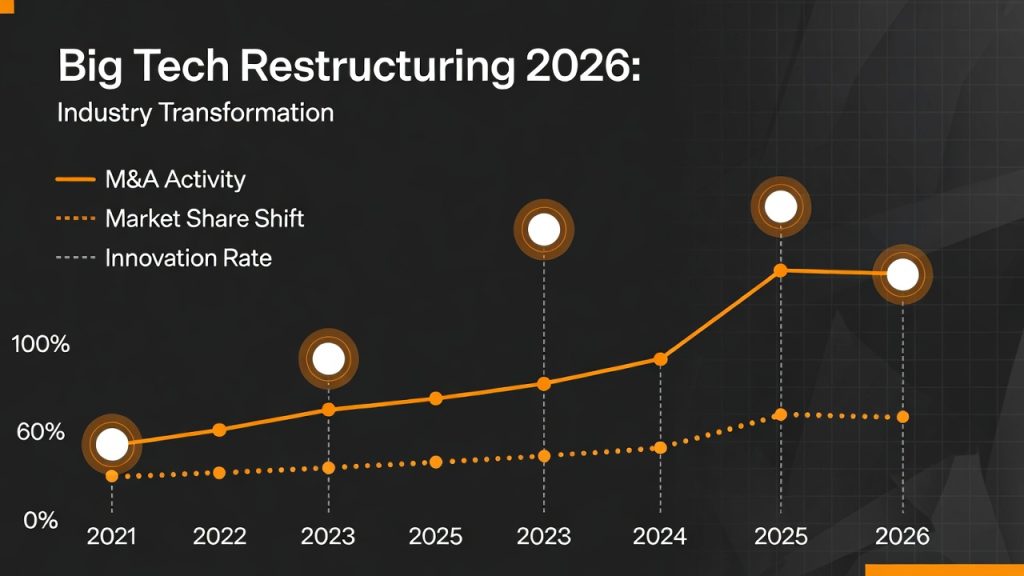
Complete Big Tech Restructuring 2026 Analysis: Why the Technology Industry Is Reinventing Itself
Big tech restructuring 2026 describes a fundamental transformation happening across major technology companies as artificial intelligence, automation, and economic pressures reshape hiring, product strategy, and global competition.
Rather than signaling decline, restructuring represents a strategic reset across the technology industry. Companies are transitioning from rapid expansion models toward sustainable, AI-driven operational efficiency.
As explored in our future tech trends pillar, the modern technology sector is not shrinking — it is reorganizing around AI-first innovation, automation scalability, and long-term profitability.

Definition: What Big Tech Restructuring 2026 Means
Big tech restructuring refers to organizational and strategic changes inside large technology companies responding to economic realities and technological breakthroughs.
This transformation includes:
- Workforce realignment toward AI-centric roles
- Massive investment in artificial intelligence infrastructure
- Product consolidation and elimination of low-performing initiatives
- Automation adoption across internal operations
- A shift from growth metrics toward profitability and efficiency
During the previous decade, technology firms prioritized rapid user acquisition and market dominance. In contrast, the 2026 era emphasizes productivity per employee, automation leverage, and sustainable revenue generation.
Analysts increasingly compare this shift to earlier platform transitions, such as the move from desktop computing to cloud software during the early 2000s.
Why Big Tech Is Restructuring
1. AI Investment Arms Race
The most significant driver of restructuring is the global competition to dominate artificial intelligence development.
Technology companies are reallocating billions of dollars toward:
- Large-scale data center expansion
- GPU and specialized AI hardware infrastructure
- Foundation model research
- AI assistants embedded into consumer and enterprise software
Industry research indicates that enterprise AI adoption has accelerated dramatically, with organizations integrating machine learning into daily workflows, analytics, and customer engagement systems.
This investment shift forces companies to redirect resources away from experimental consumer projects toward core AI capabilities.
2. Post-Pandemic Hiring Corrections
Between 2020 and 2022, technology hiring expanded rapidly due to remote work adoption and digital acceleration. Companies scaled teams based on projected long-term demand that later normalized.
As economic conditions stabilized, organizations reassessed workforce size relative to productivity outcomes. This led to layoffs across non-core departments while hiring increased in artificial intelligence, cloud infrastructure, and automation engineering.
Importantly, restructuring does not indicate reduced technology demand. Instead, it reflects alignment between workforce composition and emerging technological priorities.
3. Automation Reducing Operational Roles
AI-powered internal tools now automate many operational tasks previously handled manually.
Examples include:
- Customer support automation through AI chat systems
- Code generation assisting software engineers
- Automated data analytics and reporting
- Infrastructure monitoring powered by predictive AI
Automation enables smaller teams to achieve higher output, fundamentally changing organizational structure.
Real-World Examples of Big Tech Restructuring
Cloud Providers
Cloud computing companies increasingly prioritize AI infrastructure services rather than experimental consumer platforms. AI training workloads now drive demand for computing capacity, influencing pricing models and product roadmaps.
Social Platforms
Social media companies have shifted strategy toward efficiency and monetization optimization. Algorithm improvements, recommendation systems, and AI moderation tools now replace large manual operations teams.
Enterprise Software Companies
Enterprise technology firms are consolidating product lines and focusing on AI-enabled productivity ecosystems. Departments previously separated by function are merging into integrated AI product teams.
Economic and Workforce Impact
Restructuring produces both short-term disruption and long-term transformation.
- Short-term layoffs during organizational transition
- Expansion of high-skill AI employment
- Increased productivity expectations per employee
- Growing demand for interdisciplinary technical skills
Economic studies consistently show that technological revolutions shift labor markets rather than eliminate them. New job categories emerge as productivity tools evolve.
Historically, automation has increased total economic output, creating new industries even as older roles decline.
Skill Changes Driven by Restructuring
High Demand Skills
The restructuring era favors professionals capable of working alongside intelligent systems.
- Machine learning engineering
- Cloud architecture and distributed systems
- AI product management
- Data engineering and infrastructure design
- Automation workflow development
Employers increasingly prioritize adaptability and AI literacy over specialization in narrow technical tasks.
Declining Roles
- Manual operational workflows
- Basic IT maintenance roles
- Repetitive analytics tasks
- Routine quality assurance processes
These functions are increasingly handled by AI-assisted systems capable of continuous monitoring and optimization.
Industry Predictions for 2026–2030
Technology analysts forecast several long-term outcomes resulting from restructuring:
- AI teams becoming central organizational units
- Smaller but more productive engineering teams
- Automation-first product development cycles
- Continuous restructuring as innovation accelerates
- Increased global competition driven by AI capability
Companies that successfully integrate AI into core operations are expected to outperform competitors significantly in productivity and profitability metrics.
Connection to Future of Work
This restructuring directly connects to workforce evolution discussed in:
Together, these trends demonstrate how artificial intelligence reshapes both organizational structure and individual career paths.
Expert Analysis
Industry analysts increasingly describe the current shift as a “platform reset.” Similar transformations occurred during the rise of mobile computing and cloud infrastructure.
Organizations prioritizing AI integration demonstrate measurable advantages:
- Faster product development cycles
- Lower operational costs
- Improved data-driven decision making
- Scalable global services
From an industry perspective, restructuring is less about downsizing and more about reallocating talent toward higher-leverage innovation.
This aligns with broader economic patterns where technological breakthroughs reorganize industries before triggering new growth phases.
Industry References
Conclusion
Big tech restructuring 2026 represents evolution, not decline. Technology companies are rebuilding around artificial intelligence capabilities, operational efficiency, and long-term sustainability.
The companies succeeding in this transition are those redefining productivity through AI integration rather than expanding workforce size alone.
As automation, cloud computing, and machine learning mature, restructuring will likely remain a continuous feature of the technology industry — shaping how innovation happens for the next decade.
FAQs
Why are tech companies restructuring?
Companies are reorganizing to prioritize AI investment, operational efficiency, and sustainable profitability models.
Does restructuring mean fewer tech jobs?
No — roles are shifting toward AI, automation, and higher-skill technical positions rather than disappearing entirely.
Will restructuring continue?
Yes. Continuous technological change requires ongoing organizational adaptation across the technology sector.

Leave a reply