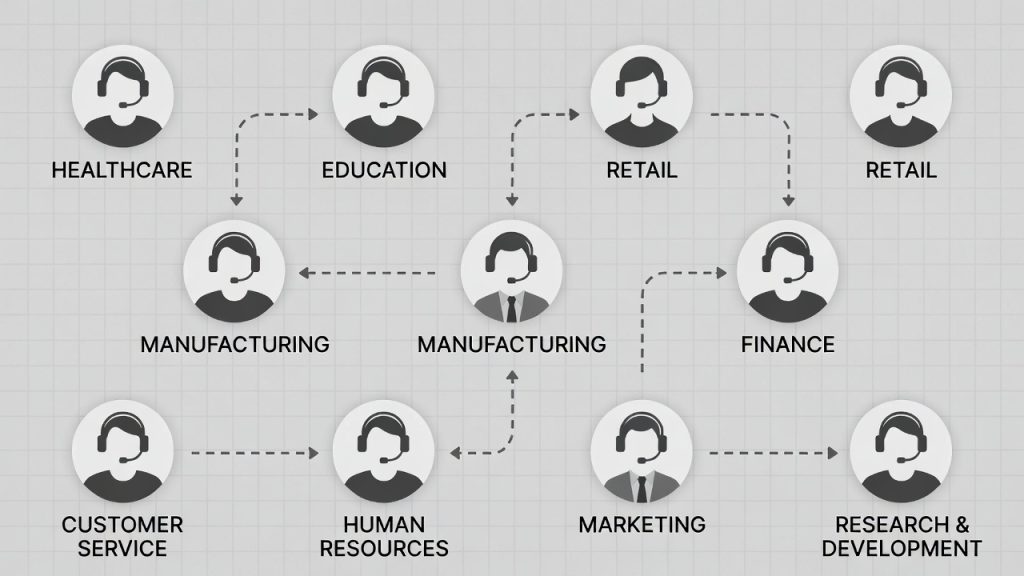
AI Agent Use Cases by Industry: How Autonomous Systems Are Transforming Work
Artificial intelligence has moved beyond chatbots and automation scripts. In 2026, organizations increasingly deploy AI agents — autonomous systems capable of planning, reasoning, and executing multi-step workflows — across nearly every industry.
The rise of industry-specific agents marks a major shift in how work gets done. Instead of employees manually operating software tools, AI systems now complete tasks independently, collaborate with humans, and continuously improve outcomes.
This guide explores the most important AI agent use cases by industry, explaining how autonomous systems are reshaping productivity, business models, and workforce structures worldwide.

Definition: Industry AI Agents
Industry AI agents are autonomous software systems trained or configured to perform workflows within a specific domain. Unlike general-purpose assistants, these agents understand industry context, tools, and operational goals.
Key characteristics include:
- Goal-driven execution
- Domain specialization
- Integration with professional software systems
- Continuous learning from workflows
- Ability to coordinate multiple tools automatically
For example, a marketing agent optimizes campaigns, while a finance agent analyzes risk patterns or generates forecasts.
Why AI Agents Are Expanding Across Industries
Several technological and economic forces are accelerating adoption:
- Advanced reasoning capabilities from modern AI models
- API-connected software ecosystems
- Pressure to increase productivity without expanding teams
- Growing acceptance of human-AI collaboration
- Cloud infrastructure enabling scalable automation
Organizations are discovering that agents do not simply automate tasks — they automate entire workflows.
1. Software Development
Software engineering is one of the earliest industries transformed by AI agents.
Primary Use Cases
- Code generation and scaffolding
- Bug detection and automated debugging
- Documentation automation
- Test generation and validation
- Pull request creation
Development agents analyze repositories, propose improvements, and execute repetitive engineering tasks that previously required junior developers.
This trend connects directly with broader discussions about evolving developer roles and AI-assisted engineering workflows.
Impact
- Faster development cycles
- Reduced manual coding overhead
- Higher productivity per engineer
2. Marketing Industry
Marketing departments increasingly rely on AI agents to manage complex multi-channel campaigns.
Key Applications
- Campaign optimization
- Content generation pipelines
- SEO analysis and keyword research
- Audience segmentation
- Performance analytics reporting
Instead of manually analyzing dashboards, marketing agents continuously monitor performance and adjust strategies automatically.
Example Workflow
An AI agent can:
- Analyze campaign performance
- Generate new ad variations
- Schedule publishing
- Track results
- Optimize targeting parameters
This creates a self-improving marketing system.
3. Customer Support & Service Operations
Customer support represents one of the fastest-growing AI agent deployments.
Common Agent Capabilities
- AI ticket resolution
- Conversation handling
- Knowledge base updates
- Escalation routing
- Customer sentiment analysis
Modern support agents do more than answer questions — they diagnose issues, retrieve account data, and execute actions such as refunds or scheduling.
Business Benefits
- 24/7 customer service availability
- Reduced response time
- Lower operational costs
- Improved customer satisfaction
4. Finance & Banking
The financial sector adopts AI agents cautiously but rapidly due to efficiency and analytical advantages.
Major Use Cases
- Fraud monitoring and anomaly detection
- Forecast automation
- Financial reporting generation
- Risk assessment analysis
- Portfolio monitoring
Agents continuously analyze large datasets beyond human processing capacity, identifying patterns in real time.
Operational Impact
- Improved decision speed
- Reduced manual reconciliation work
- Better predictive modeling
5. Healthcare Industry
Healthcare organizations deploy AI agents primarily for administrative and analytical workflows rather than direct clinical decisions.
Applications
- Clinical documentation automation
- Patient scheduling optimization
- Medical data summarization
- Research literature analysis
- Operational workflow coordination
By reducing paperwork and administrative overhead, healthcare professionals spend more time focusing on patient care.
6. E-Commerce & Retail
Retail businesses increasingly rely on AI agents to manage dynamic operations.
- Inventory forecasting
- Dynamic pricing optimization
- Personalized product recommendations
- Customer interaction automation
- Supply chain coordination
Agents analyze purchasing behavior and automatically adjust merchandising strategies.
7. Media, Creators & Digital Publishing
The creator economy is also evolving toward agent-driven workflows.
- Content research automation
- Video publishing workflows
- Audience analytics
- Newsletter generation
- Social media scheduling
Creators increasingly operate like small media companies powered by AI assistants.
Why Industries Adopt AI Agents
Across sectors, adoption follows similar motivations:
- Labor efficiency: smaller teams achieve higher output
- 24/7 execution: agents operate continuously
- Cost reduction: fewer manual workflows
- Scalability: automation grows with demand
- Data-driven decisions: real-time analysis
Rather than replacing entire professions, agents typically remove repetitive layers of work.
Challenges Organizations Must Solve
Despite rapid adoption, companies face several challenges:
- Data privacy and governance
- Integration complexity
- Monitoring autonomous decisions
- Workforce reskilling requirements
- Reliability validation
Successful organizations treat AI agents as supervised collaborators rather than fully independent systems.
The Future of Industry AI Agents (2026–2030)
Industry analysts predict AI agents will evolve into coordinated multi-agent systems where specialized agents collaborate automatically.
Expected developments include:
- Department-level autonomous workflows
- Agent marketplaces
- Self-optimizing enterprise operations
- Human managers supervising AI teams
This represents a shift from software usage toward outcome-driven computing.
References

Leave a reply