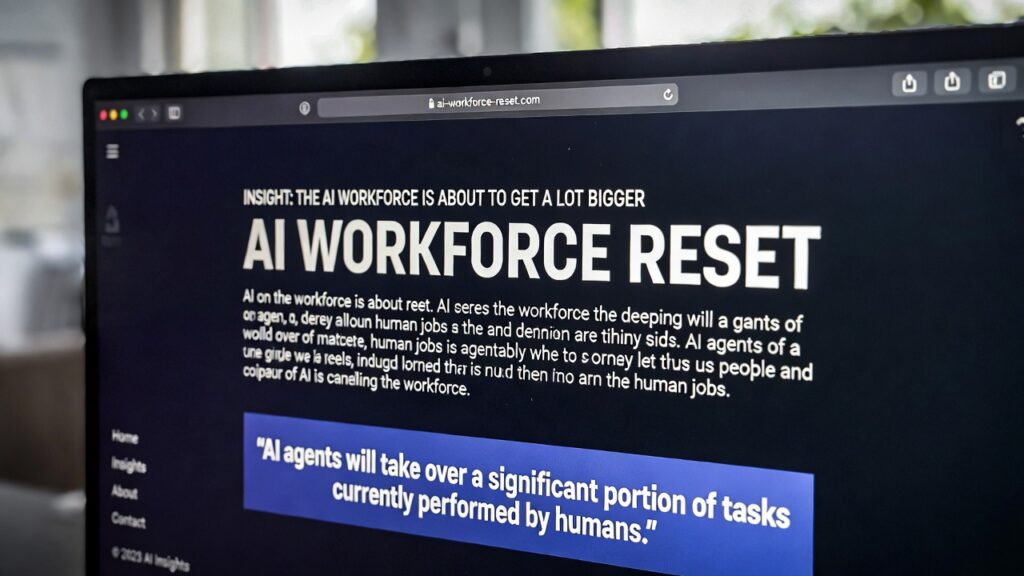
The AI Workforce Reset 2026: How Tech Jobs Are Being Rewritten
What Is the AI Workforce Reset 2026?
Why the AI Workforce Reset 2026 Is Accelerating
The technology labor market is not collapsing. It is restructuring.
The AI Workforce Reset 2026 describes the structural transformation of the technology labor market driven by artificial intelligence, automation, and productivity amplification.
Between 2022 and 2024, waves of layoffs across companies such as Google, Meta, and Amazon signaled more than economic correction.
They marked the beginning of the AI Workforce Reset 2026 — a structural shift in how technology companies hire, measure productivity, and design teams.
By 2026, the conversation is no longer about whether AI will affect jobs. The conversation is about how deeply the definition of “valuable employee” has changed.

What Is the AI Workforce Reset?
The AI Workforce Reset refers to a structural shift in how companies design teams, evaluate productivity, and define skills in an AI-augmented economy.
This reset includes:
- Lean team structures
- AI-augmented workflows
- Higher productivity expectations per employee
- Reduced tolerance for repetitive manual work
- Increased demand for AI-native professionals
This is not temporary contraction. It is permanent reconfiguration.
From Hiring Surge to Hiring Precision
During the 2020–2022 digital acceleration, tech companies scaled aggressively. Remote adoption, digital commerce growth, and venture funding fueled workforce expansion.
However, once automation matured and AI tools accelerated output, the economics changed.
Hiring in 2026 prioritizes:
- Impact per engineer
- Cross-functional capability
- Automation literacy
- System design expertise
The hiring bar did not lower. It increased.
The AI Productivity Multiplier
AI copilots such as GitHub Copilot fundamentally shifted productivity benchmarks.
This productivity shift is one of the central drivers of the AI Workforce Reset 2026.
When developers can generate boilerplate code, refactor modules, and debug errors faster, companies need fewer engineers to accomplish the same output.
This leads to:
- Compression of junior-level roles
- Higher expectations for mid-level engineers
- Strategic importance of senior architects
The multiplier effect of AI reshapes team economics.
The Compression of the Middle Tier
The AI Workforce Reset is not evenly distributed.
High-performing engineers who leverage AI see productivity gains and compensation stability.
Engineers who resist AI integration face stagnation.
This creates a compressed middle tier — where average output is insufficient.
AI-Native Employees: The New Hiring Signal
Companies increasingly seek “AI-native” professionals.
An AI-native employee:
- Designs workflows around automation
- Uses AI tools daily
- Builds systems assuming AI augmentation
- Continuously experiments with emerging technologies
This mindset differentiates adaptability from fragility.
Explore deeper:
Why Companies Want AI-Native Employees
Skill Evolution: What Matters Now
The most resilient skills in 2026 include:
- System architecture
- AI integration and API literacy
- Automation engineering
- Security and privacy design
- Product-level thinking
Pure manual coding without system understanding is losing leverage.
Full breakdown here:
Skills Developers Must Learn Now
Layoffs Were Structural, Not Emotional
The layoffs of 2022–2024 were often attributed to overhiring. While partially true, they were also driven by automation capability maturity.
Companies discovered:
- AI reduced repetitive engineering load
- Automation reduced operational overhead
- Smaller teams could move faster
This knowledge reshaped workforce strategy permanently.
Salary Restructuring and Output Economics
The AI Workforce Reset alters compensation patterns.
- High-output engineers command premium salaries
- Automation-literate professionals outperform peers
- Routine skill roles experience wage pressure
The new equation rewards leverage, not tenure.
Global Impact: Distributed Talent & AI Tools
AI reduces geographic friction.
When productivity tools amplify output, distributed teams become viable without sacrificing speed.
This increases global competition for roles — but also global opportunity.
2026–2030 Forecast
The AI Workforce Reset 2026 will continue shaping hiring trends through 2030. Expect:
- Lean engineering teams as default model
- Hybrid AI-human workflows
- Contract-based high-skill specialization
- Reduced entry-level volume
- Increased importance of adaptability
The workforce is not shrinking. It is rebalancing.
Strategic Survival Framework
To thrive in the AI Workforce Reset:
- Integrate AI into daily workflow
- Build system-level thinking
- Demonstrate measurable productivity gains
- Adopt automation-first mindset
- Stay adaptable across stacks
Resilience now depends on leverage.
Related Links
- The New Tech Hiring Reality in 2026
- Skills Developers Must Learn Now
- Why Companies Want AI-Native Employees
- AI Replacing Software Developers
- How AI Chips Improve Battery Life in Smartphones
External References
Frequently Asked Questions
What is the AI Workforce Reset?
The AI Workforce Reset refers to structural changes in hiring, productivity expectations, and skill requirements driven by artificial intelligence adoption.
Are tech jobs disappearing in 2026?
Tech jobs are not disappearing but are evolving. AI increases productivity expectations and shifts demand toward automation-literate professionals.
Will AI replace software developers?
AI augments developers and raises performance standards. Developers who integrate AI effectively remain highly valuable.
What skills protect against automation risk?
System design, AI integration, automation engineering, and product thinking reduce automation vulnerability.

Leave a reply