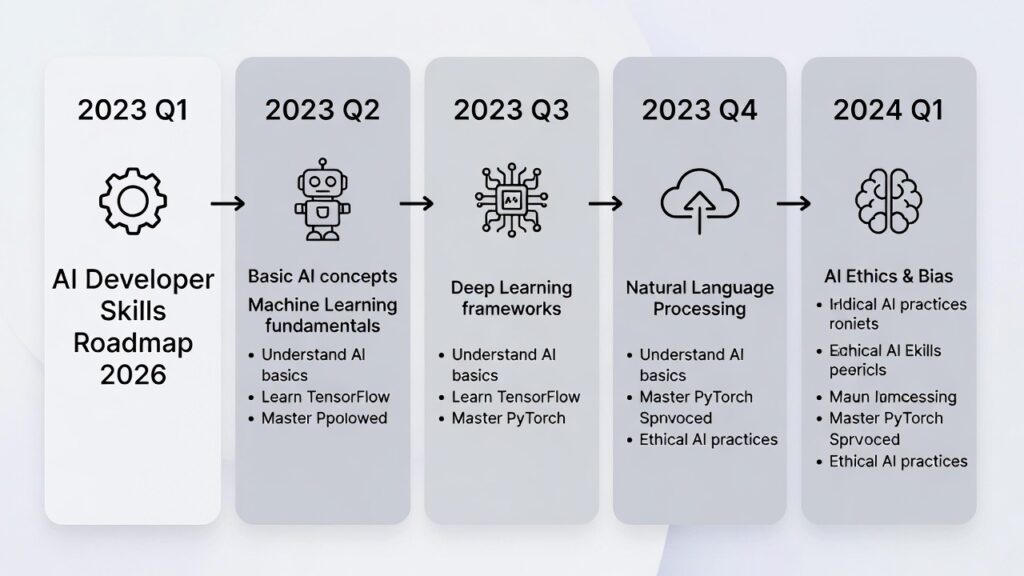
Essential AI Developer Skills 2026: The Complete Career Guide
AI developer skills 2026 are evolving rapidly as artificial intelligence transforms the software development industry. Developers who understand machine learning, AI frameworks, and automation tools are becoming some of the most valuable professionals in the technology workforce.
Over the past few years, artificial intelligence has moved from research labs into mainstream software products. Today, companies across finance, healthcare, e-commerce, cybersecurity, and entertainment are integrating AI into their platforms.
This shift is creating a massive demand for developers who understand how to build, deploy, and maintain intelligent systems.
In this guide, we explore the most important AI developer skills developers need to master in 2026, the technologies powering modern AI applications, and the career opportunities emerging in the rapidly expanding AI economy.

Why AI Developer Skills 2026 Matter More Than Ever
Artificial intelligence is no longer a niche field reserved for data scientists. It has become a core component of modern software development.
From recommendation systems to generative AI chatbots, AI capabilities are now integrated into everyday applications.
Developers who understand how these systems work — and how to build them — are quickly becoming some of the most sought-after professionals in technology.
Industry analysts estimate that the global AI market will exceed $1 trillion in economic impact within the next decade, creating millions of new jobs in AI development, machine learning engineering, and AI infrastructure.
As a result, traditional software developers are increasingly learning AI development skills to stay competitive.
Key Industry Shifts Driving AI Developer Demand
Several technological trends are driving the rapid growth of AI developer skills.
1. AI-Assisted Coding
Modern development environments increasingly rely on AI coding assistants that help developers generate, review, and optimize code.
AI tools can now:
- Suggest code completions
- Detect bugs automatically
- Generate functions from natural language prompts
- Refactor existing codebases
This shift means developers must understand how to collaborate with AI tools to improve productivity.
2. Machine Learning Integration
Machine learning is becoming a standard component of many software applications.
Examples include:
- Fraud detection systems
- Recommendation engines
- Image recognition
- Natural language processing
- Customer support automation
Developers who understand how machine learning models work — and how to integrate them into applications — have a significant advantage in today’s job market.
3. AI-Driven Automation
AI is transforming business operations through automation.
Companies now deploy AI to automate:
- customer service responses
- data analysis workflows
- marketing personalization
- supply chain optimization
AI developers often design the systems that power these automated processes.
4. Cloud-Based AI Infrastructure
Another major shift is the rise of cloud platforms that provide scalable AI infrastructure.
Developers can now train and deploy machine learning models using cloud services instead of building complex infrastructure from scratch.
Cloud AI platforms allow teams to:
- train models faster
- deploy AI APIs globally
- scale workloads dynamically
- integrate AI into existing applications
Understanding cloud-based AI deployment is therefore an essential developer skill in 2026.
Core AI Developer Skills 2026
To build modern AI systems, developers need a combination of software engineering, data science, and machine learning expertise.
Here are the most important skills shaping the AI development landscape.
1. Python Programming
Python remains the dominant programming language for artificial intelligence development.
Its popularity is driven by powerful AI libraries such as:
- TensorFlow
- PyTorch
- Scikit-learn
- Pandas
- NumPy
Python is widely used for:
- machine learning experimentation
- data processing
- neural network development
- AI research
Because of its simplicity and extensive ecosystem, Python is often the first language developers learn when entering the AI field.
2. Machine Learning Fundamentals
Understanding machine learning concepts is essential for any AI developer.
Key topics include:
- supervised learning
- unsupervised learning
- model training
- feature engineering
- model evaluation
Developers should also understand common machine learning algorithms such as:
- linear regression
- decision trees
- random forests
- support vector machines
- neural networks
A strong foundation in machine learning allows developers to design models that perform well in real-world applications.
3. Deep Learning Frameworks
Deep learning powers many of the most advanced AI systems, including generative AI models, computer vision applications, and speech recognition systems.
Developers building these systems rely on frameworks such as:
- TensorFlow
- PyTorch
- Keras
- Hugging Face Transformers
These frameworks simplify complex tasks such as:
- neural network architecture design
- GPU acceleration
- model training pipelines
- inference optimization
Developers who understand these frameworks can build sophisticated AI applications more efficiently.
4. Cloud AI Deployment
Deploying AI models into production environments requires cloud infrastructure expertise.
Many organizations rely on cloud platforms to host machine learning models and deliver AI services to users worldwide.
Developers working with AI systems should understand:
- containerization
- microservices architecture
- API deployment
- model monitoring
- scalability
Cloud knowledge ensures AI applications remain reliable and responsive under heavy workloads.
5. Data Engineering
Data is the foundation of every AI system.
Before machine learning models can be trained, developers must collect, clean, and process large datasets.
Data engineering skills include:
- data pipelines
- data cleaning
- ETL processes
- database optimization
- big data processing
Developers who understand how to manage data effectively can build more accurate and reliable AI models.
AI Programming Languages Developers Must Learn
While Python dominates AI development, several other programming languages play important roles in building AI systems.
Each language offers unique advantages depending on the type of application being developed.
Some commonly used AI programming languages include:
Python
Python remains the most widely used language in AI due to its simplicity and rich ecosystem of machine learning libraries.
R
R is commonly used in statistical computing and data science.
It is particularly popular among data scientists working with large datasets and statistical modeling.
Java
Java is often used for enterprise AI applications and large-scale backend systems.
Many organizations rely on Java-based frameworks to deploy AI models in production environments.
Julia
Julia is gaining popularity in the AI research community due to its high performance and mathematical computing capabilities.
C++
C++ is sometimes used in performance-critical AI applications such as robotics, gaming engines, and autonomous systems.
For a deeper breakdown of programming languages used in artificial intelligence, read our guide on
AI programming languages for beginners.
AI Career Roles Developers Should Know
As AI systems become more complex, companies are creating specialized roles focused on different aspects of artificial intelligence development.
Understanding these roles can help developers identify the career path that best fits their interests.
AI Engineer
AI engineers design and implement intelligent systems used in real-world applications.
Their responsibilities often include:
- building machine learning pipelines
- deploying AI models
- integrating AI APIs into applications
- optimizing model performance
Machine Learning Engineer
Machine learning engineers specialize in designing, training, and optimizing machine learning models.
They typically focus on:
- algorithm development
- feature engineering
- model training
- model evaluation
- production deployment
Data Scientist
Data scientists analyze large datasets to identify patterns, trends, and insights.
They often collaborate with AI engineers to develop predictive models and data-driven applications.
AI Infrastructure Engineer
AI infrastructure engineers focus on building the systems that support AI workloads.
Their work may include:
- distributed computing systems
- GPU infrastructure
- AI model hosting platforms
- high-performance data pipelines
If you’re exploring career options in AI development, see our full comparison of
AI engineer vs machine learning engineer comparison.
AI Certifications Developers Can Pursue
As AI development becomes more competitive, many developers pursue professional certifications to validate their skills.
Certifications can demonstrate expertise in:
- machine learning
- cloud AI deployment
- data science
- deep learning frameworks
Popular certification paths often cover topics such as:
- machine learning fundamentals
- neural network architecture
- AI model deployment
- data pipeline design
Certifications can also help developers transition from traditional software engineering into AI-focused roles.
If you’re considering earning a certification, explore our detailed guide to
AI certification pricing.
Future Career Opportunities in AI Development
The future of software development is increasingly intertwined with artificial intelligence.
Organizations across nearly every industry are investing heavily in AI capabilities.
Some of the fastest-growing AI career paths include:
- generative AI application development
- AI cybersecurity systems
- AI-powered automation platforms
- robotics and autonomous systems
- AI infrastructure engineering
In addition to traditional employment, many developers are also launching AI startups or building AI-powered SaaS products.
This entrepreneurial opportunity is creating an entirely new ecosystem of AI tools, applications, and platforms.
Industries Hiring AI Developers
AI developer demand is expanding across numerous sectors.
Some of the fastest-growing industries include:
Healthcare
AI is used to analyze medical data, assist diagnostics, and personalize treatments.
Finance
Financial institutions use AI for fraud detection, risk modeling, and algorithmic trading.
E-Commerce
Online retailers use AI to power product recommendations, search optimization, and personalized marketing.
Cybersecurity
AI helps detect threats, analyze vulnerabilities, and automate security responses.
Autonomous Systems
AI developers are building software for autonomous vehicles, drones, and robotics platforms.
How Developers Can Start Learning AI in 2026
For developers interested in entering the AI field, the learning process typically follows several stages.
Step 1: Learn Python
Start by mastering Python and basic data analysis tools.
Step 2: Study Machine Learning Concepts
Learn fundamental algorithms and model training techniques.
Step 3: Build AI Projects
Hands-on projects are one of the best ways to develop AI expertise.
Examples include:
- building a recommendation system
- training an image recognition model
- creating a chatbot
- building predictive analytics tools
Step 4: Deploy AI Applications
Learn how to deploy machine learning models using APIs and cloud platforms.
This step transforms experimental models into real-world applications.
Conclusion
AI developer skills 2026 will define the next generation of software engineering careers.
As artificial intelligence continues transforming industries, developers who understand machine learning, AI frameworks, and automation tools will be in extremely high demand.
By learning Python, mastering machine learning fundamentals, and gaining experience deploying AI systems, developers can position themselves for some of the most exciting and lucrative opportunities in technology.
The AI revolution is only beginning — and developers who build these skills today will shape the software systems of tomorrow.
Explore This Topic in Depth
What are the most important AI developer skills 2026?
Key skills include Python programming, machine learning fundamentals, deep learning frameworks, data engineering, cloud AI deployment, and AI model optimization.
Which programming language is best for AI developers?
Python is widely considered the best programming language for AI development because it provides powerful libraries like TensorFlow, PyTorch, and Scikit-learn.
Are AI developer jobs growing?
Yes. Demand for AI developers is increasing rapidly as companies adopt machine learning, generative AI, and automation technologies across multiple industries.

Leave a reply