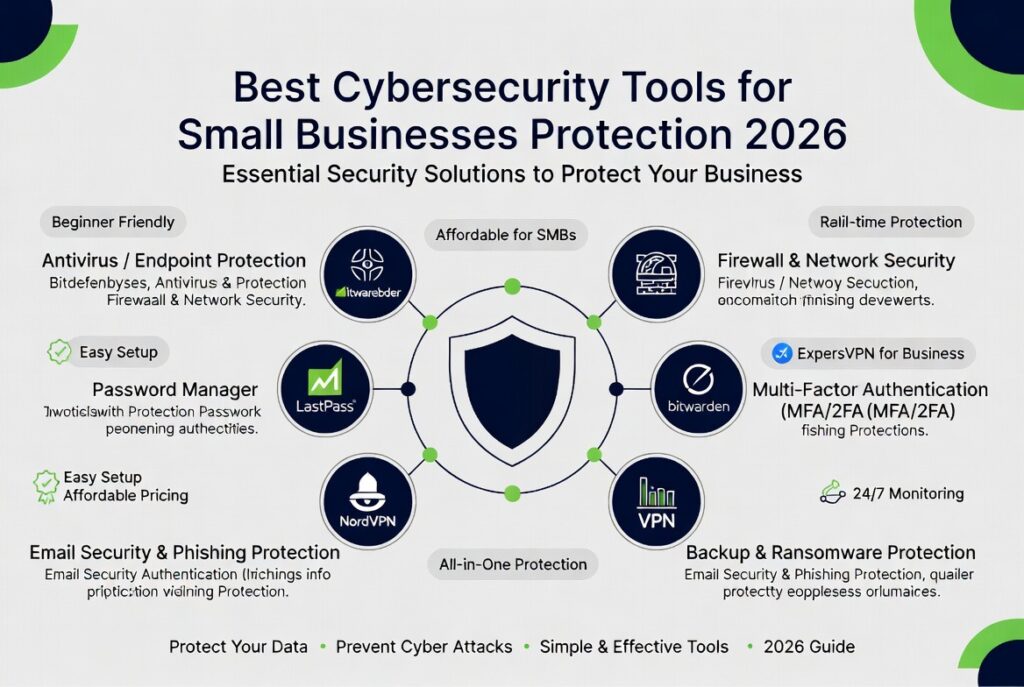
Essential Cybersecurity Tools for Small Businesses (2026 Guide)
Cybersecurity tools for small businesses are essential for protecting sensitive data, preventing cyber attacks, and ensuring business continuity in 2026. As cyber threats become more sophisticated, small businesses can no longer rely on basic antivirus software alone.
From ransomware attacks to phishing scams and data breaches, modern threats are designed to exploit weak security systems. Investing in the right cybersecurity tools helps small businesses defend against these risks while maintaining customer trust and regulatory compliance.

Why Cybersecurity Tools for Small Businesses Matter
Cybersecurity tools for small businesses matter more than ever because attackers increasingly target smaller organizations with limited protection. Many small businesses assume they are too small to be attacked, but in reality, they are often easier targets.
- Protect sensitive customer and financial data
- Prevent ransomware and malware attacks
- Ensure compliance with regulations
- Maintain business continuity
- Build customer trust and brand reputation
A single cyber attack can cause downtime, financial loss, and reputational damage that small businesses may struggle to recover from.
What Are Cybersecurity Tools
Cybersecurity tools are software and systems designed to protect networks, devices, and data from unauthorized access, attacks, and vulnerabilities. These tools work together to create multiple layers of defense across an organization.
Instead of relying on one solution, modern cybersecurity strategies use a combination of tools including endpoint protection, firewalls, encryption systems, and monitoring platforms.
Types of Cybersecurity Tools for SMBs
Endpoint Protection
External Cybersecurity Resources
For official cybersecurity guidance, small businesses can refer to
CISA cybersecurity resources
and
NCSC small business security guide.
Endpoint protection tools secure devices such as laptops, desktops, and mobile phones. These tools detect and block malware, ransomware, and suspicious activity in real time.
Popular endpoint protection solutions include antivirus software, endpoint detection and response (EDR), and mobile device management systems.
Network Security Tools
Network security tools protect internal systems from external threats. Firewalls, intrusion detection systems (IDS), and intrusion prevention systems (IPS) monitor traffic and block unauthorized access.
These tools are essential for businesses with internal networks, cloud systems, or remote employees.
Email Security
Email remains one of the most common attack vectors for cybercriminals. Email security tools filter spam, detect phishing attempts, and block malicious attachments.
Advanced email security solutions use AI to identify suspicious patterns and prevent attacks before they reach employees.
Identity and Access Management (IAM)
IAM tools control who can access systems and data. Features include multi-factor authentication (MFA), password management, and role-based access control.
These tools reduce the risk of unauthorized access and insider threats.
Cloud Security Tools
As more small businesses adopt cloud platforms, cloud security tools have become essential. These tools protect cloud infrastructure, monitor activity, and ensure compliance with security standards.
Best Cybersecurity Tools for Beginners
If you’re just getting started, begin with simple and scalable solutions designed for ease of use. These tools provide strong protection without requiring advanced technical knowledge.
Start here:
best cybersecurity tools for beginners
Endpoint Security Tools Comparison
Choosing the right endpoint security solution depends on factors such as device count, budget, and required features. Some tools focus on basic antivirus protection, while others provide advanced threat detection and automated response capabilities.
Compare solutions:
endpoint security tools comparison
Cybersecurity Software Pricing
Cybersecurity software pricing varies widely depending on features, number of users, and deployment model. Small businesses can choose from affordable entry-level tools or invest in enterprise-grade solutions.
Explore costs:
cybersecurity software pricing
Small Business Security Tools Review
Before choosing a tool, it’s important to review real-world performance, ease of use, and support. Reviews help businesses understand which tools deliver the best value.
See full analysis:
small business security tools review
How to Choose the Right Cybersecurity Tools
Selecting the right cybersecurity tools for small businesses requires careful evaluation of your needs and resources.
- Business size and number of devices
- Type of data being protected
- Budget and pricing structure
- Ease of deployment and management
- Integration with existing systems
Small businesses should prioritize tools that are easy to manage and offer automated protection to reduce operational overhead.
Best Practices for SMB Cybersecurity
In addition to using tools, small businesses should follow best practices to strengthen their security posture:
- Train employees on cybersecurity awareness
- Use strong passwords and MFA
- Regularly update software and systems
- Backup data frequently
- Monitor network activity
Cybersecurity is not just about tools—it’s about creating a culture of security within the organization.
Real-World Cybersecurity Threats for Small Businesses
Understanding common threats helps businesses choose the right protection strategies:
- Phishing attacks targeting employees
- Ransomware locking business data
- Data breaches exposing customer information
- Insider threats and unauthorized access
Cybersecurity tools for small businesses are designed to detect and prevent these threats before they cause damage.
Future Trends in Cybersecurity for SMBs
The cybersecurity landscape continues to evolve with new technologies and threats. Small businesses must stay ahead by adopting modern solutions.
- AI-driven threat detection
- Zero trust security models
- Cloud-native security platforms
- Automated incident response
- Behavioral analytics for anomaly detection
These trends will shape how cybersecurity tools for small businesses are developed and deployed in the coming years.
Common Cybersecurity Threats Facing Small Businesses
Small businesses face a growing number of cybersecurity threats that can disrupt operations and compromise sensitive data.
- Phishing attacks
- Ransomware
- Malware infections
- Insider threats
How to Choose the Right Cybersecurity Tools for Small Businesses
Choosing the right cybersecurity tools depends on your business size, industry, and risk level.
- Assess your current security gaps
- Evaluate tool scalability
- Consider ease of use
- Review pricing and support
Many businesses use enterprise-grade tools like
CrowdStrike
for advanced endpoint protection.
Conclusion
Cybersecurity tools for small businesses are no longer optional—they are critical for survival in a digital-first world. With increasing cyber threats, businesses must invest in the right tools and strategies to protect their data, systems, and customers.
By combining endpoint protection, network security, and employee awareness, small businesses can build a strong defense against modern cyber attacks.
Businesses that prioritize cybersecurity today will be better positioned to grow securely and maintain trust in an increasingly connected world.
FAQ
What are cybersecurity tools for small businesses?
Cybersecurity tools for small businesses are software and systems designed to protect data, networks, and devices from cyber threats such as malware, phishing, and data breaches.
Which cybersecurity tools are best for SMBs?
The best tools include endpoint protection software, firewalls, email security solutions, and identity management systems depending on business needs.
Do small businesses need cybersecurity?
Yes, small businesses are frequent targets of cyber attacks and need proper cybersecurity tools to protect sensitive data and maintain operations.

Leave a reply