On-Device AI Security vs Cloud AI: Which Is More Secure in 2026?
On-device AI security is becoming one of the most important topics in modern artificial intelligence. As AI systems power smartphones, enterprise software, and consumer applications, organizations must decide whether data should be processed locally on devices or sent to centralized cloud servers.
The debate between on-device AI security vs cloud AI security focuses on how data is handled, where computation occurs, and how privacy risks are managed.
Both models offer advantages, but their security profiles differ significantly depending on architecture, deployment strategy, and regulatory requirements.

What Is On-Device AI Security?
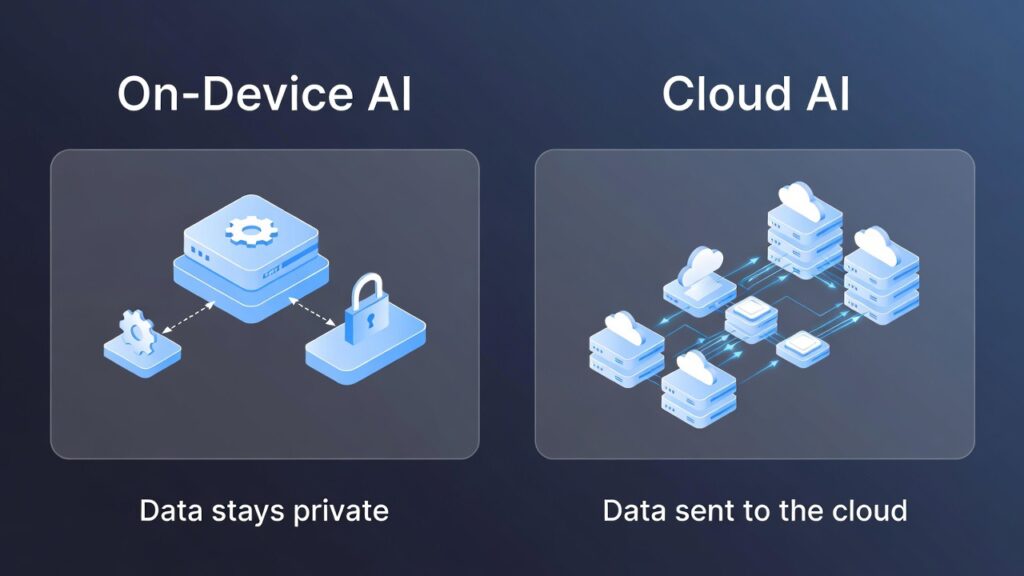
On-device AI security refers to artificial intelligence systems that process data locally on a user’s device rather than sending that data to remote cloud servers.
Examples include:
- Smartphone photo processing
- Voice assistant wake-word detection
- Biometric authentication
- Real-time language translation
Companies such as Apple emphasize on-device AI because processing data locally significantly reduces exposure to external data breaches.
When AI tasks run directly on hardware such as neural processing units (NPUs), user information never leaves the device.
This architecture reduces attack surfaces and strengthens privacy protections.
How Cloud AI Security Works
Cloud AI relies on centralized data centers where machine learning models run on powerful GPUs and AI accelerators.
Major cloud providers and AI infrastructure companies like NVIDIA power many of these large-scale systems.
Security advantages of cloud AI include:
- Centralized monitoring and security management
- Advanced threat detection systems
- Enterprise-grade encryption protocols
- Scalable infrastructure controls
However, cloud-based AI introduces additional risk vectors:
- Data transmission over networks
- Exposure during server storage
- Third-party access vulnerabilities
- Regulatory compliance complexity
Because sensitive information travels across networks, protecting that data during transmission becomes critical.
Organizations often rely on security standards such as those recommended by the National Institute of Standards and Technology to secure cloud infrastructure.
Why On-Device AI Security Improves Privacy
The biggest benefit of on-device AI security is that it minimizes data exposure.
Instead of sending raw user information to external servers, AI models process data directly on the device.
This approach offers several advantages:
- No external data transmission
- Reduced breach surface
- Faster response times
- Greater user control over personal data
For privacy-focused companies and governments operating under strict data regulations such as GDPR, on-device processing helps simplify compliance requirements.
It also reduces reliance on third-party infrastructure.
Enterprise Security Trade-Offs
Despite the privacy benefits of on-device AI security, cloud AI still plays a crucial role in large-scale machine learning systems.
Cloud infrastructure allows organizations to:
- Train massive AI models
- Aggregate global data insights
- Deploy updates quickly
- Manage centralized governance
This creates a fundamental security trade-off:
- Cloud AI: centralized control but larger breach impact
- On-device AI: decentralized processing with reduced exposure
Many companies are now adopting hybrid architectures to balance both benefits.
Hybrid AI Architecture: The Emerging Security Standard
In 2026, the most secure architecture increasingly combines both approaches.
Hybrid AI strategies typically involve:
- Sensitive inference running locally on devices
- Aggregated analytics processed in the cloud
- Privacy-preserving data collection methods
This model allows organizations to protect user privacy while still leveraging the power of large-scale cloud computing.
As AI hardware improves and edge computing expands, on-device AI security will likely play an even greater role in protecting personal data.
Related Links
Frequently Asked Questions
Is on-device AI more secure than cloud AI?
On-device AI security reduces data exposure by processing information locally on a device rather than transmitting it to remote servers. However, overall security still depends on hardware protections and operating system safeguards.
Why does cloud AI carry more privacy risks?
Cloud AI requires sending user data to remote servers for processing. This creates additional exposure points during transmission and storage compared with on-device AI processing.
What companies prioritize on-device AI security?
Companies like Apple focus heavily on on-device AI security by designing hardware and software systems that process machine learning tasks locally to protect user privacy.
Is hybrid AI architecture safer?
Hybrid AI systems combine local processing with cloud analytics. Sensitive tasks run on-device while large-scale data analysis happens in the cloud, creating a balanced security model.

Leave a reply