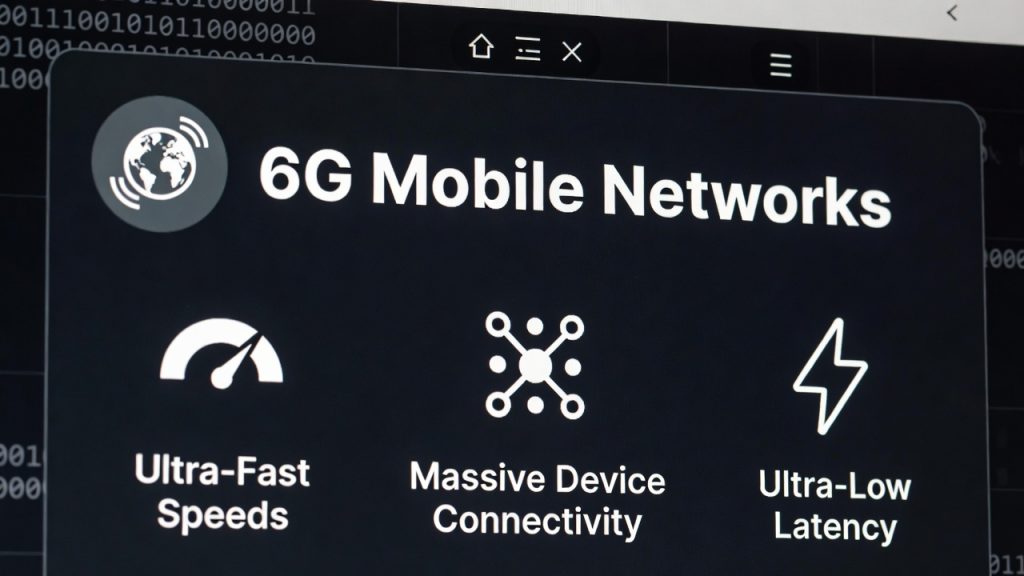
Shocking Advances in 6G Mobile Networks 2026 Explained
6G mobile networks 2026 are moving from theoretical research into early real-world testing, signaling the next major evolution in global connectivity.
While 5G deployment continues worldwide, governments, telecom companies, and semiconductor manufacturers are already investing billions into sixth-generation wireless technology. The goal is not just faster internet speeds but an entirely new communication architecture powered by artificial intelligence, ultra-low latency systems, and advanced spectrum technologies.
Understanding 6G mobile networks 2026 is essential because the infrastructure decisions being made today will define mobile innovation for the next decade.

Why 6G Mobile Networks 2026 Matter Now
Many consumers assume 6G is still far away. However, 2026 represents a critical development phase.
Global leaders including:
are actively testing next-generation networking technologies.
Unlike previous upgrades, 6G mobile networks 2026 aim to redesign how networks operate fundamentally rather than simply increasing speed.
Key objectives include:
AI-native networking
Near-zero latency communication
Intelligent spectrum allocation
Integrated sensing and communication
This represents a shift toward autonomous networks.
What Makes 6G Different From 5G
5G improved bandwidth and latency.
6G aims to transform connectivity itself.
Expected Improvements
| Feature | 5G | 6G Vision |
|---|---|---|
| Speed | Up to 10 Gbps | Up to 1 Tbps |
| Latency | ~1 ms | Microsecond-level |
| Intelligence | Cloud-assisted | AI-native |
| Coverage | Ground networks | Ground + satellite |
| Automation | Limited | Fully autonomous |
6G mobile networks 2026 focus on intelligent systems capable of optimizing themselves automatically.
The Role of AI in 6G Mobile Networks 2026
Artificial intelligence is central to 6G development.
Networks will use AI to:
Predict congestion before it occurs
Allocate bandwidth dynamically
Optimize energy usage
Detect cyber threats instantly
Self-heal network failures
Research collaborations involving MIT and global telecom alliances are exploring AI-driven radio systems.
This means future networks will behave more like adaptive computing platforms than static infrastructure.
Terahertz Spectrum: The Core Breakthrough
One defining innovation in 6G mobile networks 2026 is experimentation with terahertz (THz) frequencies.
These frequencies enable:
Extremely high data transmission rates
Ultra-high-resolution streaming
Real-time holographic communication
Advanced XR experiences
However, challenges include:
Short signal range
Environmental interference
Infrastructure density requirements
Solving these problems is a major focus of ongoing research.
Satellite Integration and Global Connectivity
Unlike earlier mobile generations, 6G is being designed with satellite connectivity from the start.
Partnerships between telecom providers and space companies aim to provide:
Global rural coverage
Maritime connectivity
Disaster recovery communication
Aviation internet services
This aligns with broader mobile technology trends 2026, where connectivity becomes ubiquitous rather than location-dependent.
How 6G Mobile Networks 2026 Will Change Smartphones
Smartphones will evolve alongside network capabilities.
Expected impacts include:
Instant cloud rendering
Real-time AI collaboration
Advanced AR glasses integration
Ultra-low-latency gaming
Continuous AI assistant connectivity
Devices discussed in our AI smartphones 2026 guide will rely heavily on next-generation networks for hybrid AI workloads.
6G will enable seamless interaction between on-device AI and cloud intelligence.
Enterprise Impact of 6G Mobile Networks 2026
Businesses stand to benefit significantly.
Industries expected to transform:
Healthcare
Remote robotic surgery
Real-time diagnostics
Continuous patient monitoring
Manufacturing
Autonomous factories
Predictive maintenance
Smart robotics coordination
Transportation
Connected autonomous vehicles
Smart traffic infrastructure
Smart Cities
Intelligent energy systems
Environmental monitoring
Public safety automation
6G mobile networks 2026 will power large-scale machine communication systems.
Global Competition for 6G Leadership
6G development has geopolitical importance.
Major regions competing include:
United States
European Union
China
South Korea
Japan
Governments view 6G leadership as both economic and strategic advantage.
Organizations like 3GPP coordinate global standards to ensure interoperability.
Standardization decisions made between 2025–2028 will shape global adoption.
Energy Efficiency and Sustainability Goals
One surprising focus of 6G mobile networks 2026 is sustainability.
Future networks aim to:
Reduce energy consumption per bit transmitted
Use AI to power down unused infrastructure
Optimize data routing automatically
Energy-efficient networking is critical as global data demand explodes.
Telecom operators are prioritizing green networking strategies.
Security Challenges in 6G Networks
Greater connectivity introduces new risks.
Potential threats include:
AI-driven cyberattacks
Network spoofing
Quantum-era encryption challenges
Massive IoT attack surfaces
Security researchers are designing quantum-resistant encryption methods to prepare for future risks.
Security must evolve alongside network capability.
Challenges Slowing 6G Deployment
Despite excitement, several hurdles remain:
Massive infrastructure costs
Spectrum regulation complexity
Hardware limitations
Standardization delays
Energy consumption concerns
Commercial rollout is expected closer to 2030, but 6G mobile networks 2026 represent the decisive research phase.
What Consumers Should Expect Before 2030
Before full deployment, users may see:
Early prototype devices
Hybrid 5G-Advanced networks
Satellite-assisted smartphones
Faster edge computing integration
Incremental improvements will arrive gradually rather than overnight.
The Future Beyond 6G
Researchers are already exploring concepts beyond traditional networking:
AI-generated wireless signals
Ambient connectivity
Integrated sensing networks
Digital twin infrastructure
6G may redefine what connectivity means entirely.
Final Thoughts
6G mobile networks 2026 represent the beginning of the next connectivity revolution.
Unlike previous upgrades focused on speed, 6G aims to create intelligent, adaptive networks capable of supporting autonomous systems, immersive computing, and AI-driven communication.
The transition will take years, but the groundwork being laid today will shape how humans and machines interact for decades.
Connectivity is evolving from infrastructure into intelligence.

Leave a reply