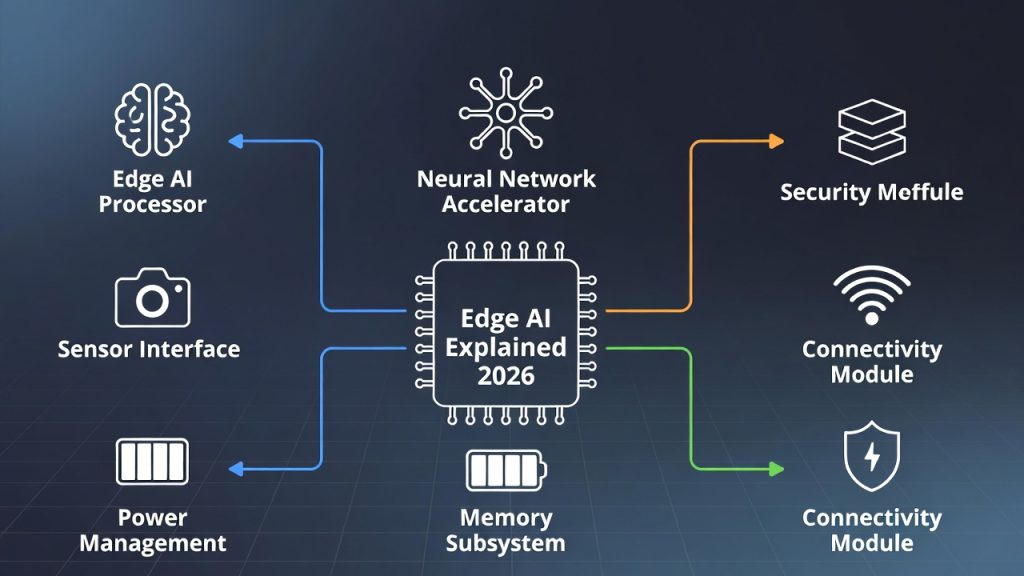
Complete Edge AI Explained 2026 Guide: How Intelligence Moves to Devices
Edge AI explained 2026 describes a major shift in artificial intelligence where data processing happens directly on devices instead of relying entirely on distant cloud servers.
As artificial intelligence adoption accelerates worldwide, organizations need faster responses, stronger privacy protection, and reduced internet dependence. Edge AI solves these problems by bringing intelligence closer to where data is created.
Building on concepts from our modern technology explained simply 2026 guide, edge computing represents one of the most important infrastructure changes powering modern digital systems.

Definition: Edge AI Explained 2026
Edge AI explained 2026 refers to artificial intelligence models running locally on hardware devices such as smartphones, cameras, vehicles, sensors, and industrial machines rather than processing data exclusively in centralized cloud environments.
Traditional AI workflow:
- Device collects data
- Data sent to cloud server
- Server processes information
- Result returned to device
Edge AI workflow:
- Device collects data
- AI processes data locally
- Instant decision occurs
This architectural change dramatically improves speed and efficiency.
Why Edge AI Explained 2026 Matters More Than Ever
The modern world generates enormous amounts of data every second through cameras, smart devices, industrial sensors, and autonomous systems.
Sending all this data to cloud servers creates challenges:
- Network delays (latency)
- Bandwidth costs
- Privacy risks
- Connectivity dependence
Edge AI reduces these limitations by processing information where it originates.
According to research from
NVIDIA Edge Computing, local AI processing significantly lowers response times while improving operational efficiency.
Key Benefits
- Real-time decision making
- Improved data privacy
- Lower cloud costs
- Offline functionality
- Reduced bandwidth usage
How Edge AI Works
Understanding edge ai explained 2026 requires examining the technology layers that enable intelligent devices.
1. AI Models Optimized for Devices
Machine learning models are compressed and optimized to run efficiently on smaller processors.
Techniques include:
- Model quantization
- Pruning unnecessary parameters
- Hardware acceleration
These optimizations allow powerful AI capabilities without requiring massive servers.
2. Specialized Edge Hardware
Modern devices now include dedicated AI chips such as:
- Neural Processing Units (NPUs)
- AI accelerators
- Embedded GPUs
These components process AI workloads faster while consuming less power.
3. Local Data Processing
Instead of transmitting raw data externally, devices analyze inputs locally.
Examples include:
- Image recognition on smartphones
- Voice commands processed offline
- Real-time anomaly detection in factories
4. Edge-to-Cloud Collaboration
Edge AI does not replace cloud computing entirely. Instead, both systems work together.
- Edge handles immediate decisions
- Cloud manages large-scale training and analytics
This hybrid model balances performance and scalability.
Real-World Examples of Edge AI
Edge AI already powers many technologies people use daily.
Smartphones
Face recognition, photo enhancement, and voice assistants operate locally for faster performance.
Autonomous Vehicles
Self-driving systems must analyze surroundings instantly without waiting for cloud responses.
Smart Security Cameras
Cameras detect motion or suspicious activity directly on-device, reducing unnecessary recordings.
Healthcare Devices
Wearable monitors analyze health data in real time, enabling faster alerts.
Industrial Automation
Factories use edge AI to detect equipment failures before breakdowns occur.
Edge AI vs Cloud AI
| Feature | Edge AI | Cloud AI |
|---|---|---|
| Speed | Instant | Network dependent |
| Privacy | High | Moderate |
| Internet Required | Often No | Yes |
| Scalability | Limited | Very High |
Most modern systems combine both approaches.
Industries Being Transformed by Edge AI
- Automotive: autonomous driving systems
- Healthcare: diagnostic monitoring
- Retail: smart checkout systems
- Manufacturing: predictive maintenance
- Smart Cities: traffic optimization
These advancements connect directly with automation trends discussed in future technology developments across the Tech News category.
Challenges of Edge AI
Hardware Limitations
Devices have less computing power than cloud servers.
Security Management
Distributed devices increase attack surfaces.
Model Updates
Updating AI models across thousands of devices can be complex.
Despite challenges, rapid innovation continues improving edge capabilities.
Future Impact of Edge AI Explained 2026
The future of computing increasingly depends on decentralized intelligence.
Expected developments include:
- Fully autonomous robotics
- Real-time language translation devices
- AI-powered smart homes
- Energy-efficient AI systems
- Ultra-low latency applications
Industry analysts predict billions of edge-enabled devices will operate globally within the next decade.
Edge AI will also work alongside sustainable technologies discussed in our article on what is green computing 2026, enabling efficient processing with lower energy usage.
Who Should Learn About Edge AI?
- Software developers
- AI engineers
- Technology students
- Business leaders
- IoT professionals
Understanding edge ai explained 2026 prepares professionals for a future where intelligence exists everywhere — not just in data centers.
Related Links
Conclusion
Edge ai explained 2026 represents a fundamental evolution in artificial intelligence architecture. By moving intelligence closer to users and devices, organizations achieve faster responses, stronger privacy, and more reliable automation.
As connected devices continue expanding worldwide, edge AI will become one of the defining technologies powering real-time digital experiences.
FAQs
Is edge AI faster than cloud AI?
Yes. Edge AI processes data locally, eliminating network delays and enabling real-time decisions.
Does edge AI improve privacy?
Yes. Sensitive data can remain on-device instead of being transmitted to external servers.
Where is edge AI used most today?
Automotive systems, smart devices, healthcare monitoring, and industrial automation rely heavily on edge AI.

Leave a reply