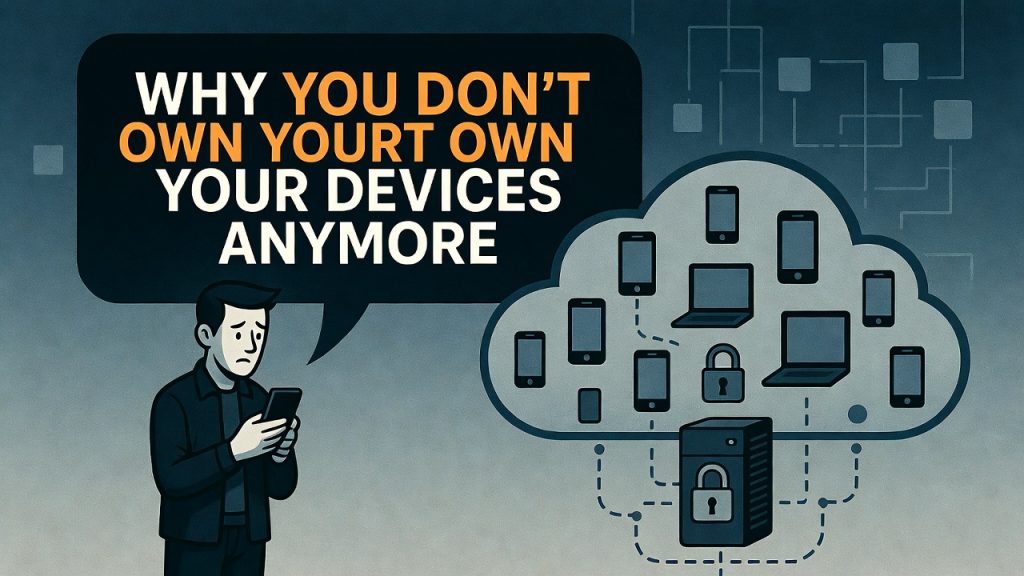
Why You Don’t Own Your Devices Anymore (And What Changed)
Introduction
Why you don’t own your devices anymore is a question millions of users are beginning to ask as modern technology behaves very differently from the computers and phones of the past. You may buy a smartphone, laptop, or smart TV outright — yet lose access if accounts fail, servers go offline, or software verification stops working.
Ownership used to mean control. Today, ownership often means permission.
Behind this shift lies a quiet transformation driven by software licensing, cloud infrastructure, artificial intelligence, and subscription-based business models. Devices have evolved from independent machines into connected services controlled partly by manufacturers.
This article explains what changed, why companies moved in this direction, and what it means for consumers going forward.
The Evolution of Software Licensing
The first major change happened not in hardware — but in software.
In earlier decades, software purchases granted permanent usage rights. Programs shipped on disks or CDs worked indefinitely once installed.
Then Licensing Replaced Ownership
Modern operating systems and applications are typically licensed, not sold.
- You agree to terms instead of owning software
- Access can be revoked under conditions
- Updates are controlled remotely
- Features may change over time
Most users accept license agreements without realizing they redefine ownership legally and technically.
This licensing model laid the foundation for today’s connected device ecosystems.
Always-Online Hardware Changed Everything
Another major reason why you dont own your devices anymore is the rise of always-online hardware.
Modern devices rely on internet connectivity for essential functions.
Examples Include:
- Operating system verification during installation
- Cloud backups and synchronization
- AI-powered assistants
- Security validation checks
- Remote feature activation
Without internet access, many devices operate in limited modes or fail entirely.
Connectivity improves convenience but introduces dependency on external infrastructure.
This trend is explored deeper in our main analysis:
Digital Ownership Technology 2026 Guide.
Account Lock Systems and Digital Identity
Account-based ecosystems represent one of the biggest ownership changes.
Devices are now tied to user identities rather than simply functioning as standalone hardware.
How Account Locks Work
- Devices link permanently to user accounts
- Factory resets still require authentication
- Cloud services verify ownership
- Anti-theft systems block unauthorized access
These protections dramatically reduce theft but also mean users depend on account recovery systems controlled by companies.
Lose account access — and the device may become unusable.
The Subscription Hardware Trend
Another reason why you dont own your devices anymore is the growing shift toward subscription-based hardware features.
Manufacturers increasingly sell devices with capabilities locked behind ongoing payments.
Common Subscription Examples
- Cloud storage expansions
- AI assistant premium features
- Advanced photo processing tools
- Vehicle performance upgrades
- Security monitoring services
Hardware becomes a gateway to services rather than a complete product.
This model provides continuous revenue for companies while transforming ownership into an ongoing relationship.
Why Companies Changed the Model
Technology companies argue the shift improves security, innovation, and sustainability.
Industry Motivations
- Better cybersecurity protection
- Continuous feature improvements
- Reduced piracy
- Predictable revenue streams
- AI system optimization
However, critics argue these benefits come at the cost of user independence.
Governments are responding through legislation such as:
Right to Repair Laws 2026.
The Psychological Shift: Access Over Ownership
Consumers increasingly prioritize convenience over control.
Streaming replaced physical media. Cloud software replaced boxed applications. Now devices themselves are becoming service platforms.
Ownership is evolving into:
- Access rights
- Account privileges
- Subscription tiers
- Cloud-enabled functionality
You still hold the hardware — but core capabilities live elsewhere.
What This Means for the Future
The trend suggests a future where technology behaves less like owned property and more like leased infrastructure.
Expected Developments
- AI-managed operating systems
- Cloud-first computing models
- Longer subscription ecosystems
- Remote device governance
Understanding these changes helps consumers make smarter purchasing and data decisions.
How Users Can Protect Their Control
While the industry moves toward controlled ownership, users still have options.
- Maintain local backups
- Document account credentials securely
- Research ecosystem lock-in before purchase
- Support repair-friendly brands
- Understand licensing agreements
Awareness is now part of digital literacy.
Conclusion
Why you dont own your devices anymore is not the result of a single decision but a decade-long evolution combining software licensing, cloud computing, AI integration, and subscription economics.
Modern technology offers unprecedented intelligence and convenience, yet it redefines ownership in ways many users are only beginning to understand.
The future of ownership will likely balance security, innovation, and user rights — and the outcome will shape how humanity interacts with technology for generations.
 why you dont own your devices anymore connected cloud devices illustration

Leave a reply